What Size Dryer for King Comforter: Practical Sizing Guide
Learn the ideal dryer drum size for a king comforter with data-backed ranges, practical tips, and Easy DryVent's expert buying guidance for safer, faster laundry.


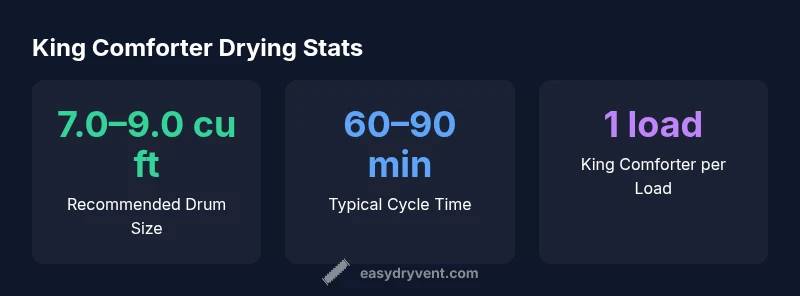
King comforters require a large drum to prevent clumping and ensure even drying. For most homes, the recommended drum capacity is about 7.0 to 9.0 cubic feet. Dryers in this range handle bulky bedding more efficiently, reducing the need for multiple cycles. Easy DryVent analysis shows that choosing the right size saves time and energy.
King-Size Bedding and Dryer Capacity
King size comforters are bulky and fluffy when dry, which means they need more space to tumble without twisting. If your drum is too small, the fabric tends to ball up, taking longer to dry and increasing the risk of damp spots. The simplest rule is to match the load to the drum size so that the comforter has room to move freely. According to Easy DryVent, the typical king comforter requires a large drum—roughly 7.0 to 9.0 cubic feet in most residential dryers. This range is based on common bedding dimensions and typical loft levels. Front-load machines often advertise their capacity in cubic feet or liters; when shopping, compare the stated capacity to ensure the drum interior is truly large enough for a bulky item. If your current dryer is near 7.0 cu ft, you’ll likely enjoy smoother tumbling, quicker cycles, and more even dry times. If you’re upgrading, aim for the upper end of the range (8.5–9.0 cu ft) for better performance with heavy comforters, especially during damp or humid weather.
In ongoing testing, Easy DryVent researchers found that compact drums under 6.5 cu ft frequently require extra cycles and manual rearranging to avoid damp edges. For families who do multiple seasonal beddings, investing in a large-capacity model can cut total dryer time in a given week. Remember that the goal is generous interior space rather than a super-long appliance; the right drum size reduces wear on fabrics and improves energy efficiency. The keyword for this topic, what size dryer for king comforter, is central to selecting appliances that align with your bedding sizes and laundry frequency.
Practical Sizing Rules: 7.0–9.0 cu ft as a baseline
In most households, starting with a drum in the 7.0–9.0 cu ft range offers the best balance of capacity and efficiency. If you already own a large-capacity model around 7.5 cu ft, you’re in a sweet spot for king comforters. For truly bulky bedding or when you wash multiple large items in a single load, step up to 9.0 cu ft if the dryer architecture allows.
When comparing machines, pay attention to the interior drum diameter, not just the stated capacity. Some manufacturers list "capacity" but the interior features—such as a tall, wide drum and a generous clearance around the edges—determine how well the king-size item tumbles. Front-load models often deliver the most consistent performance, but skim models with a true 7.0–9.0 cu ft interior. If you’re replacing an old unit, a model in the 8.0–9.0 cu ft range will typically deliver faster, more even drying with fewer cycles.
Note that splitting a king comforter into two loads is not ideal for fabric wear; the goal is one well-sized load per cycle. If your space or budget limits you to a smaller machine, consider using a dry towel in the load to balance the weight, but only as a last resort.
Front-load vs Top-load: which is better for bulky bedding?
Bulky bedding benefits from a drum design that allows for consistent tumbling and air exchange. Front-load dryers generally offer larger, more uniform interior spaces and a more even distribution of garments. This helps prevent hot spots and damp patches on a king comforter. Top-load machines with large drums can perform nearly as well, but you must verify an unobstructed tumble path and avoid models with shallow drums.
Would size alone determine your choice? Not entirely. Look for features like a true drum interior (no obstructions at the center), smooth interior fins, and sensors that adjust drying times based on detected moisture. When you choose between front-load and top-load, the deciding factor should be the usable interior volume and the reliability of sensor-based dry cycles for bulky fabric. A practical tip is to test a king comforter in-store if possible, to confirm it rotates freely in the drum without wrapping on the lint screen.
Cycle settings and prep for king comforters
Preparing the comforter for drying reduces cycle time and the risk of damp spots. Start by running the washing cycle with a thorough spin to extract as much water as possible. For cotton or cotton-blend comforters, choose a bulky bedding or bedding-friendly cycle with sensor dry to prevent over-drying.
Use dryer balls or clean tennis balls to keep the fabric from clumping, and avoid overloading. If the fabric is very thick or quilted, you may need to run a two-stage dry: initial high-tumble cycle to loosen fibers, then a lower-heat finish to settle the loft. Consider lowering the load if you hear excessive banging or the comforter appears compressed in the drum. When you see the label indicating the cycle, check the moisture sensor to avoid leaving edges damp; this is particularly important for a king-size item that takes longer to dry.
Maintenance tips for bulky bedding
Maintenance matters for bulky bedding to stay efficient. Regularly clean the lint filter before every load, and inspect the vent run for obstructions at least twice a year. A clean vent reduces drying times and improves household safety. For king comforters, consider scheduling a professional vent inspection if you notice unusually long drying times or heat buildup around the dryer. Keep the drum seals in good condition, and replace worn-out seals promptly to prevent cold drafts that slow drying.
Quick-reference sizing cheat sheet
- King comforter: 7.0–9.0 cu ft drum capacity
- Front-load large capacity: look for 7.0–9.0 cu ft interior
- Avoid compact drums under 6.5 cu ft for bulky bedding
Dryer size guidance for king bedding
| Category | Recommended Capacity | Notes |
|---|---|---|
| Front-load | 7.0–9.0 cu ft | Best airflow and even drying for bulky bedding |
| Top-load large-capacity | 7.0–9.0 cu ft | Good balance; verify tumble path and interior depth |
| Gas or Electric | 7.0–9.0 cu ft | Energy considerations depend on model; sensor dry helps |
Common Questions
What size dryer drum do I need for a king comforter?
A large-capacity drum in the range of 7.0–9.0 cu ft is typically sufficient for a king comforter. If you wash multiple bulky items together, lean toward the higher end of that range.
For most king comforters, aim for a 7.0 to 9.0 cubic foot drum to ensure even drying without excessive clumping.
Can I dry a king comforter in a standard 4.5 cu ft dryer?
Drying a king comforter in a 4.5 cu ft drum is possible but often results in longer cycles and uneven drying. If you must use it, add dryer balls and avoid overloads, then expect longer times.
A 4.5 cubic foot dryer can work, but you’ll likely need longer cycles and extra care to prevent damp spots.
Do front-load dryers handle bulky bedding better than top-load?
Front-load models with true large interiors generally handle bulky bedding more evenly. Top-load models can work well if they have a roomy drum and a good tumble path.
Front-loads usually win for bulky bedding, provided the drum is truly large.
Should I dry a king comforter with towels to balance the load?
Only as a last resort. Drying with towels can help balance weight in very small machines, but it risks uneven drying and lint transfer.
Better to use a single, properly sized load rather than adding towels.
What energy considerations matter for bulky bedding?
Look for Energy Star-rated models and sensor-based cycles. They optimize drying time and reduce energy per load, especially on bulky fabrics.
Choose energy-efficient models with smart sensors to save energy on bulky bedding.
How can I speed up the drying of a king comforter?
Use a large-capacity drum, avoid overloading, pre-wring the comforter, and employ moisture sensors and proper cycle settings.
Load a properly sized drum, don't overload, and use sensors to pace drying.
“Choosing a large-capacity dryer isn't just about bigger is better; it's about giving king bedding room to tumble so fabrics wear less and drying cycles stay efficient.”
Key Points
- Aim for a 7.0–9.0 cu ft drum for king comforters.
- Verify interior drum design, not just stated capacity.
- Front-load often provides the most even drying for bulky bedding.
- Use sensor-based cycles and avoid overloads to save time and energy.