Dryer Size cu ft: A Practical Guide for Homeowners
A data-driven guide to selecting the right dryer size cu ft for your home. Learn how to size for family load, energy efficiency, and practical space considerations with Easy DryVent.


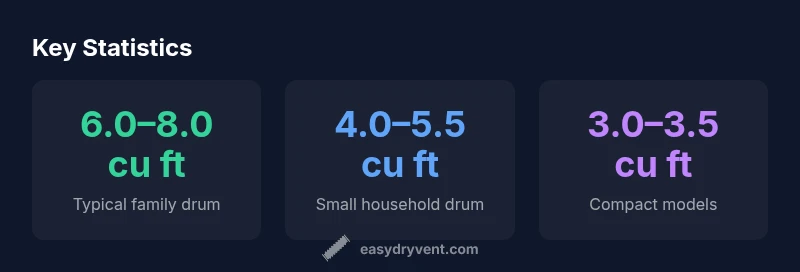
According to Easy DryVent, choosing the right dryer size in cu ft is essential for both performance and efficiency. The general rule is to match drum volume to household laundry load, typically 6.0–8.0 cu ft for families, 4.0–5.5 cu ft for individuals, with taller homes needing additional capacity. This guide covers sizing factors, energy implications, and practical selection tips.
Understanding dryer size cu ft and its impact on performance
The drum capacity of a clothes dryer, measured in cubic feet (cu ft), is a primary driver of how much laundry you can dry efficiently in a single cycle. A larger drum can process bulkier or multiple loads at once, potentially reducing overall cycle time. However, it is not a panacea for efficiency. If a large drum is paired with frequent small loads, the dryer may run longer cycles or heat up more than needed. In practice, the decision should balance typical laundry volume, available space, and venting constraints. Easy DryVent recommends viewing cu ft as a guide to expected dry time and energy use, not a ticket to oversized purchases. When you compare models, ensure the stated cu ft aligns with the usable interior space, as gross drum capacity can differ from net usable capacity depending on design.
How to calculate your ideal cu ft based on household size
Sizing your dryer starts with your weekly laundry load. For a two-person household with moderate washing needs, a smaller to mid-sized drum (around 4.0–5.5 cu ft) can be sufficient if cycles are optimized for energy efficiency. Families of four or more typically benefit from mid-to-large drums (6.0–7.5 cu ft), especially if you frequently dry bulky items like bedding or towels. If your household alternates between light and heavy load weeks, you might prefer a model in the 6.0–7.0 cu ft range to handle peak periods without compromising daily use. Always verify the model’s cu ft rating against its actual interior dimensions and consider venting limits and installation space.
When to size up or down based on living situation
If your laundry area doubles as a multi-purpose room with tight clearance, a slightly smaller drum (4.0–5.5 cu ft) may fit better and still meet your needs if you optimize each load. In a home with frequent large or bulky items, a 7.0–8.0 cu ft drum can reduce the number of cycles and improve efficiency. People who rarely run full loads can still benefit from medium drums paired with sensor-dry technology to avoid over-drying and energy waste. The key is to map your typical weekly pattern and align it with a drum size that minimizes under- or over-drying.
Energy implications: why bigger isn't always better
Larger drums can improve energy efficiency when you regularly run full or near-full loads, because they maximize moisture removal per cycle. However, if you habitually dry small loads in a large drum, you may experience longer cycle times and higher energy use per pound of laundry. Energy-star certified models with moisture sensors help ensure you’re not wasting energy on over-drying. Easy DryVent’s analysis shows that properly matched drum size, coupled with modern sensor technology, yields meaningful energy savings over the lifetime of the appliance.
Common myths and missteps
Myth: Bigger is always better. Reality: Correct drum size depends on load size, space, and venting. Myth: All 7 cu ft dryers are the same. Reality: Internal geometry, door opening, and drum shape affect usable volume. Misstep: Assuming gross drum capacity equals usable capacity. Always check the net usable drum space in product specs and compare to your laundry patterns.
Real-world sizing scenarios: case studies
Scenario A: A couple in a small apartment uses a 4.5 cu ft model and runs moderate loads three to four times a week. Sensor-based cycles and proper lint maintenance keep drying times predictable. Scenario B: A family of four with weekly bedding and towels benefits from a 7.0–7.5 cu ft unit that handles bulky items in a single cycle. Scenario C: A larger home with mixed spaces can optimize performance with a 6.0–7.0 cu ft dryer and a matching vent run to maintain consistent airflow.
Recommended dryer drum sizes by household size
| Household Size | Recommended Dryer Size (cu ft) | Notes |
|---|---|---|
| 1-2 people | 4.0–5.5 cu ft | Good for apartments and small spaces |
| 3-4 people | 6.0–7.5 cu ft | Balanced for shared laundry |
| 5+ people | 7.5–8.5 cu ft | Best for heavy weekly loads |
Common Questions
What happens if you buy a dryer that's too large for your space or needs?
A too-large dryer often means higher upfront cost and longer dry times for small loads. It can also waste energy and occupy valuable floor space. If you rarely fill the drum, a smaller model with sensor-dry technology is usually more efficient and cost-effective.
If you buy a drum bigger than your needs, you’ll likely pay more upfront and for energy, with longer dry times on small loads.
Can you fit a large drum in a small laundry room?
Yes, but it requires careful measurement of the footprint, door swing, and vent path. Some 4.5–6.0 cu ft models offer compact footprints with generous interior space. Always check installation clearances and venting constraints before purchasing.
You can fit a larger drum in a tight space if you measure carefully and choose a model designed for compact spaces.
Is a 6.0 cu ft dryer enough for a family of four?
A 6.0 cu ft dryer can handle typical weekly loads for many families of four, especially with sensor-dry features. If you regularly dry bulky items or towels, you may prefer a 7.0–7.5 cu ft model to reduce cycle count.
For a family of four, a 6.0 cu ft dryer often works, but bulky loads may push you toward 7 cu ft.
How does drum size affect drying time?
Drum size influences how much laundry dries per cycle. Larger drums can reduce the number of cycles for bulky loads, but if you underfill the drum, you may waste energy. Use efficient cycles and sensors to optimize drying times regardless of size.
Larger drums can help with bulky loads, but only if you fill them appropriately and use sensor-dry cycles.
What other factors should I consider besides cu ft?
Consider venting length, door orientation, electrical requirements, cycle options, moisture sensors, energy ratings, and maintenance access. Net capacity, not just drum size, determines usable space. Check installation space and warranty considerations.
Besides cu ft, look at venting, energy ratings, and sensor features to maximize efficiency.
“"The right dryer size cu ft delivers comfort and efficiency by matching load patterns to drum volume, reducing energy use and wear."”
Key Points
- Match drum size to your weekly laundry load.
- Factor your space and venting when sizing.
- Consider energy efficiency features and load sensors.
- Use the table to guide size before buying.