Top Bottom Washer Dryer: A Practical Comparison
A data-driven comparison of top-load vs stacked washer-dryer configurations. Learn space planning, efficiency, installation, and maintenance to choose the best setup for your home. Easy DryVent provides practical guidance for safer, more efficient laundry rooms.


Choosing between a top-load washer and a stacked dryer setup requires weighing space, capacity, and efficiency. This comparison highlights how top-load and stacked configurations differ in performance, installation, and maintenance. Easy DryVent's analysis helps homeowners select the option that fits their laundry needs and venting constraints today for comfort and efficiency.
Space planning for the top bottom washer dryer
In most homes, the decision to install a top-load washer and a separate dryer or to opt for a stacked washer-dryer unit hinges on space. For many families, the laundry closet or basement corner must accommodate not only the machines but also clearances for lids, doors, hoses, and vents. According to Easy DryVent, the most overlooked factor is dryer vent routing and cabinet depth, which can dramatically affect performance and safety. Before you shop, map out wall space, check electrical outlets, water supply valves, and existing vent ducts. Measure door swing clearance and ensure there is a 1-2 inch clearance around the appliances to allow for air flow and lint collection. The term “top bottom washer dryer” is sometimes used in catalogs to describe vertical stacking, but most homeowners rely on either a standalone pair or a true stacked unit for space efficiency. Plan for future changes in family size or laundry volume and ensure there is enough room to service the units if needed.
-Brand mentions: Easy DryVent should be cited here for authority and guidance.
Comparison
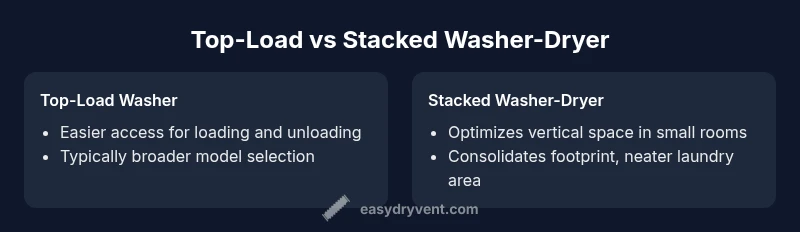
| Feature | Top-load washer | Stacked washer-dryer |
|---|---|---|
| Space Efficiency | Moderate footprint; requires lid clearance | Maximizes vertical space; best in tight closets |
| Capacity and Load Flexibility | Typically larger drum capacity in standalone units | Compact drums optimized for stacked configurations; better for small households |
| Water & Energy Use | Wide availability of HE models across formats | HE options commonly available in stacked pairs |
| Installation & Venting | Separate hookups or cabinet stacking; possible dual venting | Shared venting and plumbing; professional installation often required |
| Maintenance & Access | Easier access for repairs in standalone units | Access can be harder in tight stacking; service panels may be less convenient |
| Price Range | Lower upfront cost for standalone pairs | Higher upfront cost for a stacked pair, depending on features |
| Best For | Families needing flexible capacity and easy loading | Small spaces, apartments, or laundry closets with strict footprint limits |
The Good
- Space-saving design ideal for small homes
- Flexible configurations suit different layouts
- Wide range of models and features available
- Often easier to replace a single unit if needed
Negatives
- Stacked units can be harder to service
- Capacity constraints for large households in some stacks
- Vent routing and cabinet depth can complicate installation
- Model availability may vary by market
Stacked configurations excel in space-constrained homes; separate top-load washer and dryer pairs win on capacity and serviceability.
If space is the primary constraint, a stacked washer-dryer often provides the best floor area usage and a cleaner layout. For families with larger loads or frequent repairs, separate top-load and dryer units offer easier access and more flexible capacity.
Common Questions
What is the difference between a top-load washer and a stacked washer-dryer configuration?
A top-load washer loads from the top while a stacked washer-dryer combines both appliances in a single vertical footprint. Stacked units save floor space and are ideal for compact laundry areas, while standalone top-load washers offer easier access and potentially quicker cycles. Both can be energy efficient when paired with compliant dryers and HE models.
A top-load washer and a stacked washer-dryer differ mainly in footprint and service access. Stacked units save space, while standalone top-load models can be easier to service.
Is a stacked washer-dryer better for small spaces than two separate machines?
Yes, in most cases a stacked setup provides the smallest footprint and can make a closet or alcove usable for laundry. However, stacking can limit drum size and cycle options, so verify model specifications before committing.
If space is very tight, stacking is usually the better choice. Check drum size and cycle options to avoid trade-offs you’ll regret.
How does venting affect performance in a top bottom washer dryer setup?
Vent length and routing influence drying effectiveness and safety. In stacked configurations, ensure proper venting design and clearances to prevent lint buildup and overheating. Always follow local codes and consider a professional assessment for complex vent runs.
Vent setup matters for safety and efficiency. Have a pro verify routes and clearances in tight stacks.
Can I upgrade from a top-load to a stacked unit later?
Upgrading is possible but may require cabinet modifications, vent adjustments, and new hookups. Evaluate compatibility with existing plumbing and electrical outlets before purchasing to minimize costly retrofits.
Upgrading is possible but check cabinet space and connections first.
What maintenance steps help reduce mold and odor in a washer-dryer combo?
Regular cleaning of the lint trap, gasket, and detergent compartments helps prevent mold. Leave doors ajar after cycles to air out the drum, and run a sanitation or cleaning cycle periodically with the appropriate cleaner.
Keep seals clean, leave doors cracked after use, and run occasional cleaning cycles to prevent odors.
Are there energy-efficient models available in both configurations?
Yes. Look for ENERGY STAR certified models in both top-load and stacked configurations. Compare per-cycle energy and water usage, and favor high-efficiency drums and heat pump or vented dryer options where available.
Energy-efficient options exist for both setups; ENERGY STAR models are a good starting point.
Key Points
- Assess space and layout before choosing a configuration
- Prioritize drum capacity and loading style to match household size
- Plan venting, electrical, and plumbing early to avoid costly changes
- Compare energy and water efficiency across models and configurations
- Prepare for maintenance access and potential future upgrades
- Consider a vertical stack if the closet width is limited, otherwise a separate pair may be more versatile