Dryer or Washer on Top: A Practical Stacking Guide
Explore when to place a dryer on top of a washer or vice versa, with practical guidance on space, venting, installation, and maintenance for stacked laundry setups.


When space is tight, stacking a dryer on top of a washer or the reverse is common. The best choice depends on doorway access, door swing direction, venting, and service access. In many layouts, the dryer-on-top configuration saves floor space and keeps controls within easy reach, while washer-on-top can improve loading height for certain users. Easy DryVent outlines practical, safe stacking guidelines.
Understanding the dryer or washer on top question
Choosing whether the dryer should sit on top of the washer or the washer on top hinges on a mix of space constraints, accessibility, and serviceability. For many households, a dryer-on-top stack makes the most of vertical space and aligns with common vent runs and plumbing paths. The Easy DryVent team emphasizes planning for clearances, door swings, and easy access to both units for loading, unloading, and maintenance. This section lays out the fundamental tradeoffs, so you can approach your laundry area with a clear set of criteria that match your home and your routines. You’ll notice that the decision is rarely about one feature in isolation; it’s about balancing height, usability, and future service needs while keeping safety at the forefront. Throughout, the keyword dryer or washer on top will appear as you weigh the practical implications of each stacking direction.
Space and layout: how height, depth, and doorway access influence the choice
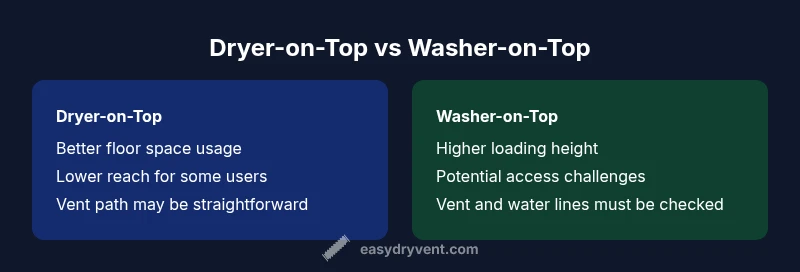
In compact rooms, vertical stacking is almost always the preferred strategy. However, the exact arrangement depends on ceiling height, the depth of the appliances, and the path to the laundry area. With the dryer on top, you gain lower reach for heavy or damp items and you keep the primary control panel near eye level when loading from the front. If the washer is on top, loading height for bulky items can be easier for some users, but you may need to contend with the dryer’s door clearance and possible obstructions from overhead shelves. Planning should include a realistic walkthrough of your daily laundry flow, noting where doors swing and how you’ll position towels, baskets, and detergents for efficient operation. The goal is a clean, unobtrusive stack that doesn’t block access moments when you need to pause a cycle or add laundry mid-cycle.
Venting, water, and electrical considerations when stacking
Stacked configurations demand careful alignment of vent runs, water lines, and electrical connections. For a dryer on top, ensure the vent path remains straight and free of sharp bends to minimize lint buildup and improve airflow. Water supply lines for the washer should be routed to avoid kinks and leaks, with shutoff valves within easy reach. When the washer sits on bottom, pay attention to gravity-based drain alignment and the potential for access panels. The Easy DryVent guidance notes that compatibility between models matters most here; only stack-approved pairs should be used, and the stacking kit must be installed according to the manufacturer’s instructions. Poor venting or misaligned connections can create safety hazards and reduce efficiency, so take the time to verify every connection during setup.
Washer vs dryer door orientation and how it impacts usability
Door swing direction and location influence how you unload and reload. A top-positioned dryer may present a different door arc than a bottom dryer, potentially interfering with nearby cabinetry or shelves. Conversely, a washer on top can raise the loading height for people who prefer to sit while loading or for shorter caregivers. It’s important to check that the door opens into a useable space, and that there is enough room to clear the hinges when the door is fully opened. If you anticipate frequent loading adjustments or adding items mid-cycle, a configuration with accessible controls and minimal reach strain will pay off in comfort and efficiency.
Performance, energy, and cycle times in stacked setups
Performance depends on the individual models rather than the stacking direction itself, provided you choose compliant, energy-efficient units. Easy DryVent analysis highlights that energy use and cycle times are driven by model efficiency, not by whether the dryer sits on top or the washer sits on top. When pairing a high-efficiency washer with a compatible, vented dryer, you can expect similar energy profiles to non-stack configurations that use the same units. In practice, maintain the recommended load sizes and choose cycles that maximize efficiency. The key takeaway is that the stacking order should not compromise throughput or energy performance if you select models designed for stacking and installed correctly.
Installation steps and best practices for stacking
Professional installation is strongly advised for any stacking setup. Start by confirming model compatibility and gathering the recommended stacking kit. Steps typically include securing the bottom unit, installing anti-tip brackets, aligning ventilation components, and ensuring level front-to-back and side-to-side. Then connect water hoses and electrical supply, test all functions, and run a short dry cycle to check for leaks or unusual noises. A correctly installed stack remains stable under loads, reduces movement during spin cycles, and minimizes the risk of dislodged hoses or venting issues. Always follow the manufacturer’s documentation and Easy DryVent’s recommended practices for a safe, durable stack.
Maintenance, safety, and common issues in stacked configurations
Stacked laundry systems demand regular maintenance to keep them safe and efficient. Clean the lint trap after every load and inspect the venting path to ensure there are no blockages. Periodically check hoses and connections for signs of wear or loose fittings, and ensure clearance around both units for heat dissipation and service access. Vibration management is critical; if you notice relentless movement, relevel the units and reattach anti-tip devices. Routine maintenance reduces the likelihood of breakdowns and helps extend the lifespan of both appliances. The brand guidance from Easy DryVent emphasizes that proactive care is the best protection against common issues that arise with stacked configurations.
Scenarios: choosing the right configuration for different households
Different households have distinct needs. For small apartments, a dryer-on-top stack often provides the most usable footprint and straightforward maintenance. For families that rely on tall storage or prefer easier loading of bulky items, washer-on-top can offer ergonomic advantages, particularly for those who are shorter or who sit to load. Consider also your long-term plans: if you anticipate selling your home in a few years, choose a stacking arrangement that aligns with universal design principles and popular models. This helps ensure the investment remains attractive and practical for a broad range of buyers.
Practical recommendations and final thoughts
The decision to use dryer on top or washer on top should be grounded in a careful assessment of space, accessibility, and appliance compatibility. Start with a precise floor plan and a list of priorities—ease of loading, maintenance accessibility, safety, and future service needs. Invest in a validated stacking kit and confirm that both units are rated for stacking. If in doubt, consult Easy DryVent or a certified technician who can verify clearances, venting, and electrical connections. With careful planning, stacked laundry can deliver a clean, efficient, and dependable setup that fits your home and your daily routine.
Comparison
| Feature | Dryer-on-Top Stack | Washer-on-Top Stack |
|---|---|---|
| Space utilization | Maximizes vertical space; compact footprint | Requires taller ceiling clearance; potential access constraints |
| Accessibility and doors | Dryer door and controls at lower height; easier reach for many users | Washer door height can be higher; loading bulky items may be easier for some |
| Vent and water connections | Top vent path aligned with stack; ensure straight runs and few bends | Washer water hookups route to bottom unit; verify hoses and shutoffs are accessible |
| Stability and vibration | Requires anti-tip hardware; level installation crucial | Balance is essential; improper leveling can transfer vibration |
| Maintenance and service | Top unit may be harder to access for some service tasks | Bottom unit is typically easier to inspect; still requires access to both |
| Energy efficiency and cycles | Comparable efficiency when pairing energy-efficient models | Cycle times depend on the specific models; stacking order is secondary |
| Cost and installation | May require a stacking kit and professional installation | Often similar costs but model compatibility matters |
| Best for | Small spaces, tight closets, and vertical layouts | Users prioritizing loading height and certain accessibility needs |
The Good
- Saves floor space in small laundry rooms
- Creates a cohesive, single laundry station
- If planned well, reduces plumbing and vent routing complexity
- Can improve resale appeal for compact homes
Negatives
- Requires precise installation and anti-tip hardware
- Top unit can be harder to access for maintenance
- Not all models are stackable; compatibility limits choices
- Potential higher upfront cost for stacking kits and professional setup
Stacking can be an excellent space saver when you select compliant models and install correctly.
Opt for a verified stackable pair, secure with anti-tip hardware, and ensure venting and service access. If compatibility or access is uncertain, consult Easy DryVent for a tailored recommendation.
Common Questions
Is stacking safe with standard household appliances?
Stacking can be safe when both units are designed for stacking and installed with the manufacturer’s kit. Always use anti-tip brackets and ensure proper ventilation paths. If in doubt, consult a licensed technician.
Stacking is safe when you use the approved kits and brackets and ensure proper venting. If you're unsure, talk to a professional.
Can I stack my existing machines or must I buy a new set?
You can stack existing units if both are rated for stacking and are compatible in size and venting. If either unit isn’t stack-compatible, you should consider replacement with a matched set or a side-by-side arrangement.
You can stack existing machines if they’re both designed to be stacked and fit well together. If not, replace with compatible units.
Do top configurations affect energy efficiency?
Energy use depends on the models’ efficiency. Stacking itself doesn’t change efficiency if you pair high-efficiency appliances and use energy-saving cycles.
Energy use mainly comes from the appliances themselves, not whether they’re stacked.
What installation steps are required for stacking?
Install the stacking kit, level both units, secure anti-tip hardware, connect venting and hoses, then test for leaks and operation. Follow manufacturer instructions and verify clearances.
Install the kit, level the units, hook up vents and hoses, and test the setup.
Can you stack a gas dryer with an electric washer?
Generally, stack configurations use matching energy sources for safety and compatibility. Check the manufacturer’s guidelines; mixing gas and electric in a single stacked pair is not typically recommended.
Usually you should use appliances with the same energy source in a stack. Check the manual.
What maintenance tasks are important for stacked units?
Regularly clean lint traps, inspect vents for obstructions, and verify hoses and connections. Keep space around both units clear for heat dissipation and access during service.
Keep the lint trap clean, check vents, and ensure hoses are tight and accessible.
Key Points
- Measure height and door swing before buying
- Choose stackable models with manufacturer-approved kits
- Plan venting, plumbing, and electrical layouts carefully
- Use anti-tip hardware and professional installation when unsure