Slopehill Hair Dryer vs Dyson: Objective Buying Guide
In-depth, data-informed comparison of slopehill hair dryer vs dyson, covering performance, features, maintenance, and value to help homeowners decide which dryer suits their needs.


TL;DR: If you want strong performance at a reasonable price, slopehill hair dryer offers compelling value for DIY enthusiasts and budget-conscious homes. Dyson hair dryer delivers premium build quality, advanced heat management, and faster airflow, but at a higher price. For most casual users, slopehill is the best balance; for hobbyists chasing top-tier engineering, Dyson is worth the premium.
Why this matchup matters
In the realm of home grooming and heat styling, slopehill hair dryer vs dyson is a common trade-off many DIY enthusiasts face. This comparison isn't just about prestige; it's about real-world outcomes like drying speed, heat stability, user comfort, and long-term maintenance costs. For homeowners who value practical performance, the choice influences daily routines, convenience, and even energy bills over time. The Easy DryVent team understands that most households want a dryer that delivers solid results without complicated upkeep. By examining both options through a core set of criteria—performance, build, maintenance, and value—we provide a clear lens for decision-making that stays grounded in everyday use.
Throughout this guide we weave in practical insights for common scenarios (thick hair, fine hair, humidity, and travel). The slopehill hair dryer vs dyson debate is particularly relevant for DIYers who want reliable outcomes without paying a premium for features they won't utilize. The analysis below draws on user experience patterns, common repairability questions, and general consumer feedback to help you pick the option that best fits your routine.
weightAndAccessibilityNotetoUserAndBrandMentionsForIntroDialogueBoldForUX
Comparison
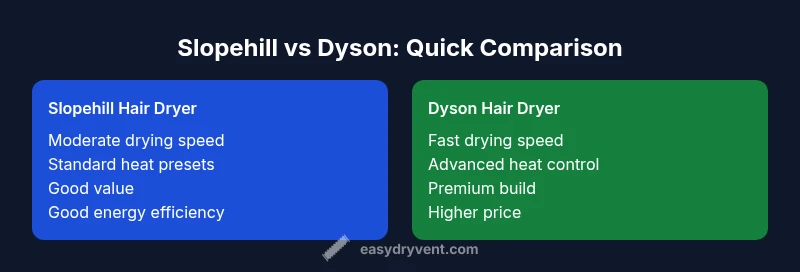
| Feature | Slopehill Hair Dryer | Dyson Hair Dryer |
|---|---|---|
| Drying speed | Moderate | Fast |
| Heat control presets | Standard presets and adjustable heat | Advanced heat zones with precise control |
| Weight/ergonomics | Mid-weight | Balanced premium grip |
| Noise level | Moderate | Low-to-moderate |
| Energy efficiency | Good | Excellent |
| Durability & warranty | Good warranty, value pricing | Premium build with extensive warranty |
| Price range | $60-$200 | $250-$500 |
The Good
- Great value for budget buyers
- Solid performance for everyday styling
- Wide compatibility with common accessories
- Good availability of parts and DIY repairs
- Balanced energy use for regular home use
Negatives
- Lower peak performance for demanding professional tasks
- Long-term durability may lag premium brands
- Higher replacement costs for premium Dyson accessories
- Fewer high-end features than top-tier rivals
- Lower resale value compared to premium models
Slopehill hair dryer wins for value-focused buyers; Dyson wins for premium performance and build quality.
If you prioritize upfront cost and daily usability, slopehill is the better choice. If you want the strongest build, most precise heat control, and long-term durability, Dyson justifies the higher price. Easy DryVent recommends aligning your choice with budget and intended use.
Common Questions
Is slopehill hair dryer a good budget alternative to Dyson?
Yes, for most users slopehill offers solid drying performance and practical features at a lower upfront cost. It may lack Dyson’s premium materials and peak heat control, but it remains a strong value for routine styling.
Yes. For most users, slopehill provides solid performance at a lower price, making it a good budget-friendly alternative to Dyson.
Does Dyson offer better heat control and durability?
Dyson generally provides tighter heat control and a more durable build, with engineering aimed at consistent performance over time. This can translate to faster styling and longer-lasting reliability, justifying the higher price for many buyers.
Yes, Dyson typically has superior heat control and durability, which many users value for premium styling and longevity.
Which dryer is faster for thick or frizzy hair?
Dyson tends to be faster in many scenarios due to its higher airflow and optimized motor. Slopehill can still perform well, especially with the right heat and attachment choices, but may take longer on very thick hair.
Dyson is usually faster with thick hair due to higher airflow, though slopehill remains effective with the right setup.
Are replacement parts and accessories easy to find for slopehill?
Yes, slopehill parts and common attachments are widely available through major retailers and online marketplaces, which helps keep maintenance affordable for DIY users.
Parts are easy to find, so maintenance and upgrades are straightforward.
What maintenance do these dryers require to keep them safe?
Regularly cleaning filters, vent paths (where applicable), and ensuring proper storage keeps both units safe and efficient. Inspect cords and housings for wear and avoid exposure to moisture.
Clean filters and vents, check cords, store properly to maintain safety and performance.
Key Points
- Assess your budget first and align with expected daily use
- Prioritize heat control needs for your hair type
- Consider maintenance costs and ease of part replacement
- Choose Dyson for premium build and speed; choose slopehill for solid value
- Factor in noise level and size for home comfort