Ionic Hair Dryer vs Tourmaline: A Practical Comparison for Safer Drying
Compare ionic hair dryer vs tourmaline technologies to decide which suits your hair type and budget. Easy DryVent explains how each works, who benefits, and how to choose.


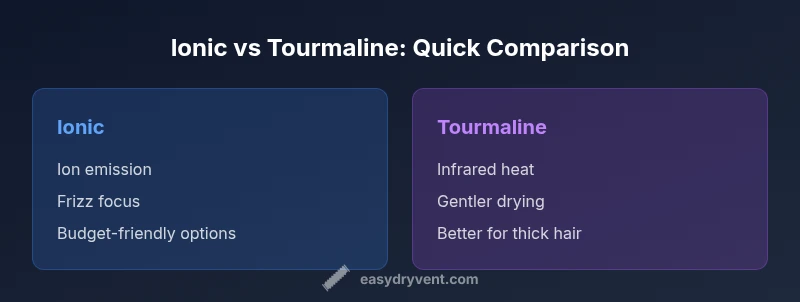
Ionic hair dryer vs tourmaline: Ionic models emit negative ions to reduce static and smooth the cuticle, often improving frizz control; tourmaline dryers incorporate crushed tourmaline crystals that generate infrared heat and negative ions for gentler drying. Results vary by model, so choose based on your hair type and priorities such as frizz control, drying speed, or hair health.
Overview of ionic hair dryer vs tourmaline technology
Hair care technology has progressed to the point that consumers can choose between devices that rely on ionic and tourmaline principles. This guide compares ionic hair dryer vs tourmaline to help homeowners and DIY enthusiasts evaluate which approach aligns with their goals: faster drying, less frizz, or gentler heat. While both technologies promise benefits, practical results depend on the overall dryer design, heat management, and user technique. By understanding how each works, you can make a smarter purchase decision that fits your routine and hair type.
How ionic dryers work
Ionic dryers rely on a built-in ion generator to emit negative ions during operation. The idea is that negative ions help break down water molecules on the hair shaft, accelerate moisture removal, and seal the cuticle more smoothly. In practice, the effectiveness of frizz reduction or shine depends on the specific model, airspeed, and heat settings. Important caveats include the fact that ions alone do not cool the hair and that user technique still drives results. For homeowners on a budget, ionic systems can provide noticeable frizz reduction when combined with higher airspeed and adjustable heat.
How tourmaline dryers work
Tourmaline dryers incorporate crushed tourmaline crystals that, when heated, generate infrared heat and a broad spectrum of negative ions. The infrared component is often marketed as a gentler drying method because heat is distributed more evenly along the hair shaft, potentially reducing heat spikes. In reality, outcomes depend on the dryer’s overall design, including motor power, heat control, and nozzle options. Tourmaline can be especially appealing for those dealing with thick, coarse, or damaged hair, where gentler, more even drying is desirable.
Real-world performance: drying time and frizz
In everyday use, the drying speed of ionic and tourmaline dryers is influenced by more than the core technology. A high-quality dryer with efficient airflow and good heat management can shorten styling time, while frizz control is often more noticeable on hair with larger cuticle gaps or static issues. Ionic dryers tend to shine for fine or frizz-prone hair when paired with appropriate heat settings and a cool-shot finish. Tourmaline-based models may offer smoother textures and less static on thicker hair due to infrared-assisted drying, but results vary by model and hair condition.
Heat distribution, safety, and comfort
One of the key questions is how heat is delivered. Ionic dryers focus on ion production with standard electric heating elements, while tourmaline devices emphasize infrared emission. Infrared heat can feel gentler on the surface of the hair because it heats from within the shaft, potentially reducing surface damage when used correctly. Regardless of the technology, always start with lower heat and a discrete airflow setting for color-treated or damaged hair, and use a cool shot to set styles.
Hair type scenarios and practical recommendations
- Fine or damaged hair: Ionic dryers with careful heat control can reduce frizz and promote smoothness without excessive drying time, particularly when used with a cooler finish.
- Thick, coarse, or highly textured hair: Tourmaline dryers may offer more comfortable drying due to infrared heat, which can enable more even moisture removal without high surface temperatures.
- Color-treated or chemically sensitive hair: Prioritize dryers with adjustable heat and sensor-controlled shutoffs to minimize thermal exposure, regardless of technology.
Durability, maintenance, and longevity
Maintenance matters as much as the core technology. Regularly cleaning lint screens, filters, and attachments helps maintain airflow and performance. Both ionic and tourmaline dryers benefit from clean vents and well-sealed housings. Replacing worn parts, such as filters and attachments, extends life, but the durability of the crystals or ion generators depends on the build quality and usage patterns. Always opt for reputable brands with adequate warranty coverage.
Price, value, and buying considerations
Price ranges for both technologies vary by brand, motor power, and included features. In this market, a buyer should consider long-term value rather than short-term savings. Look for models with multiple heat and speed settings, reliable safety features, and a good warranty. When budgeting, weigh the potential benefits of infrared warmth against the frizz-control promises of ion generation, and decide which aligns with your hair goals and styling habits.
Quick-start buying checklist and next steps
- Define your primary goal: frizz control, drying speed, or gentle heat.
- Check heat settings, including a cool-shot option and sensor-based shutoff.
- Evaluate attachments: diffusers for curly hair, concentrators for sleek results.
- Read independent reviews and verify warranty terms.
- Try models in-store when possible to observe airflow, weight, and noise.
Comparison
| Feature | ionic hair dryer | tourmaline dryer |
|---|---|---|
| Ion emission | strong negative-ion emission | tourmaline crystals generate ions when heated |
| Heat source | electric heating element with ion technology | built-in tourmaline crystals producing infrared heat |
| Drying speed | often quick drying with frizz control | gentler drying with infrared assistance |
| Frizz control | commonly effective for fine or frizz-prone hair | can smooth surface texture with infrared warmth |
| Best for hair type | fine or color-treated hair seeking frizz reduction | thick, coarse, or curly hair needing gentler drying |
| Price range | broadly similar across models | broadly similar across models |
| Durability & maintenance | depends on build quality; easier maintenance | depends on build quality; crystals and electronics require care |
| Best use case | frizz-prone styling with quick results | even, gentle drying for textured or processed hair |
The Good
- Potential for faster styling with frizz reduction
- Tourmaline-assisted infrared heat can be gentler on the hair shaft
- Both options are widely available across budgets
- Modern dryers offer multiple heat and speed settings
- Attachments like diffusers and concentrators are broadly compatible
Negatives
- Results vary by model; technology alone doesn't guarantee outcomes
- Marketing claims can overstate ion or infrared benefits
- Maintenance and care are required to keep performance high
Neither technology is universally superior; choose based on hair type and priorities.
For most users, tourmaline offers gentler drying for thicker or treated hair, while ionic models excel at frizz control for fine hair. Prioritize your hair type and styling priorities when choosing between ionic and tourmaline dryers.
Common Questions
What is the main difference between ionic and tourmaline hair dryers?
Ionic dryers focus on emitting negative ions to reduce frizz and smooth the hair cuticle, while tourmaline dryers rely on infrared heat produced by crystals to dry hair more evenly. Both aim to improve styling outcomes, but the mechanism and typical results differ. Your choice should reflect your hair type and styling priorities.
The main difference is ions versus infrared heat; ionic dryers help with frizz, while tourmaline uses infrared heat for gentler drying. Pick based on your hair type and what you value most in a style.
Do ionic and tourmaline dryers actually reduce drying time?
Both technologies can shorten drying time when paired with a strong airflow and appropriate heat, but actual results depend on the dryer’s overall design and motor power. Testing models with your hair type is the best way to confirm perceived speed.
They can speed up drying, but it depends on the model and your hair. Check real-world tests with hair similar to yours.
Which is better for frizz control?
Ionic dryers generally offer noticeable frizz reduction for many hair types due to ion emission. Tourmaline’s infrared component can also smooth the cuticle, especially on thicker hair. Your results may vary by model and technique.
Both can reduce frizz, but ionic is often stronger for frizz control, while tourmaline helps with smoothness on thicker hair.
Are these dryers suitable for color-treated or chemically processed hair?
Yes, but you should prioritize dryers with precise heat control and a cool-shot option to protect color. Both technologies can be suitable when used with proper settings and shorter high-heat bursts.
Yes, with careful heat control and a cool setting to protect color.
Is price a good indicator of performance for ionic vs tourmaline dryers?
Not automatically. A higher price can reflect better build quality, motor power, and features, regardless of whether the dryer is ionic or tourmaline. Focus on performance, settings, and warranty.
Price isn’t a perfect proxy for performance; check features and warranty instead.
How should I maintain an ionic or tourmaline dryer to extend its life?
Regularly clean lint screens, vents, and attachments. Store in a dry place, avoid pulling cords, and replace worn parts as recommended by the manufacturer. Routine maintenance helps preserve airflow and heat control.
Keep filters clean and store the dryer properly to extend life.
Can I get the same results from a non-ionic, non-tourmaline dryer?
Yes, but you may rely more on overall airflow, heat control, and styling technique rather than ion or infrared benefits. A high-quality non-ion dryer can still deliver excellent results with proper technique.
Yes—great results are possible with a good non-ionic dryer if you master the technique.
What should I test when evaluating a dryer in-store?
Ask to test with your hair type. Compare how quickly it dries, the feel of heat, and the level of frizz after styling. Pay attention to noise, weight, and usability, as these affect day-to-day satisfaction.
Test it on your hair, listen to the sound, and check how it feels when styling.
Key Points
- Assess hair type to guide technology choice
- Ionic dryers target frizz control through ion emission
- Tourmaline dryers emphasize infrared heating for gentler drying
- Model quality and settings impact results more than technology alone
- Test in-store to compare outcomes on your hair