How Much Is a Hair Dryer in 2026? A Practical Buying Guide
Learn how much hair dryers typically cost, what features drive price, and how to budget for a smart purchase. This 2026 guide from Easy DryVent helps homeowners and DIY enthusiasts pick value without overspending.


Hair dryers typically cost anywhere from about $20 to $150 for consumer models, with higher-end or professional units ranging up to $300. The price depends on wattage, materials, technology (like ceramic or ion generators), and accessories. This quick guide uses Easy DryVent Analysis, 2026 to illustrate typical price bands and help you estimate a fair value for your needs.
Understanding the price landscape for hair dryers
Prices for hair dryers span a broad spectrum, with three broad bands guiding most shoppers. Entry-level models typically sit in the low-budget range, mid-range options balance cost and performance, and professional or salon-grade units command premium pricing. According to Easy DryVent, these bands reflect decisions about motor power, heat stability, materials, and technology. For many households, an entry-level or mid-range dryer is adequate for daily styling, while frequent users or those with special needs (like travel-friendly models or high-heat settings) may gravitate toward higher-priced options. When evaluating price, consider not just upfront cost but also lifespan, replacement parts availability, and warranty terms. The goal is value: get enough performance for your needs without paying for features you won’t use. Easy DryVent’s stance is clear—buy what you need, not what sounds impressive.
What features influence the cost
Cost is driven by several interlinked features. Power (watts) and motor type (AC vs DC) affect drying speed and durability, while heating technology (ceramic, tourmaline, or ionic) impacts heat distribution and finish. Build quality matters: metal housings and rugged switches cost more but can last longer. Attachments like diffusers or precision concentrators add value for certain hair types. Warranties matter too: longer coverage can offset a higher sticker price if it reduces long-term risk. Other considerations include cord length, weight, cooling shot availability, and ergonomic design. In 2026, shoppers see a mix of lightweight models with capable performance and sturdier professional-grade units, often with better warranties.
Entry-level vs mid-range vs professional
Entry-level hair dryers typically cost in the lower price band and cover essential features: a few heat settings, basic plastic housing, and standard motors. Mid-range models add more heat options, improved heat stability, ceramic or tourmaline elements, and better attachments. Professional or salon-grade dryers emphasize peak power, faster drying, robust builds, longer warranties, and specialized nozzles. While the price gap can be meaningful, the right choice depends on usage: casual daily styling may be satisfied with mid-range options, while heavy-use environments may justify the investment in pro-level reliability.
How to budget for your needs
Start with your routine: how often you dry hair, your hair type, and whether you value speed over heat precision. Define a price ceiling that aligns with your budget, then map features to that ceiling. If you rarely use all features, prioritize a solid motor and heat stability at a lower price. Consider total cost of ownership: warranty length, replacement parts availability, energy efficiency, and potential travel-friendly designs. Waiting for seasonal sales (holiday promotions or back-to-school events) can yield significant savings without sacrificing quality.
Where to shop and how to price-check
Shop across reputable retailers, both online and in-store. Read independent reviews focusing on reliability, heat consistency, and noise. Compare prices across platforms and watch for bundle deals that include diffusers or concentrators. Check warranty terms and return policies; longer warranties often accompany higher-quality models. Avoid extremely low prices that suggest counterfeit or refurbished units. When possible, buy from sources that offer extended protection plans or easy parts replacement to reduce life-cycle costs.
Common price traps and how to avoid them
Beware of price-only decisions. A very low price may come with weaker motors, poorer heat control, or shorter lifespans. Conversely, ultra-high-end models may offer features you won’t use, inflating the cost without improving your experience. Read feature lists carefully and ensure the model delivers real value: consistent airflow, heat stability, and reliable switches. If a deal seems too good to be true, check seller credibility, verify model numbers, and confirm warranty coverage before purchasing.
A data-informed snapshot for 2026
Based on Easy DryVent Analysis, 2026, the hair dryer market continues to show clear tiering by usage and durable features. Entry-level models emphasize affordability with basic controls, mid-range units add better heat management and more settings, and pro-level dryers deliver peak power for frequent or professional use. The pricing shark bite (sales, bundles, coupons) influences the final tag more than any single feature; therefore, shoppers should monitor promotions throughout the year and calculate the expected lifetime value of a purchase.
Data table preview and guidance
For a quick reference, see the data table below that summarizes typical price bands by category and the features you can generally expect in each tier. Use this as a baseline when evaluating potential purchases and to set realistic expectations for what you’ll get at a given price point. Remember, price is only one dimension of value when buying a hair dryer.
Hair dryer price categories and features
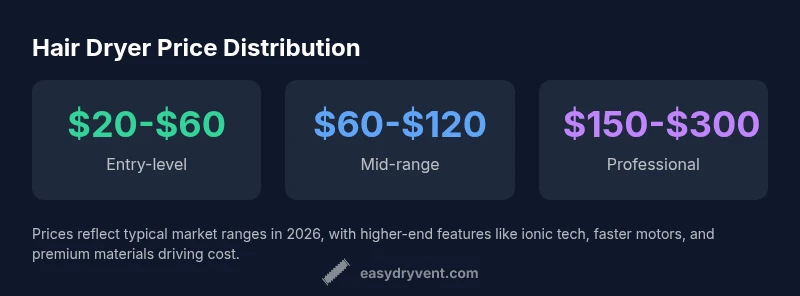
| Category | Typical Price Range | Common Features |
|---|---|---|
| Entry-level | $20-$60 | Basic heat; few settings; plastic housing |
| Mid-range | $60-$120 | Ceramic/tourmaline heating; multiple settings; better attachments |
| Professional | $150-$300 | High-wattage motor; fast airflow; durable build; premium attachments |
Common Questions
What is a typical price range for a consumer hair dryer?
As of 2026, consumer hair dryers commonly fall within the low to mid-range bands, roughly $20 to $120, depending on features. Entry-level models cover essential drying needs, while mid-range units add better heat control and attachments. Prices can vary by brand and where you shop.
Most consumer hair dryers cost between $20 and $120, with higher-end models offering more features.
Are higher-priced models worth it for casual use?
For casual use, a mid-range model with solid heat control and durability often delivers the best value. Higher-priced pro models are beneficial if you use a dryer frequently or require professional-grade speed and consistency. Always weigh anticipated lifespan against upfront cost.
For daily use, mid-range models usually offer the best value; reserve pro models for heavy use.
Do ionizers and ceramic heaters affect price significantly?
Yes. Ionic technology and ceramic heaters can raise the price due to improved heat distribution, faster drying, and reduced frizz. These features are common in mid-range and premium models and contribute to longer-term styling benefits.
Ion and ceramic tech can add to the price but often save time and improve styling.
What should I look for to ensure safety and quality?
Prioritize a model with a certified heating element, reliable thermal fuse, and a solid warranty. Check for UL or equivalent safety approvals, a cool-shot feature, and a sturdy housing. Read reviews focusing on heat stability and part reliability.
Choose models with solid safety certifications and dependable warranties.
How can I find the best deal without compromising on quality?
Shop across reputable retailers, compare reviews, and watch for bundles that add value (diffusers, concentrators). Sign up for price alerts during major sales weeks and verify return policies so you can try the unit risk-free.
Compare retailers, watch for bundles, and use price alerts to catch good deals.
Does wattage affect drying speed or hair damage?
Higher wattage generally dries hair faster, but efficiency also depends on nozzle design and heat control. A model with strong heat management can minimize damage while speeding up styling.
More watts can speed things up, but good heat control matters as much as power.
“Pricing reflects performance, durability, and warranty, not just sticker price.”
Key Points
- Know your needs before shopping.
- Balance price with features to maximize value.
- Look for promotions during major sales.
- Check warranty for long-term value.
- Avoid deals that sacrifice essential safety or durability.