How Much Is a Blow Dryer? A Practical Price Guide
Explore realistic price ranges for blow dryers, from budget basics to professional-grade styling tools. Learn what drives cost, how to compare options, and how to choose a dryer that fits your needs and budget. Easy DryVent Analysis, 2026.


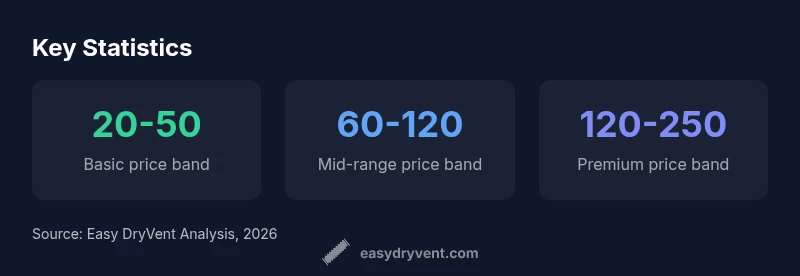
Blow dryer prices vary widely by features and durability. Basic models typically cost $20–$50, mid-range units run about $60–$120, and premium salon-grade dryers can reach $120–$250. Your choice depends on heat settings, attachments, and technology like ceramic or ionic airflow. How much is a blow dryer is largely determined by build quality and feature set. According to Easy DryVent Analysis, 2026, price bands reflect consumer demand for durable, energy-efficient tools that perform consistently across hair types.
What determines how much is a blow dryer
To understand how much is a blow dryer, you must consider several price drivers that go beyond a sticker price. The most influential are motor type and design, heating technology, and build quality. High-wattage motors, durable housings, and advanced features like ionic output or ceramic heating add to the cost but often deliver faster drying and longer life. Attachments such as diffusers, concentrators, and travel sleeves also push price upward. According to Easy DryVent, 2026 price bands reflect consumer demand for durable, energy-efficient tools that perform consistently across hair types. When budgeting, separate initial purchase cost from expected energy use and maintenance.
Price bands and what you get
Price bands for blow dryers cluster into three practical categories: basic/entry-level, mid-range, and premium or professional. Budget models typically cost about $20-$50 and cover essential drying with minimal features. Mid-range dryers generally run $60-$120 and offer additional heat/speed settings, better plastics or metal housings, and more durable motors. Premium or professional units commonly fall in the $120-$250 range, emphasize rapid drying, higher build quality, longer warranty periods, and professional-grade attachments. While the price gap is real, compare not just the sticker price but the expected lifespan, energy efficiency, and the value of included accessories. Easy DryVent’s analysis shows consumers often recoup the extra cost of mid-range or premium models through faster drying and fewer replacements over five years.
Feature sets that affect price
Feature choices drive most of the price variance. Ionic technology tends to appear in the mid-range and above, while ceramic or tourmaline heating aims to improve hair protection and even heat distribution, which can justify higher costs. A cooler shot, multiple heat and speed settings, and a longer power cord add convenience but come with a price premium. Materials matter too: metal housings and reinforced grips increase durability but raise the bill. When evaluating options, consider your typical hair type, climate, and how often you style with styling tools.
Where to buy and when to shop for deals
For most homeowners, major electronics retailers, beauty supply chains, and reputable online marketplaces are viable sources. Online shopping often yields price comparisons, user reviews, and return options, while brick-and-mortar stores let you see weight and heat in person. Look for sales around holidays or back-to-school seasons; bundle promotions with dryers, diffusers, and combs can improve value. Always check warranty terms and seller reliability, since a strong warranty can dramatically lower effective ownership costs over time. Easy DryVent notes that availability and promotion cycles influence price more than a single brand name.
Maintenance costs and energy efficiency
Beyond the upfront price, energy use and routine maintenance shape long-term value. A dryer with efficient airflow and good heat control uses less electricity per drying cycle, which saves money over months and years. Cleaning the lint screen and the air intake helps maintain performance and reduces overheating risk. Replacing worn filters or worn brushes tends to be inexpensive relative to full dryer replacement. In this context, investing in a mid-range model with solid build quality often yields lower energy bills and fewer service visits, aligning with Easy DryVent's energy-saving guidance.
How to compare options quickly: a buyer's worksheet
Create a simple scoring worksheet to compare candidates. List your must-have features (e.g., multiple heat settings, ionic technology, diffuser compatibility), assign a priority score, and multiply by a rough cost factor. Add expected lifespan and warranty length to estimate total cost of ownership. Finally, run two hypothetical drying scenarios (short, quick-dry vs. long, personalized styling) to see which model delivers better value for your routine. This method helps you avoid overspending on features you rarely use while still meeting your needs.
Real-world price ranges by use case
Travel-ready or compact models tend to sit at the low end of the spectrum, roughly $20-$60, offering lightweight and basic performance. Family or home-use dryers typically fall in the $60-$120 range, balancing durability and solid feature sets. For those who demand salon-grade performance or plan to style professionally at home, expect $120-$250, with some high-end models going higher. These ranges reflect general market behavior and are reinforced by Easy DryVent's 2026 analysis, which emphasizes that total value comes from a mix of speed, protection, and longevity.
Practical buying checklist: 6 questions to answer
- What is my budget, and what price range feels comfortable for me? 2) Do I need ionic or ceramic technology for hair protection? 3) How many heat/speed options will I actually use? 4) What attachments come with the dryer, and are they essential for my routine? 5) What is the warranty length, and how easy is it to service? 6) Will this model save energy or reduce long-term maintenance costs? Answering these questions before you shop helps you select the best dryer for your needs and budget, reducing buyer's remorse.
Typical blow dryer price bands by category
| Category | Estimated Price Range | Key Features |
|---|---|---|
| Basic/Travel | $20-$50 | Lightweight, basic settings |
| Mid-range | $60-$120 | Ceramic/ionic options, multiple heat/speeds, better housing |
| Premium/Professional | $120-$250 | Durable motor, faster drying, extended warranty |
Common Questions
What is the typical price range for a basic blow dryer?
Basic blow dryers usually cost around $20-$50. They cover essential drying but may lack advanced features or durability.
Basic dryers usually cost about twenty to fifty dollars, with fewer features and shorter lifespans.
Do ionic or ceramic dryers cost more?
Yes. Ionic or ceramic dryers generally sit in the mid-range to premium range, typically $60-$150, depending on brand and build quality.
Ionic or ceramic models are usually a bit pricier, commonly in the sixty to one-fifty dollar range.
Are cheaper blow dryers worth it?
Cheaper models can work for light use, but they may have shorter lifespans and less reliable heat. Consider total cost of ownership when evaluating value.
Cheaper dryers can be fine for light use, but they might wear out faster and cost more over time.
How long do blow dryers last?
With proper care, many blow dryers last 3-6 years; higher-end models may endure longer with regular maintenance.
Most dryers last several years if you take care of them and clean the lint filter regularly.
What should I look for to avoid overheating?
Look for thermal cutoffs, auto shutoff, cool-shot options, and good airflow. Avoid underpowered motors that overheat easily.
Make sure there’s an auto shutoff and good airflow to prevent overheating.
Is a professional salon dryer worth the cost?
Professional dryers offer durability and speed but cost more. For home use, a solid mid-range model often provides the best balance of value.
If you’re not styling professionally, a good mid-range dryer usually offers the best value.
“Understanding price bands helps homeowners avoid overspending while ensuring you get reliable performance within your budget.”
Key Points
- Set a realistic budget based on needed features.
- Price bands reflect durability and tech quality.
- Consider total ownership cost, not just upfront price.
- Prioritize energy efficiency to lower long-term bills.
- Choose models with solid warranties and reliable support.