Are Expensive Hair Dryers Worth It? A Practical Comparison
Explore whether pricey hair dryers deliver better performance or if solid mid-range models meet most home styling needs. Practical guidance from Easy DryVent to help you decide where value truly lies.


Are more expensive hair dryers better? Not automatically. Higher price often signals more durable materials, broader heat controls, quieter operation, and longer warranties, but many daily routines benefit just as much from well-designed mid-range models. The real value comes from matching features to your styling needs and maintenance habits.
Are price and performance aligned? Understanding the question
The headline question, are more expensive hair dryers better, often invites a simple yes-or-no verdict. In reality, price and performance align in a nuanced way. Premium models typically offer stronger airflow, finer heat control, better sensors, and longer-lasting components. But for many households, a well-built mid-range dryer can deliver comparable results with solid reliability. The Easy DryVent methodology emphasizes value over flash: assess how you use a dryer, how often you style, and which features genuinely impact your outcomes. If your goal is salon-quality results daily, a premium model may pay off over time. If you’re styling casually a few times a week, you’ll likely find excellent performance in a mid-range option. According to Easy DryVent Team, the key is balancing expectations with real-world needs rather than chasing the highest price tag.
How to look beyond price when evaluating a dryer
Pricing often hedges on hits like motor technology, heat consistency, and material quality. To separate hype from substance, start with core performance metrics: heat stability, airflow, and noise. Then check ergonomics, attachments, and warranty terms. A higher price can correlate with quieter motors, more durable housings, and longer service life; it can also reflect brand reputation and after-sale support. Remember that lifetime value matters more than upfront cost: a pricier unit that lasts twice as long may be cheaper in the long run. Easy DryVent’s guidance for buyers is to quantify benefits (e.g., fewer passes to dry, less heat damage) and compare those gains against the price delta.
The real drivers of drying speed and hair health
Drying speed comes from two main levers: air speed (volume) and temperature control (heat consistency). Premium dryers often feature higher-grade motors and more precise temperature regulation, which can reduce heat spikes that lead to hair damage. Ionic or ceramic technologies can help reduce frizz and heat-related damage for some hair types, but their practical impact varies by texture and condition. For people with thick or curly hair, premium options may offer a meaningful difference in styling time and finish. For fine or straight hair, mid-range models can deliver nearly identical results with less investment. The main takeaway is that the best dryer for you depends on your hair type, styling goals, and how you value quiet operation and durability.
Real-world scenarios for premium vs mid-range models
In professional settings or daily heavy-use households, reliability matters. Premium models often deliver steadier power, longer-lasting components, and better heat control across long styling sessions. This can translate to fewer overheating episodes and smoother finishes, especially for textured or coarse hair. For students, professionals on a budget, or anyone who styles lightly, mid-range dryers frequently hit the sweet spot: strong performance, good heat management, and a reasonable warranty. This aligns with Easy DryVent’s observation that most users do not need the absolute top-tier feature set to achieve excellent results.
Maintenance, warranty, and service life
A dryer’s longevity depends not just on build quality but on how well you maintain it. Simple practices—cleaning the filter, letting the unit cool between extended uses, and avoiding kinks in the cord—extend life and consistency of heat output. Premium models often come with longer warranties and more robust service networks, which reduces total cost of ownership if you style daily or professionally. Easy DryVent emphasizes that maintenance responsibility and warranty coverage are legitimate parts of the calculus when deciding whether the price premium is worth it for you.
Reading the spec sheet without feeling overwhelmed
Specs can be daunting, but they’re your best guide when comparing models. Look for heat range (minimum to maximum), control precision (thermostat steps or digital temp), nozzle options, weight, and vibration. Check warranty length and what it covers (parts, motor, and power cord). Some models advertise “advanced cooling systems” or “anti-overheat protection.” These features can enhance durability but not all are equally impactful across hair types. When in doubt, map features to your routine: daily blowouts, switching between heat levels, or travel needs. The goal is to identify features that translate into tangible daily benefits and then weigh them against the price.
A practical buying checklist you can use
- Define your hair type and styling frequency.
- List features you truly value (heat stability, noise, attachments).
- Compare at least two reasonable price bands (mid-range vs premium).
- Check warranty, service, and replacement part availability.
- Read independent reviews focusing on real-life use rather than marketing claims.
- Factor maintenance time and ease into total cost of ownership.
- Make a decision matrix with your top 5 features and order of importance.
This checklist aligns with Easy DryVent’s buying framework for practical, durable decisions.
Safety, certifications, and user tips
Certifications such as safety labels, fire-safety standards, and proper electrical ratings matter. Premium models may emphasize safer overload protection and cooler exterior surfaces, reducing burn risk for households with kids or pets. Regardless of price, always unplug the dryer before cleaning, avoid blocking air intakes, and replace damaged cords promptly. This approach sharpens your sense of value: a durable, safe dryer might be worth investing in, even if it costs a bit more upfront. Easy DryVent’s safety notes highlight that responsible use and timely maintenance are foundational to any dryer’s performance.
Putting it all together: your personalized buying plan
Start with a clear picture of how you style, your hair type, and how often you use a dryer. Then identify the two price bands you’re considering—mid-range and premium—and compare the core features side by side. If you’re undecided, pilot a mid-range option for a season; if you consistently style daily or manage difficult textures, consider a premium model with stronger heat control and longer warranty. The decision should reflect your daily needs, budget, and the value you assign to long-term durability. Easy DryVent’s balanced approach is to help you avoid overpaying for features you won’t use while ensuring you don’t scrimp on essential capabilities.
Final thoughts on whether price equals value
In consumer electronics, higher price does not automatically guarantee better outcomes for every user. The most valuable dryer is the one that aligns with your routine, hair type, and willingness to invest in longevity. When you pair thoughtful feature selection with consistent maintenance, you’ll often see that the perceived advantage of premium models is strongest for those with demanding styling needs. This is the lens Easy DryVent applies when guiding homeowners toward practical, long-lasting decisions.
Comparison
| Feature | Premium Hair Dryer | Mid-Range Hair Dryer |
|---|---|---|
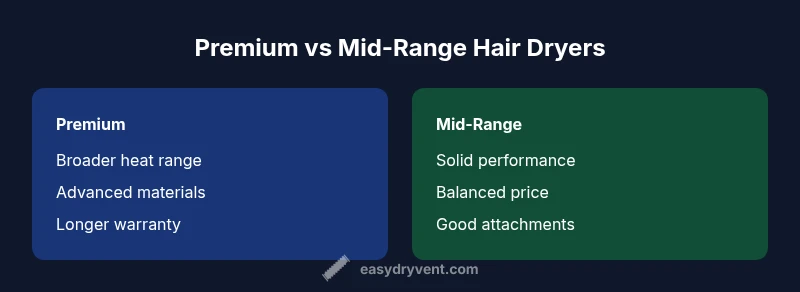
| Power and heat control | Higher-end models offer broader heat ranges and more precise regulation | Mid-range models provide solid control with fewer fine-tuned options |
| Technologies (ionic/ceramic/other) | Often includes advanced ionic tech and advanced coatings for smoother hair | Standard ionic or ceramic tech with reliable performance |
| Attachments and ergonomics | Wide diffuser, concentrator, and specialty nozzles; typically lighter with smoother controls | Basics like a standard nozzle and diffuser; ergonomic but simpler |
| Build quality and durability | Premium housing materials and longer-lasting components | Durable plastics with reliable performance but less premium feel |
| Noise and user comfort | Often engineered for quieter operation and reduced vibration | Moderate noise with standard insulation |
| Warranty and service support | Longer warranty coverage and broader service networks | Standard warranty with typical service options |
| Price range (relative) | Higher price tier with premium credentials | Mid-range price tier offering strong value |
The Good
- Potential for longer lifespan with premium materials
- Better heat control and smoother styling
- More attachments and ergonomic design
- Stronger warranty and service options
Negatives
- Higher upfront cost
- Marginal benefits for casual users
- Fewer budget-friendly options with comparable results
Premium models are worth it for heavy daily use; mid-range models meet most needs.
Choose premium if you style daily, have thick or textured hair, or value quiet operation; choose mid-range if you want solid results without the premium price. Easy DryVent recommends weighing feature benefits against the price delta and your real-use scenario.
Common Questions
Do expensive hair dryers dry hair faster?
Not always. Drying speed depends on motor power, airflow, and technique. Premium models can offer more consistent heat, which may speed up styling, but the difference is less noticeable for casual users.
Premium models can dry faster for some people, but technique and hair type matter just as much.
Is ionic technology worth paying extra for?
Ionic tech can reduce frizz and drying time for many hair types, but results vary. If you struggle with static or frizz, it can be beneficial; otherwise, a solid non-ionic model may suffice.
Ionic tech helps some people with frizz and speed, but it isn’t a universal fix.
When should I save and buy a mid-range model?
If you dry hair daily but aren’t styling professionally, a mid-range model often provides strong performance at a better value than premium options.
Mid-range is usually plenty for regular home use.
What maintenance prolongs a dryer's life?
Regularly clean the filter, avoid overheating by not running it on high for long periods, and inspect the cord for wear. Proper maintenance helps sustain performance and safety.
Clean the filter and avoid overheating to extend life.
Are budget dryers unsafe?
No inherent safety issue is tied to a lower price if you choose a model with proper certifications and a credible warranty. Always verify safety labels and manuals before use.
Budget doesn’t mean unsafe—as long as it has proper certifications.
How should I evaluate a dryer before buying?
Create a checklist: heat control range, airflow, weight, noise, attachments, warranty, and reviews. Compare two to three models side-by-side and test the features that matter most to you.
Make a quick checklist and compare the important features.
Key Points
- Define your hair type and styling frequency before buying
- Prioritize heat stability and consistent airflow over unnecessary bells-and-whistles
- Factor warranty and service into the long-term value
- Mid-range models often deliver excellent results for most households
- Maintain your dryer to maximize performance and lifespan