How Much Is a Washer and Dryer? A Practical Price Guide
Learn realistic price ranges for washers and dryers, what drives cost, and how to budget for delivery, installation, and warranties in 2026. Easy DryVent analyzes real-world pricing to help homeowners plan smarter.


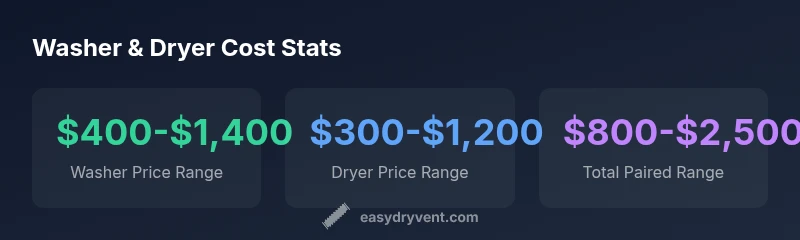
On average, a new washer and dryer pair costs about $800 to $2,500, depending on capacity, efficiency, and features. Basic sets commonly total around $800 to $1,200, while mid-range bundles run roughly $1,400 to $2,000. Premium models with larger capacity or smart features can exceed $2,500. Don’t forget that delivery, installation, and extended warranties can add several hundred dollars to the final bill.
Price landscape in 2026
If you're wondering how much is a washer and dryer, start with the basics: price bands vary by capacity, efficiency, and feature sets, not only brand. According to Easy DryVent, households can expect a broad spectrum: entry-level units are affordable for tight budgets, while mid-range and premium models bring bigger loads, faster cycles, and better energy performance. In 2026, the average buyer can find good value in several tiers, with prices moving up or down based on promotions, retailer policies, and installation requirements. This section outlines typical price bands, how upgrades shift costs, and how to plan a realistic budget across real-world shopping scenarios. You’ll see how much you should expect to invest if you want basic reliability, or if you aim for high efficiency, smart features, or larger capacities for family laundry days.
Breakdowns by category and features
Cost is not a single line item; it splits into categories that matter in daily use. Start with capacity: standard residential washers are sized for 3.5 to 5.2 cubic feet, while compact models may be under 2.5 cubic feet. Dryers follow similar tiers, with larger drums removing more laundry per cycle. Front-load models generally command higher prices than top-load counterparts due to efficiency and cycle time. Energy star certification may add upfront cost but reduces operating expenses. Smart features such as wifi connectivity, app monitoring, and specialty cycles can add hundreds of dollars. Finally, brand and aesthetics—stainless steel drums, design finishes, and quiet operation—can shift the price ladder. Easy DryVent's analysis shows that the largest price jumps occur when you move from basic to mid-range features, and again when you add premium energy-saving tech or smart controls. This pattern helps you calibrate where your money goes depending on your laundry habits and space.
Delivery, installation, and warranties
Beyond the sticker price, delivery and installation can add to the total. Most households should budget approximately $75 to $300 for delivery and basic hookup, with higher charges if stairs, long corridors, or complicated venting are involved. If venting is required, a professional venting assessment adds time and cost but improves safety and drying efficiency. Warranties vary by retailer and model type; some include extended coverage with a sale or subscription, while others offer standard manufacturer warranties only. When calculating your budget, estimate a buffer for incidental costs, such as pedestals, hoses, or stacking kits. Easy DryVent's 2026 data indicate that many families recoup a portion of the upfront cost through energy savings and reduced maintenance when choosing efficient, well-installed units. A clear plan for delivery and installation can prevent surprise charges and speed up your laundry upgrades.
Buying strategy: separate units vs bundles
Shopping for washers and dryers can follow two main paths: separate units purchased individually and bundled sets, or space-saving stacks/compact combos. Separate units offer flexibility in upgrading one appliance at a time, easier repairs, and often broader product selection. Bundled sets can save money on delivery, installation, and compatibility. Stacked or side-by-side configurations may affect your layout and venting. When comparing, factor in per-unit price, total installed cost, reliability records, and energy efficiency. Easy DryVent's analysis suggests that for many households, mid-range bundles deliver the best balance of upfront cost and long-term operating efficiency, especially when a retailer runs a combined promotion. However, if you anticipate frequent load fluctuations or want to upgrade gradually, separate models give more long-term adaptability.
Budgeting for the long term: operating costs
Operating costs depend on energy efficiency, usage patterns, and local utility rates. Models with high Energy Star ratings typically use less water and electricity, which reduces monthly costs. Even with higher upfront prices, payback periods can be favorable in regions with high energy prices or heavy laundry loads. To estimate, compare energy consumption in kilowatt-hours (kWh) per year for each model and multiply by your local rate. Also consider water usage: front-load washers typically use less water than top-load models. A rough plan is to budget $15–$60 per month in ongoing costs depending on usage, family size, and the efficiency of your machines. This is a general guideline; use a model’s energy guide label to calculate your true annual cost.
Timing and promotions: when to buy
Retailers typically host appliance promotions around major holidays, model-year changes, and end-of-quarter clearances. Planning a purchase around these events can lead to meaningful savings, especially when combined with delivery or installation promotions. Sign up for retailer newsletters, track price histories, and consider price-matching policies. If you can delay your purchase until a sale, you may reduce your upfront cost by a significant margin. Another strategy is to buy a floor model or refurbished unit from reputable sellers, which can provide substantial savings with limited risk when backed by a warranty. Always verify return policies and condition before purchase.
Quick buying checklist
- Determine budget and total installed cost
- Decide on capacity needs and cycle options
- Compare energy ratings and running costs
- Check for delivery, installation, and venting charges
- Look for promotions and bundle offers
- Read warranty terms and service options
- Inspect drum materials and build quality
- Check dimensions for your space and doorways
Common pitfalls to avoid
- Overlooking venting requirements or improper duct sizing
- Underestimating installation complexity or stairs usage
- Choosing a model based on aesthetics instead of capacity and efficiency
- Ignoring energy ratings and utility costs in the long term
- Missing out on promotions or bundle deals that reduce total cost
- Skipping the warranty review and service options for reliability
Typical price ranges for washers and dryers by category
| Category | Washer Price Range | Dryer Price Range | Total Price Range |
|---|---|---|---|
| Entry-level | 400-600 | 300-600 | 700-1,200 |
| Mid-range | 600-1,000 | 500-900 | 1,100-1,900 |
| Premium | 1,000-1,400 | 800-1,200 | 1,800-2,600 |
Common Questions
What is the typical price range for a new washer and dryer?
Washer prices span roughly $400-$1,400 and dryers $300-$1,200. When bought as a set, expect about $800-$2,500, depending on capacity and efficiency. Delivery and installation can add to the total. Easy DryVent Analysis, 2026.
Washer prices usually start around a few hundred dollars, and dryers are similar, with total costs varying by features and delivery.
Should I buy separate units or a stacked/compact combo?
Separate units offer flexibility for upgrades and repairs, while bundles or stacked units save space and can reduce delivery costs. Consider room layout, venting needs, and long-term maintenance when choosing.
If you have space, separate machines give flexibility; if space is tight, a stacked unit can help.
Do energy-efficient models save money over time?
Yes. Energy-efficient models typically reduce operating costs, especially with high usage. Upfront costs may be higher, but long-term savings depend on usage and local energy prices.
Energy-efficient models usually save on bills over time, especially with heavy laundry loads.
What installation costs should I expect?
Delivery and installation often add $75-$300, depending on stairs, venting, and site access. Venting work or professional checks can increase costs; always get a written quote.
Delivery and install costs can be a noticeable chunk; get a quote before buying.
When is it worth waiting for sales or promotions?
Appliance promotions commonly occur around holidays and model-year changes. Timing promotions can yield meaningful savings; plan around these events and compare offers.
Look for promotions around holidays and model-year changes.
“Prices reflect capacity, efficiency, and features more than brand. A careful model-to-model comparison reveals true value.”
Key Points
- Compare bundles to save on delivery and install
- Expect price ranges to widen with capacity and features
- Budget for installation, venting, and warranties
- Energy-efficient models can reduce long-term costs