Condenser tumble dryer vs heat pump: Which is best for energy and cost?
A thorough comparison of condenser tumble dryers and heat pump models to understand energy use, drying times, upfront costs, and long-term savings. Practical guidance for homeowners and DIY enthusiasts by Easy DryVent.


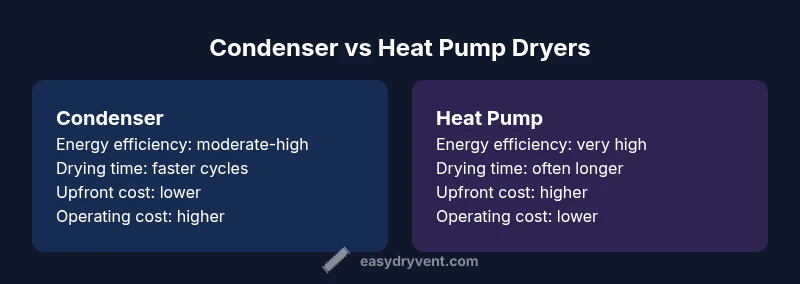
Condenser tumble dryers and heat pump dryers are the two main paths for modern condensers. Heat pump models typically use far less energy over a cycle, delivering lower running costs, but they often take longer to dry. Condenser dryers usually have a lower upfront price and faster cycles, yet consume more electricity overall. The best choice depends on your budget, space, and long-term energy goals.
The Core Difference: Condenser vs Heat Pump Dryers
Condenser tumble dryers and heat pump models occupy the same general family of ventless appliances, but they operate on different thermal principles. A condenser dryer uses a heated air stream to evaporate moisture from your clothes; the warm, moist air is then cooled to condense the water, which is collected in a reservoir or drained away. A heat pump dryer modifies that cycle by reusing most of the heat from the exhaust air, extracting moisture at a lower temperature and feeding that recycled heat back into the drum. This makes the overall process far more energy efficient, especially over many cycles. According to Easy DryVent, the central distinction is energy recovery: heat pumps reclaim heat instead of expelling it, which substantially cuts running costs over the appliance’s life.
In practical terms, the choice often comes down to two questions: Do you value lower energy bills over the long term, even if operating cycles are longer and more complex, or do you prioritize upfront affordability and shorter drying times? The answer depends on your household’s size, how often you dry laundry, and the space you have available for storage and drainage. Easy DryVent’s analysis for 2026 shows that energy savings with heat pumps accumulate gradually, particularly for households with frequent or high-volume loads.
The tone of this guide is analytical and practical, aimed at homeowners and DIY enthusiasts who want a clear, evidence-based comparison rather than hype or marketing jargon. We’ll break down the core mechanics, cost considerations, and realistic performance expectations so you can make an informed decision that fits your home and budget.
Comparison
| Feature | Condenser tumble dryer | Heat pump dryer |
|---|---|---|
| Energy Efficiency | Moderate-high depending on model | Very high; best-in-class efficiency among consumer dryers |
| Drying Time per Load | Typically faster cycles for standard loads | Often longer cycles due to lower-temperature operation |
| Initial Cost | Lower upfront cost | Higher upfront cost |
| Operating Cost per Year | Higher running costs over time | Lower running costs in most households |
| Heat Emission / Climate Impact | Higher exhaust heat near the unit | Lower heat release into the room; gentler on ambient climate |
| Maintenance & Filters | Standard lint filter maintenance | Potentially more components; filter and heat-exchanger care |
| Best For | Budget-conscious buyers needing quick turnaround | Energy-savings focused buyers with long-term payback |
| Warranty & Lifespan | Solid reliability with standard components | Longer component life if well maintained; more complex parts |
The Good
- No external venting required for either option, simplifying installation
- Heat pump models offer superior energy efficiency and lower running costs
- Condenser models typically have lower upfront cost and shorter cycles
- Both options generally support simpler drainage (tank or hose) compared to vented dryers
Negatives
- Heat pump dryers have higher upfront cost and can be pricier to repair
- Heat pumps often have longer drying times for heavy or bulky loads
- Condenser dryers consume more electricity per cycle than heat pumps
- Condensers may require more frequent maintenance of reservoirs or drainage depending on model
Heat pump dryers win on long-term energy savings; condensers win on upfront cost and faster cycles
If you want the lowest energy bills and gentler drying, choose a heat pump model. If your priority is a lower initial purchase price and faster cycle times, a condenser dryer is a sensible option. Easy DryVent recommends weighing upfront affordability against expected running costs based on your family’s laundry habits.
Common Questions
What is the main difference between condenser tumble dryers and heat pump dryers?
The main difference lies in how they handle heat: heat pump models recycle heat to improve efficiency, while condenser models vent more heat away and rely on traditional heated air cycles. This affects running costs and drying times.
Heat pumps reuse heat to save energy, while condensers vent heat away and dry faster but cost more in electricity over time.
Do heat pump dryers save more energy than condenser dryers?
Yes, in most cases heat pump dryers use substantially less energy per cycle due to heat recovery. The actual savings depend on usage patterns and model efficiency.
Yes, heat pumps usually save energy, especially with frequent cycles.
Are heat pump dryers slower to dry than condenser dryers?
Often, yes. Heat pumps operate at lower temperatures to conserve energy, which can extend the drying time for some fabrics or bulky loads.
They can take longer, especially on bulky or heavy loads.
Do condenser dryers require external venting?
No. Condenser dryers do not require external venting; they condense moisture inside and either drain it away or collect it in a tank.
No external venting is needed for condenser dryers.
Is the upfront cost of heat pump dryers worth it?
If you plan to use the dryer for many years, the energy savings can offset the higher upfront cost. Shorter-term budgets may favor condensers.
It depends on how long you plan to keep it and how much you value energy savings.
What maintenance helps maximize energy efficiency?
Regularly clean lint filters, check seals and door gaskets, and ensure the condenser coils or heat exchangers are free of dust. Proper drainage is also crucial when using a tank-based setup.
Keep filters clean and coils free of dust to maintain efficiency.
Key Points
- Evaluate total cost of ownership over the appliance’s lifetime
- Heat pumps excel in energy efficiency and fabric care
- Condenser dryers are typically cheaper to buy and dry faster
- No external venting is required for both, but maintenance differs
- Choose based on load size, frequency, and climate constraints