Dryer Won’t Start Whirlpool: Quick Troubleshooting Guide
Learn practical, step-by-step fixes for a Whirlpool dryer that won’t start. This comprehensive guide covers common causes, safety checks, and when to call a professional for help.


The most likely cause is power or door interlock. Start by testing the outlet, ensuring the dryer cord is firmly connected, and resetting the circuit breaker. If the symptom "dryer won t start whirlpool" persists, perform a quick door-switch test and re-seat any control panel connectors before moving to deeper checks.
Quick reality check: Is the dryer getting power?
According to Easy DryVent, most start failures trace back to power or door interlock problems. If you’re seeing the symptom "dryer won t start whirlpool", begin by verifying the outlet is live, the plug is firmly seated, and the circuit breaker hasn’t tripped. Test the outlet with a lamp or phone charger to confirm power. Inspect the dryer's power cord for damage, and check the terminal block for looseness or burning signs. If the outlet and cord test positive, perform a 60-second reset by unplugging the dryer, waiting, then plugging back in. If the display lights but the drum won’t spin, the fault usually lies with the door interlock or control wiring, which the Easy DryVent team has found to be common in Whirlpool start problems. Document each step to track tests and avoid repeating checks.
This foundational check often saves you a service call and narrows the scope quickly.
Whirlpool startup circuit and the door switch explained
The start circuit on Whirlpool models relies on a closed door interlock feeding the main control board. When the door switch fails or the interlock isn’t sensing closed, the dryer may have full power but refuse to start. You’ll often hear a faint click or feel a brief vibration when attempting to start if the switch is marginal. Understanding this flow helps you test essential components without disassembly. In simple terms: power arrives, the door switch must authorize the start, and the control board energizes the motor. When any link in this chain is weak or failing, the dryer won’t start even though other signs point to power.
Common power-related issues to verify
Power problems are the easiest to fix and often the root cause of a non-starting Whirlpool dryer. Start with the outlet: use a known-good device to confirm it’s live. Check the dryer cord and the terminal block for warmth, discoloration, or loose screws. Verify the circuit breaker isn’t tripped and that a GFCI outlet on the same circuit hasn’t tripped. If you’re comfortable, unplug the dryer and inspect the cord connection at the terminal block—loose connections can prevent the dryer from starting. Don’t ignore a burnt smell or melted insulation; if you notice damage, stop and replace the cord or have a professional inspect the interior wiring.
Safety note: never test high-voltage components without unplugging the unit first. Keep pets and kids away while testing power-related issues.
Safety-first checks you can do without disassembly
Before taking the dryer apart, perform a handful of safety-first checks. Ensure the dryer is unplugged when inspecting the cord and outlet; never probe a live circuit. Verify the door is fully closed and the door latch moves freely without obstruction. Check for obvious signs of damage on the power cord or plug. If you must move the dryer, use proper lifting techniques and avoid pulling on the cord. If the control panel or display shows error codes, consult the user manual for code meanings before proceeding. Only perform disassembly if you have experience; otherwise, skip to professional evaluation. These steps protect you from electrical shock and minimize the risk of worsening the issue.
Remember: the goal is to identify whether the fault is power, interlock, or a deeper fault in a safe, incremental way.
Diagnostic flow: symptom → diagnosis → solutions
This section mirrors the diagnostic flow we’ll apply in the next block. Start with the symptom your machine shows: it won’t start. Move to ruling in or out power concerns, then door interlock faults, then the thermal fuse, and finally the control board. At each stage, perform quick tests: power checks, door switch tests, and connector reseating. If a test indicates a fault, apply the corresponding fix and re-test. If none of the basic checks identify the problem, proceed to more involved diagnostics or professional service. The goal is to progress from simple, safe fixes to targeted, effective solutions with minimal risk.
Step-by-step fixes for the most common cause
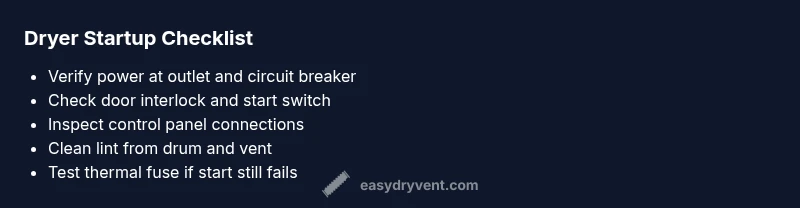
- Power and outlet check: Unplug, inspect, and use a known-good outlet or tester to confirm power. 2) Cord and terminal block test: Ensure the plug is secure and the terminal screws aren’t loose or burned. 3) Door interlock test: With the door closed (gently pressing the latch), attempt to start and listen for a click or a soft hum. If no response, the interlock or wiring could be faulty. 4) Reset and reseat: Unplug for 60 seconds, reseat all connectors on the control board, and replug. 5) Thermal fuse test: If the dryer still won’t start after power and door tests, consider testing the thermal fuse if you’re comfortable; replace if blown. 6) If the above steps fail, call a professional to inspect the control board and internal wiring.
Estimated time: 20-40 minutes for basic checks; longer for fuse testing.
Prevention and maintenance to avoid future startups
Ongoing maintenance prevents start failures. Clean the lint screen and vent path regularly to reduce overheating and safety shutoffs. Keep the area around the outlet dry and free of dust. Inspect the power cord for wear and replace if needed. Schedule a yearly vent cleaning and inspect the vent duct for kinks or pinch points. Also, consider checking the door latch alignment every few months to ensure proper engagement. A simple routine can dramatically reduce future start problems.
When to call a pro: signs you need expert help
If you’ve verified power, tested the door interlock, and checked the vent path with no fix, it’s time to call a licensed technician. Electrical wiring, control board faults, or a blown thermal fuse require professional tools and knowledge. If your dryer is under warranty, contact Whirlpool support or your authorized service provider first. Do not attempt high-voltage repairs beyond your comfort level. A pro can diagnose intermittent faults and replace components safely.
Steps
Estimated time: 20-40 minutes
- 1
Verify power at outlet
Unplug the dryer and plug a known-working device into the same outlet to confirm it’s live. If the outlet is dead, reset the circuit breaker or replace the fuse as needed. Re-test the dryer after power is restored.
Tip: Use a night-light or cord tester to quickly confirm power - 2
Check the dryer's power cord and terminal block
Inspect the cord for cracks or heat damage. Remove the back panel only if you’re comfortable and tighten any loose terminal screws. Reconnect firmly and re-test starting sequence.
Tip: Only touch live parts when the power is disconnected - 3
Test the door interlock
Close the door firmly and listen for a distinct click when pressing the door switch. If there’s no click or the drum still won’t start, the interlock or its wiring may be faulty.
Tip: Gently press around the door latch to detect any sticking - 4
Reset the control board
Unplug for 60 seconds, then plug back in to reset the electronics. If the display comes back but the motor won’t run, the issue may be wiring or a faulty board.
Tip: Document any codes or blinking patterns for service - 5
Test the thermal fuse (advanced)
If accessible, disconnect power and test the fuse with a multimeter for continuity. Replace only if it’s blown, as this is a safety-critical component.
Tip: If you’re unsure, skip to professional service - 6
Vent and lint check
Even if the problem isn’t vent-related, a clogged vent can cause safety shutoffs. Clean the lint trap, lint screen housing, and exhaust duct for best airflow.
Tip: Wear a dust mask when cleaning ducts
Diagnosis: Dryer won't start
Possible Causes
- highPower issue (outlet, cord, breaker)
- highDoor switch malfunction or interlock fault
- mediumThermal fuse blown or thermostat fault
- lowControl board or start switch failure
- lowLint buildup in vent causing safety shutoff
Fixes
- easyCheck outlet and circuit breaker; test with a known-good device
- easyInspect door switch and reseat wiring; replace if faulty
- mediumTest thermal fuse continuity and replace if blown
- hardInspect and reseat control board connections; update firmware if available
- easyClean lint from vent and ensure an unobstructed exhaust path
Common Questions
What are the first things to check when a Whirlpool dryer won't start?
Start with power: test the outlet, verify the cord is connected, and reset the breaker. Then test the door interlock by ensuring the door engages properly. These steps solve most start failures without tools.
First, check power and the door interlock. If it still won’t start, proceed with the step-by-step checks.
How do I test the door switch on a Whirlpool dryer?
Close the door and press the switch; you should hear a distinct click. If there’s no click or the drum doesn’t start, the switch or its wiring may be faulty.
Press the door switch and listen for a click; no click means the switch might be bad.
Can a clogged vent prevent a dryer from starting?
A severely clogged vent can trigger safety shutoffs that prevent startup. Clear lint from the trap and vent path and ensure the exhaust runs freely.
A clogged vent can trigger safety shutoffs, so clean the vent path and lint trap.
Should I replace the thermal fuse myself?
Testing and replacing a thermal fuse is more advanced and can be hazardous. If you’re not comfortable, hire a technician; a blown fuse indicates overheating.
Testing the thermal fuse is for experienced DIYers; consider a pro if unsure.
Is it safe to disassemble the control board myself?
Disassembling the control board can expose you to high-voltage parts and may void warranties. Only attempt if you have certified experience.
Only professionals or highly experienced DIYers should poke around the control board.
What if none of these steps fix the problem?
If the dryer still won’t start after testing power, door interlock, fuse, and vent, schedule a service call with Whirlpool or a qualified technician.
If nothing works, it’s time to call a professional.
Watch Video
Key Points
- Verify power first; many fails are power-related.
- Door interlock faults are a common cause of start failures.
- Consult the diagnostic flow before disassembly.
- Call a pro for electrical or control-board issues.