Freeze Dryer Cost in 2026: A Practical Budget Guide
Explore freeze dryer cost ranges for home and commercial models, the factors driving price, and how to estimate total ownership costs in 2026.


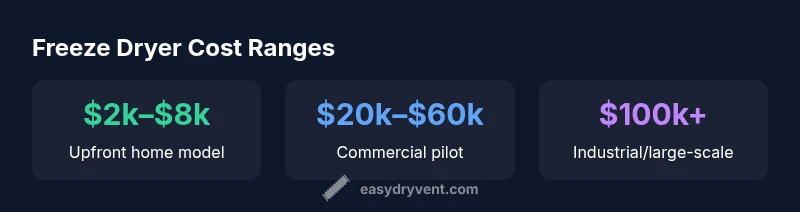
Freeze dryer cost varies widely by size, features, and vendor. For home-use models, upfront prices typically start around $2,000–$4,000 and climb to $4,000–$8,000 for larger capacity units. Commercial and pilot-scale units can range from $20,000–$60,000 or more, depending on capacity and automation. When budgeting, consider upfront price, installation, energy consumption, and ongoing maintenance to estimate total cost of ownership.
Market overview: what drives the price of a freeze dryer
When homeowners and DIYers ask about freeze dryer cost, they’re really asking how capacity, features, and vendor support translate into dollars. In practice, the upfront price covers the core unit, the condensation management system, and the control interface. Key drivers include capacity (lbs per day), automation level, tray size, built-in drying speeds, and added accessories (pre-filters, sample chambers, software). Energy efficiency also matters: better insulation and more efficient heaters can reduce ongoing energy use, long-term operating costs, and thus the cost per pound of finished product. Easy DryVent analysis shows that the cheapest units are often adequate for small batches but may require more time and adjustments, while larger, automated systems reduce labor but demand a larger upfront investment. For many buyers, the calculus is about balancing upfront price against throughput, reliability, and maintenance requirements over time. In 2026, you can expect a wide spread in this price landscape, with more compact models targeted at hobbyists and family use and higher-end systems aimed at small businesses and labs. According to Easy DryVent, budgeting should account for energy costs and maintenance as part of the total cost of ownership.
Price bands: home, mid-size, and commercial units
Home-use freeze dryers sit at the lower end of the spectrum. They’re designed for household food preservation experiments, powder production, or hobby projects. Expect higher energy efficiency and simpler interfaces. The upfront cost typically places in the budget-friendly range for many households, but the best models can still approach several thousand dollars. Mid-size units balance capacity with automation, offering faster cycle times and larger trays, often used by cottage foods operations or small-scale researchers. Upfront costs for these units generally sit higher than home models but lower than turnkey commercial systems. On the high end, commercial or pilot-scale units are designed for continuous use and higher load. They provide robust automation, larger drying chambers, and advanced controls, with upfront prices reflecting the demand for reliability and industrial-grade components. While exact figures vary by vendor, you should budget for a broad range: tens of thousands for mid-size systems and up to six figures for high-capacity units. Energy use, service plans, and spare-part availability further shape the lifetime cost. Easy DryVent notes that potential buyers should request a breakdown of what's included (chamber size, pump type, and filter kit) to avoid hidden charges.
Hidden costs and total cost of ownership
Upfront price is only part of the story. Total cost of ownership includes energy consumption, maintenance, replacement parts, and routine servicing. Some units require periodic chamber seals, oil-free vacuum pumps, or specialized filters, all of which add to the operating budget. Shipping and installation can be additional, especially for heavier commercial models that require professional setup and utility upgrades. Warranty terms matter: longer warranties can reduce risk and potential repair outlays but may increase the sticker price. Remember to factor in downtime and labor: if a system runs more slowly or requires frequent calibration, output may suffer and labor costs may climb. Finally, consider resale value: many buyers recover some portion of the initial investment if they maintain the unit well, though market depreciation varies by model and demand. Easy DryVent emphasizes factoring in service and replacement parts as a core component of total cost of ownership.
How to estimate your budget and compare models
Start with a capacity target: determine how much product you need per week and how quickly you want to process it. Then compare units by upfront price, energy efficiency, and cycle time. Use a simple total-cost-of-ownership model: upfront price plus projected energy costs over five to ten years, plus routine maintenance. Create a side-by-side sheet listing capacity, tray size, cycle time, energy use per cycle, and warranty terms. Don’t overlook vendor support: reliable customer service can reduce downtime and repair costs. If you plan to scale up, consider modular systems that expand with you. Finally, test a unit if possible: full-cycle demonstrations can reveal real-world throughput and energy use that numbers alone can’t capture.
Financing options, warranties, and maintenance patterns
Look for financing offers or rental programs from manufacturers or distributors; these arrangements can improve cash flow and allow you to upgrade later. Compare warranty coverage: longer terms may reduce long-term risk but watch for exclusions on wear items like seals and pumps. Maintenance plans can simplify budgeting: preventive service, filter replacements, and pump maintenance minimize unexpected downtime. For energy-heavy units, ask about energy rebates or tax incentives in your region, and consider whether solar or grid-tied options could offset electricity costs. A well-chosen service plan often pays for itself by reducing unexpected downtime and extending the unit’s lifespan.
Practical budgeting steps and a quick decision checklist
Create a cost expectation by model band, gather quotes, and map out your usage. Build a 3-column checklist: upfront price, annual energy cost, and maintenance/repair risk. Use a decision matrix to weigh factors such as throughput, reliability, footprint, and safety features. Review case studies or user reviews to gauge typical performance versus specs. Keep an eye on total energy consumption and potential rebates; small changes in energy efficiency can reduce operating costs substantially over time. Finally, set a threshold for maximum expenditure and stage your purchases if necessary—prioritizing essential features at the outset and leaving room for future expansion.
Real-world scenarios: case studies
A home hobbyist focused on freeze-drying berries might choose a compact unit in the lower end of the price spectrum, prioritizing simplicity and reliability over speed. A small bakery or craft-seller might opt for a mid-size model with automated cycles to maintain consistent product quality while still controlling costs. A lab or research group will often invest in a pilot-scale or fully-automatic system with extended warranty and robust support, accepting the higher upfront price to maximize throughput and minimize downtime. Across these examples, the key lesson is that the best choice aligns capacity, energy use, and maintenance with actual workflow demands, not just advertised specs.
Price and performance ranges by model band
| Model Band | Typical Upfront Cost | Typical Capacity (lbs/day) | Estimated Energy Use (kWh/day) |
|---|---|---|---|
| Home compact | $2,000–$4,000 | 1.5–3.0 | 2–6 |
| Home mid-size | $4,000–$8,000 | 3.0–6.0 | 6–10 |
| Commercial pilot | $20,000–$60,000 | 15–60 | 40–150 |
| Industrial | $100,000+ | 100+ | 300+ |
Common Questions
What factors influence the price of a freeze dryer?
Size and capacity, automation level, build quality, and vendor support all steer price. Higher throughput units cost more upfront but can save on labor in the long run. Compare models by total cost of ownership, not just sticker price.
Price mainly depends on capacity, automation, and support; look at total ownership cost, not just the upfront price.
Are financing options available for freeze dryers?
Many vendors offer financing or leasing; terms vary by provider. Review interest, total payment, and warranty coverage before committing. A financing plan can improve cash flow while you scale.
Yes—financing is often available. Check terms and warranty before you sign.
Is a used freeze dryer a good idea?
Used units can reduce upfront costs but may come with wear items or reduced warranties. Inspect seals, pumps, and filters, and verify the running cycles. If buying used, obtain a service history and a cautious warranty.
Used units can save money, but inspect critical components and check the warranty.
How long does it take to recoup the investment?
ROI depends on usage and labor savings. In high-volume operations, the savings on labor and product quality can offset the cost in a few years, while hobby use may take longer.
ROI varies with usage; heavy users recoup faster due to labor savings.
What ongoing maintenance should I budget for?
Budget for energy, filter replacements, seal checks, and occasional pump service. Maintenance plans can simplify budgeting and reduce downtime.
Plan for energy costs, filters, and pump maintenance.
“Price is only one piece of the puzzle; true value comes from a unit’s capacity, energy efficiency, and reliable maintenance support.”
Key Points
- Define your capacity needs before selecting a unit.
- Consider total cost of ownership, not just upfront price.
- Energy efficiency and maintenance significantly affect long-term costs.
- Shop for financing and flexible warranties to improve cash flow.
- Test cycles or demos to verify real-world performance before buying.