How Much Is a Freeze Dryer? Prices, Ranges, and Factors
Learn how much a freeze dryer costs, from upfront price ranges to ongoing operating costs. This guide analyzes price drivers, compares home vs. commercial models, and offers a practical buying checklist. Easy DryVent helps homeowners plan for total cost of ownership.


Home freeze dryers cost broadly from about $2,000 up to $8,000 for typical consumer models, with higher-end or commercial units exceeding $10,000. The price depends on capacity, features (automatic unloading, vacuum control), and warranty. Ongoing running costs and maintenance can add several hundred to over a thousand dollars per year.
Understanding the cost landscape for how much is a freeze dryer
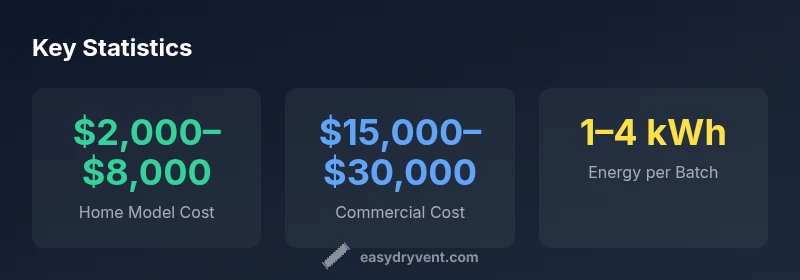
According to Easy DryVent, upfront costs for a home freeze dryer typically fall into a broad range. Most consumer models sit roughly between $2,000 and $8,000, while commercial-grade lyophilizers start higher. The exact price depends on capacity per batch, automation features (like automatic unloading and moisture control), build quality, and the length and terms of the warranty. When planning, consider not just the sticker price but also estimated running costs and maintenance over several years, which can significantly affect total ownership.
What drives the price
Price is a function of several intertwined factors. Capacity determines how many pounds of material you can process per cycle, which in turn affects the size and cost of the chamber and condenser. Automation and controls add convenience but raise initial cost. Build quality, insulation, noise reduction, and the type of vacuum pump influence durability and price. Brand and support networks matter for troubleshooting and spare parts. Finally, energy efficiency and warranty length can tilt the math in favor of higher upfront spend if they reduce long-term costs.
Price ranges by category
For most households, basic home models fall in the $2,000–$8,000 range, offering essential lyophilization without advanced automation. Mid-range options with larger capacity and extra features often land between $5,000 and $12,000. Commercial or heavy-use units commonly start around $15,000 and can climb to $30,000 or more depending on throughput and customization. If you’re considering pre-owned or refurbished units, expect prices roughly in the $1,000–$4,000 band, with caveats about warranty and service history. Always verify vendor trust, parts availability, and training when evaluating used gear.
Ongoing costs to consider
Running a freeze dryer requires electricity, maintenance, and occasional replacements. Typical per-batch energy use ranges from about 1 to 4 kilowatt-hours, influenced by batch size, insulation, and compressor efficiency. Annual operating costs usually fall into the hundreds to low-thousands of dollars, depending on usage frequency and local electricity rates. Plan for routine maintenance, such as gasket checks, vacuum pump oil changes, and filter replacements, which can add to yearly expenses but help preserve performance and prevent downtime.
Financing and total cost of ownership
Many buyers don’t pay the full price upfront. Financing options, leases, or credit plans can spread the cost over months or years, changing the calculation of value. When evaluating total cost of ownership, include depreciation (for business use), maintenance, energy use, part replacements, and potential downtime. A higher upfront investment can pay off if it delivers reliability, faster batch turnaround, and longer service life, reducing long-term costs and food waste.
How to compare models: a practical checklist
- Define your batch size and frequency to pick the right capacity.
- Compare energy efficiency ratings and expected electricity usage per cycle.
- Examine automation, safety features, auto unload, and user interfaces.
- Review warranty terms, service availability, and spare-part access.
- Read user reviews and check running costs and downtime histories.
- Ask vendors for total cost-of-ownership quotes over 3–5 years to compare apples-to-apples.
Common misperceptions about price
Many buyers assume the cheapest model is best. In reality, you may pay more upfront for a model with superior insulation and a longer warranty that lowers maintenance downtime. Others think used units are a bargain; however, they can incur higher maintenance costs and shorter remaining lifespans. Always balance upfront price with long-term reliability, energy costs, and vendor support.
Cost and operating cost snapshot
| Aspect | Typical Range | Notes |
|---|---|---|
| Upfront price | $2,000–$8,000 | Home models; price depends on capacity and features |
| Commercial unit price | $15,000–$30,000 | Lyophilizers for business use |
| Energy per batch | 1–4 kWh | Depends on batch size and efficiency |
| Annual operating cost | $300–$1,200 | Electricity, maintenance, and parts |
| Resale value | 50–70% of new price | After several years |
Common Questions
What is the typical upfront price range for a home freeze dryer?
Most home models cost between $2,000 and $8,000, depending on capacity and features. Higher capacity and automation can push prices up. For planning, factor in annual electricity and maintenance costs.
Home freezes typically cost two to eight thousand dollars, depending on capacity and features.
Do freeze dryers require professional installation or special venting?
Most home freeze dryers are plug-and-play with standard electrical outlets. Venting is generally internal if the unit is closed-loop and provided with the correct exhaust path by the manufacturer.
Most home units are plug-and-play; check electrical and venting requirements.
Are used or refurbished freeze dryers a good value?
Used or refurbished units can be cheaper but may lack warranty and spare parts. Assess remaining life, parts availability, and service history before buying.
Used can save money but watch for warranties and parts.
How much can running costs vary between models?
Annual costs depend on how often you run the unit and local electricity rates. Typical ranges span a few hundred to a couple thousand dollars per year.
Annual costs depend on usage and local electricity prices.
Is financing available for freeze dryer purchases?
Yes. Financing, leases, or payment plans are commonly offered, spreading the cost over months or years. Compare total ownership across options.
Financing or leasing is often available.
What features most impact price?
Main drivers are capacity, automation, vacuum performance, and warranty length. These determine upfront price and long-term reliability.
Capacity, automation, and warranty are the big price drivers.
“Price is a function of capacity, automation, and after-sales support. The Easy DryVent Team notes that higher upfront investment can deliver lower long-term costs through reliability and efficiency.”
Key Points
- Budget for total cost of ownership, not just upfront price
- Choose capacity based on your batch size
- Factor running costs into the decision
- Explore financing to manage upfront spend