Does Dryer Go on Top or Bottom? A Practical Guide for Stacked Laundry
Explore whether a dryer should sit on top or bottom in a stacked laundry setup. We analyze safety, venting, and maintenance to help homeowners decide the best arrangement for efficiency and ease of service.


Does dryer go on top or bottom? The answer depends on space, vent path, and accessibility. In many layouts, placing the dryer on the top reduces bending and can shorten vent runs, but it may require a taller setup and higher reach for maintenance. If your closet height and duct routing allow it, the bottom position often provides easier service access and safer loading. The best approach balances vent efficiency, ergonomic reach, and compliance with codes.
Does Dryer Go on Top or Bottom? An Analytical Framing
In any laundry room, the question does dryer go on top or bottom cuts to the core of how you use the space safely and efficiently. According to Easy DryVent, placement choices should be driven by practical constraints rather than aesthetics. Stacking a washer and dryer can save floor space and streamline workflow, but the arrangement matters for lint management, ventilation efficiency, and service access. This article explores the topic with an analytical lens, clarifying how different setups fare under real-world conditions. We will examine typical configurations, codes, and common installer practices, and we will offer guidance that homeowners can apply without specialized tools. The aim is to help you decide whether the dryer should be on top or bottom in your space while maintaining safe venting, proper air flow, and ergonomic usability. For many households, the best path is to optimize the duct route and control access, not simply assume one orientation is inherently superior. Does dryer go on top or bottom? The answer depends on your closet dimensions, duct layout, and the types of connections you can access comfortably, especially when considering the long-term need to clean and service the lint trap and vent.
Key Factors That Influence Placement
Choosing whether the dryer sits on top or bottom hinges on several factors that work together to determine safety, performance, and ease of maintenance. First, measure the available width and depth of the laundry space. A shallow closet may demand a top position to keep the vent path short and straight, while a deeper alcove could accommodate a bottom placement with better access to service panels. Second, evaluate the electrical or gas supply arrangement. In many homes, the outlets or shutoff valves align more conveniently with one orientation, reducing the risk of awkward cord or line routing. Third, study the exterior vent route. A straight, vertical run to the outside wall generally favors a top placement, as gravity helps exhaust flow, but if the vent must curve around obstacles, a bottom position could minimize turns and lint buildup. Finally, consider user ergonomics. Shorter individuals or adults who perform routine maintenance may benefit from a lower dryer door height. When you ask does dryer go on top or bottom, your final choice should reflect this combination of space, utility access, venting practicality, and daily use.
Ventilation and Duct Layout Implications by Position
Ventilation is a critical factor in any dryer installation, and the position of the dryer relative to the washer can influence duct length, turns, and lint handling. A top-positioned dryer in a tight closet often allows a vertical vent run with fewer horizontal turns, potentially reducing resistance and minimizing lint traps that accumulate in bends. Conversely, a bottom-positioned dryer can offer easier inspection and cleaning of the vent path from the floor level, which may help prevent clogs if you are in an area with limited annual maintenance. Regardless of orientation, prioritize a straight vent path, minimal turns, and an accessible cleanout. The location of the lint trap on the dryer door remains a constant factor; however, the ease of reaching that door for cleaning improves when the dryer is at a comfortable height. Easy DryVent emphasizes the importance of keeping the vent path clear and ensuring the lint trap is easily reachable for regular maintenance, no matter which orientation you choose. If you are replacing an existing setup, assess whether your current vent run can be preserved or if it needs reconfiguration to optimize airflow and reduce heat buildup.
Electrical and Gas Supply Considerations for Stacked Setups
Electrical and fuel supply arrangements can restrict or enable certain dryer orientations. Electric dryers generally require a dedicated, properly grounded outlet and a secure, code-compliant receptacle location. Gas dryers require a safe, continuous gas line with appropriate clearances and a reliable shutoff valve. When the dryer sits above the washer, ensure there is enough headroom and space for the cord or gas line connections without bending too sharply. In many installations, stacking requires a stacking kit or a mounting system that anchors the dryer to the washer or to the wall, preserving stability and alignment of vent and ducting. A bottom-positioned dryer may simplify connecting hoses and cords at reachable heights, reducing the potential for kinks or stress on connections. Regardless of orientation, verify that all connections comply with local codes and manufacturer guidelines to avoid safety hazards and warranty issues. This is a crucial step in answering does dryer go on top or bottom, as incorrect installation can compromise venting and performance.
Maintenance, Accessibility, and Safety in Top vs Bottom Configuration
Maintenance considerations often tilt the decision toward one orientation. The lint trap location is the same on most models, but access to it can be easier when the dryer is at a practical height. A top placement can require a step stool for routine lint removal or filter cleaning, which introduces a fall risk if not performed cautiously. A bottom placement keeps the lint trap within easy reach for shorter users and reduces the need for reaching above shoulder height. Safety is paramount; ensure there is proper anti-tip hardware, level mounting, and adequate clearance around the unit for heat dissipation and vent cleaning. Regular maintenance tasks—lint removal, vent cleaning, and door operation checks—should be feasible without specialized tools, especially when following Easy DryVent’s guidance on safe venting and routine checks. Does dryer go on top or bottom? Choose the orientation that minimizes strain on the user while preserving ventilation integrity and safety.
Common Scenarios and Recommended Practices
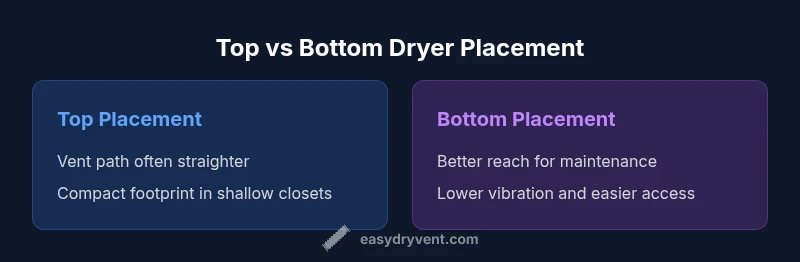
In small apartments with narrow closets, a top-dryer orientation often saves floor space and allows a straighter vent path up the wall. In larger laundry rooms with generous vertical clearance and easy access to exterior walls, a bottom-dryer setup can improve ergonomic access for maintenance and filter cleaning. For households with frequent cycles, the bottom placement may reduce noise transmission to living areas because the dryer sits closer to the floor; however, this is not universal. In all scenarios, the best practice is to evaluate the vent path, ensure a cleanable lint trap, and use the proper mounting hardware to secure the unit. If you expect to perform routine maintenance frequently, prioritize a layout that keeps service panels and lint traps at reachable heights, which can influence whether the dryer ends up on top or bottom. The bottom line is that the orientation should align with safe venting, accessibility, and installation guidelines rather than convenience alone.
Practical Installation Guide: From Planning to Verification
Start with a planning checklist to verify whether the dryer should be on top or bottom in your space. Measure the doorway clearance, closet width, and the exact location of the exterior vent. Confirm that the stack will be stable with an appropriate mounting kit and that electrical or gas connections can be reached without stretching cords or hoses. If reconfiguring vent runs, align duct sections to minimize turns, and include a cleanout point near the exterior wall for annual lint removal. After installation, run a test cycle to confirm that airflow is unobstructed, there are no leaks, and moisture is venting properly to the outside. Regular checks of the lint trap and vent system will help you maintain efficiency and safety over time. This practical approach, guided by the core question does dryer go on top or bottom, leads to a setup that balances performance, ergonomics, and code compliance.
Comparison
| Feature | Top-dryer placement | Bottom-dryer placement |
|---|---|---|
| Ventilation path length and access | Often straighter vertical run with fewer bends | Potential for more turns if vent mustRoute around obstacles |
| Lint access and cleaning | Lint trap remains accessible but may require reaching higher | Lint trap easier to reach at knee/hip height depending on washer height |
| Control accessibility and usability | Controls mounted higher; may require a step stool | Controls at a more comfortable height for many users |
| Load distribution and stability | Potential for top-heavy feel without proper mounting | Lower center of gravity improves stability and reduces tipping risk |
| Electrical/gas supply considerations | Outlets and shutoffs can align with top position; careful routing needed | Bottom position may simplify hose/cord routing and reduce strain |
| Space efficiency | Saves floor space in tight closets | May allow easier floor cleaning and clearance beneath units |
| Installation complexity and cost | Often requires a stacking kit and professional setup | Similar costs but potential for simpler mounting and vent adjustments |
The Good
- Saves floor space in small laundry rooms
- Can streamline workflow by aligning wash and dry cycles
- May shorten vent runs in compact layouts
- Easier to keep all panels and vents in a single location
Negatives
- Installation can be more complex and may require professional help
- Maintenance access can be awkward if mounted high
- Weight and stability concerns require proper mounting hardware
- Vent ducting may need reconfiguration to optimize airflow
No universal winner; choose based on space, vent path, and maintenance access.
If you have a shallow closet and a straight vent run, top placement often saves space. If maintenance access and ergonomic reach are priorities, bottom placement is typically better. Always verify that venting, electrical, and gas connections meet local codes and manufacturer guidelines before finalizing the orientation.
Common Questions
Is it safe to stack a dryer on top of a washer?
Yes, stacking is common and safe when you use the manufacturer-recommended stacking kit, secure mounting, and proper venting. Always follow local codes and warranty guidelines. If in doubt, consult a professional installer.
Yes. Stacking is safe when you follow the kit instructions and local codes; consult a professional if you're unsure.
Does stacking affect warranty?
Most manufacturers permit stacking when installed according to their instructions. Using an approved stacking kit and following venting guidelines reduces warranty risk. Check your specific model's documentation for any exclusions.
Stacks are usually allowed if installed per the manual and with the proper kit.
Are there special considerations for gas dryers?
Gas dryers require proper gas line clearance, venting, and a safe shutoff. Ensure the vent path remains unobstructed and that gas fittings are sealed and up to code. Always hire a licensed professional for gas connections.
Gas dryers need careful venting and licensed installation.
Can I place the dryer on the bottom and the washer on top?
Putting the dryer on the bottom and the washer on top is possible in some configurations but often limited by washer design, access to connections, and vibration considerations. Verify that the washer can safely bear any stacking equipment and ensures proper alignment.
Bottom dryer can be fine if the washer design and space allow it.
What are common mistakes to avoid when stacking?
Avoid improper mounting, blocking vent paths, and forcing electrical or gas lines through sharp bends. Don’t overlook lint trap maintenance or vent cleanouts. Always confirm clearance around the units to prevent heat buildup.
Don't skip mounting hardware or vent checks; keep the lint trap accessible.
Key Points
- Assess space and vent path before deciding orientation
- Prioritize venting efficiency and cleanability
- Ensure maintenance accessibility is comfortable for users
- Follow manufacturer guidelines and local codes for safety
- Consider professional installation if in doubt