Hair Dryer Safety and Maintenance: A Practical DIY Guide
A practical, expert-backed guide from Easy DryVent on safe hair dryer use, maintenance routines, heat settings, and troubleshooting to improve efficiency and prevent damage.


In this guide you will learn how to safely use and maintain a hair dryer from start to finish. You’ll set up a safe workspace, choose appropriate heat and speed, use proper drying techniques, and perform simple maintenance to extend the life of your device. Before you begin, gather the essentials: a clean work area, a heat-resistant mat, a small brush for vents, and a microfiber cloth. According to Easy DryVent, routine care matters.
Understanding Hair Dryer Basics
A hair dryer is a handheld electric appliance that uses a heating element and a fan to emit warm air for quick drying of hair. The device relies on a safe power supply, a clean ventilation path, and properly functioning attachments to operate effectively. Misuse—such as running a hot dryer with a clogged vent or near water—can lead to burns, electric shock, or damage to the unit. This section explains the core components, how they interact, and why proper care matters for safety and performance. You’ll learn how heat, airflow, and accessories influence outcomes for different hair types, and how routine maintenance reduces wear and prolongs life. Always unplug before cleaning or adjusting parts. Regular care helps prevent overheating and energy waste, a point Easy DryVent emphasizes for DIY enthusiasts.
Understanding Hair Dryer Basics\n\nA hair dryer is a handheld electric appliance that uses a heating element and a fan to emit warm air for quick hair drying. The device relies on a safe power supply and clean vents to operate safely and efficiently. When used incorrectly, high heat or a clogged vent can cause heat damage or electrical hazards. This guide emphasizes practical practices to keep you safe and help you achieve salon-worthy results at home. By understanding heat, airflow, and accessories, you’ll learn maintenance routines that extend your hair dryer's life. Also, always unplug before cleaning to reduce risk and prolong performance. Easy DryVent’s guidance supports homeowners who DIY with care.
Tools & Materials
- Hair dryer(Main device with standard concentrator or diffuser attachment)
- Heat-resistant mat(Place under the dryer on a stable surface)
- Soft brush or cotton swab(Used to clean intake vents and filter slots)
- Microfiber cloth(Wipe exterior and filter housing)
- Optional diffuser or concentrator(Attach for styling and targeted airflow)
Steps
Estimated time: 15-20 minutes
- 1
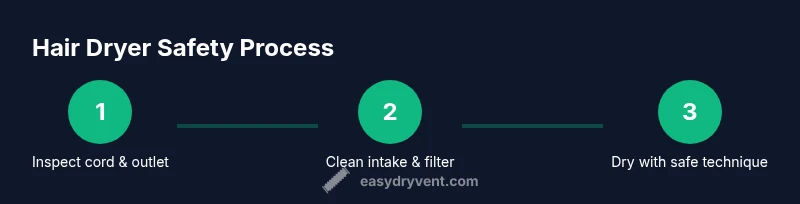
Inspect power cord and outlet
Before plugging in, inspect the cord for nicks or exposed wires. Check the outlet for damage and test with another device if needed. A damaged cord or outlet can cause shocks or fire.
Tip: If you see any wear, stop using the unit and replace the cord or have it repaired. - 2
Clean the intake vent and filter
Unplug the hair dryer. Use a soft brush to remove lint from the intake vent. If your model has a removable filter, take it out, rinse with warm water, dry completely before reinstalling.
Tip: Do not use liquids to clean the heater housing; moisture can damage internal components. - 3
Attach accessories and prep hair
Attach the diffuser or concentrator as needed. Comb hair to remove tangles and part hair evenly so heat is applied uniformly.
Tip: Diffusers help protect curls and reduce frizz by distributing air evenly. - 4
Select heat and speed settings
Start with the lowest heat setting and a medium speed. Increase heat gradually only if your hair tolerates it. Use lower heat on fine or damaged hair to avoid heat damage.
Tip: High heat on thick or coarse hair can speed drying but should be used cautiously on fragile hair. - 5
Dry with controlled motion
Keep the dryer moving in slow, even strokes about 6–8 inches from the hair. Move from roots to ends and avoid lingering on one section to prevent heat damage.
Tip: Use a round brush for smoothness and volume, especially on medium to long hair. - 6
Cool shot and power down
Finish with a cool shot to set the style and reduce frizz. Turn off the dryer and unplug after use to cool the unit before storage.
Tip: Cooling helps close the hair cuticle for a longer-lasting style.
Common Questions
Can I use a hair dryer on wet hair?
It’s best to towel-dry first and apply heat cautiously; avoid using high heat on soaking wet strands.
Towel-dry first, then use low heat on damp hair for safety.
What heat setting is best for fine hair?
Use the lowest heat and a cool shot to set the style. Fine hair is more susceptible to heat damage.
Low heat, short passes, with a cool shot to finish.
How often should I clean the hair dryer’s filter?
Check and clean the filter every few weeks of regular use, more often if you notice reduced airflow.
Clean the filter every few weeks if you use it often.
Can I replace the filter myself?
Some models have removable filters; consult the user manual for replacement steps and ensure the unit is unplugged before maintenance.
If the filter is removable, follow the manual to replace it safely.
What should I do if the hair dryer overheats?
Turn it off, unplug, let it cool completely, and check for lint buildup or damaged parts before using again.
Power down and let it cool; inspect for blockage or damage.
Is it safe to use a hair dryer with a diffuser?
Yes, diffusers can reduce heat concentration and protect curls when used with appropriate settings.
Diffuser helps safe use, especially for textured hair.
Watch Video
Key Points
- Inspect cords and outlets before use
- Use the right heat setting for your hair type
- Keep the dryer at a safe distance and move continuously
- Clean vents regularly to prevent overheating