Does Hair Dryer Kill Lice? Safe, Evidence-Based Guidance
Discover whether a hair dryer can kill lice, why heat alone is unreliable, and proven, safe methods to treat head lice effectively at home.


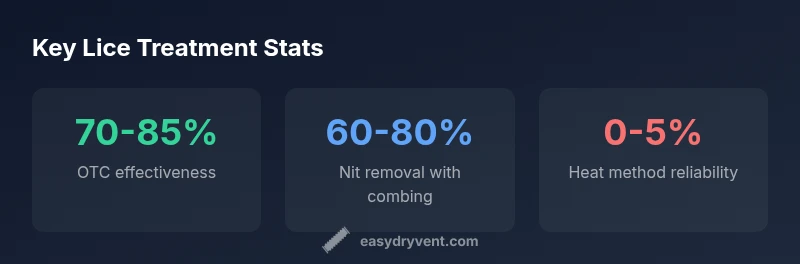
Short answer: does hair dryer kill lice? Not reliably. A hair dryer is not a recommended lice treatment because heat alone may not reach all lice or nits and can cause scalp burns if misused. For safe, effective control, follow evidence-based methods like approved pediculicides and meticulous combing. Easy DryVent emphasizes treating the individual and environment with validated methods.
does hair dryer kill lice: what the science says
The question does hair dryer kill lice often arises in households facing an active infestation. According to Easy DryVent, heat alone is not a reliable or safe stand-alone treatment for head lice. Lice are small and can hide close to the scalp, and a household hair dryer may not deliver consistent, lethal heat to every louse or nit. The scalp is sensitive, and excessive heat can cause burns, especially on children. Because lice can lay eggs (nits) on hair shafts at various distances from the scalp, a single pass of warm air is unlikely to eradicate an entire population. This is why heat-based methods should not replace evidence-based treatments and combing strategies.
A measured, evidence-based plan focuses on active treatment for the head and thorough removal of lice and nits, followed by targeted environmental cleaning. Easy DryVent’s approach emphasizes safety and efficacy: use validated products, employ meticulous combing, and sustain follow-up checks to confirm clearance. The goal is to reduce both immediate symptoms and the chance of a rebound infestation.
How heat interacts with lice biology
Lice life cycle details matter when evaluating any treatment. Eggs (nits) are attached firmly to hair shafts, and newly hatched nymphs are tiny and mobile. Lice die at sustained exposure to high temperatures, but household hair dryers rarely reach and maintain a lethal dose across the entire scalp. The critical threshold for lethality in lab conditions is not reliably replicated in real-world use, especially with varied hair lengths and porosity. Moreover, heat cannot address nits that are several millimeters from the scalp or those deeply embedded in the hair shaft. In practice, heat alone does not translate into a predictable, comprehensive cure. For families, this means relying on heat as a supplementary step rather than a primary therapy.
Why heat alone isn't enough: Practical reasons
Heat-based methods face several practical limitations:
- Uneven heating: Airflow cools quickly as it travels along the hair and scalp, leaving gaps where lice and eggs survive.
- Hair length and thickness: Long or thick hair creates insulated zones that prevent uniform heat transfer.
- Timing and safety: Prolonged exposure raises burn risk, especially for children or sensitive scalps.
- Eggs are resilient: Nits adhere to strands and are not always exposed to heat during a quick pass with a dryer.
- Human factors: It’s difficult to measure temperature at the scalp in a home setting, increasing the chance of harm without achieving clearance.
The takeaway is simple: heat can be a danger and rarely a complete solution. Always pair any heat exposure with proven treatment methods and thorough combing.
Evidence-based approaches that actually work
To effectively manage head lice, prioritize evidence-based methods:
- Use an approved pediculicide (OTC or prescription) according to label directions.
- Combine chemical treatment with mechanical removal: meticulous combing to extract nits and live lice.
- Conduct regular rechecks for several weeks to ensure eradication and prevent reinfestation.
- Clean the environment: wash bedding and clothing in hot water, seal non-washables in plastic bags during the treatment window, and clean combs and brushes.
- Consider a professional evaluation if resistance is suspected or if live lice persist after two treatment cycles.
Heat alone should not be used as the sole strategy. A structured plan that blends chemical, mechanical, and environmental steps yields the best chance of success.
Step-by-step treatment plan you can follow
- Confirm the infestation with a careful examination of the scalp and hair surface using a fine-tooth comb.
- Choose an evidence-based treatment (OTC pediculicide or prescription if needed) and follow the product’s instructions precisely.
- Perform thorough combing to remove live lice and as many nits as possible after each treatment session.
- Repeat treatment exactly as recommended (commonly after 7-10 days) to catch newly hatched lice.
- Launder bedding, hats, towels, and clothing in hot water; seal non-washables in bags for two weeks if washing isn’t feasible.
- Clean combs, brushes, and personal items with hot soapy water or alcohol; avoid sharing personal items during the treatment window.
- Recheck the head every 2-3 days for at least two weeks and repeat steps if live lice or nits are found.
- If resistance is suspected or if symptoms persist, consult a healthcare professional for alternatives.
This plan minimizes exposure and emphasizes proven methods rather than relying on heat alone.
Environmental cleanup and prevention
Lice can spread via shared hair accessories, combs, hats, and bedding. Practical environmental actions include:
- Washing and drying items that touch the head on high heat for at least 20 minutes when feasible.
- Vacuuming car seats and living spaces where lice may hide, and cleaning combs and brushes with hot water.
- Avoiding sharing hats, brushes, or headgear during treatment and for at least two weeks after clearance.
- Educating household members about early signs and the importance of prompt treatment to reduce onward transmission.
- Maintaining a routine check every 7-10 days during the focus treatment window.
A systematic approach to environmental control reduces the chance of a rapid rebound and supports the efficacy of the medical treatment.
When to seek professional help for stubborn cases
If live lice persist after two full treatment cycles, or if a child has frequent reinfestations, seek professional guidance. A healthcare professional can assess resistance patterns, recommend alternative prescription therapies, or suggest a neurostimulation-based approach in special cases. For families, professional support can help ensure that the regimen is implemented correctly and that safe, child-friendly practices are followed. Easy DryVent endorses consulting a clinician when standard measures fail to deliver results within a reasonable timeframe.
Debunking common myths about home remedies
Many home remedy ideas lack solid evidence and can delay effective treatment. For example, essential oils or unproven topical mixtures have not consistently demonstrated reliable lice-killing ability and may irritate the scalp. Scrubbers or home devices claiming to “cook” lice are not proven and can cause harm. The safe path is to rely on clinically supported products and professional guidance rather than relying on unverified home remedies. Real-world results come from a combination of validated treatments, careful combing, and environmental hygiene, not from heat alone.
Lice life cycle and treatment cadence
| Aspect | What to Do | Notes |
|---|---|---|
| Lifespan | 30-45 days | Lice survive on a host for about a month to six weeks |
| Treatment cadence | 1-2 cycles, 7-10 days apart | Repeat as directions indicate to catch hatchings |
Common Questions
Can a hair dryer kill lice?
No. Heat alone does not reliably kill lice, and relying on a hair dryer can risk burns. Use proven treatments and meticulous combing instead.
No. Heat alone won't reliably kill lice; use proven treatments and combing instead.
Are heat-based methods safe?
Direct exposure to high heat can burn the scalp. Heat methods should not replace medically approved treatments.
Heat can burn the scalp; don't rely on it as the main treatment.
What is the most effective treatment for head lice?
An approved pediculicide combined with thorough combing of wet hair is highly effective when used correctly.
The best approach is a medicated treatment plus careful combing.
How should I comb for lice removal?
Use a fine-toothed comb on damp hair, section by section, from scalp to ends, repeating until no nits or live lice remain.
Comb carefully through wet hair, section by section.
Do I need to wash bedding and clothing?
Yes. Wash head-touch items in hot water and dry on high heat; non-washables can be bagged or treated to prevent spread.
Wash and dry items that touch the head to prevent spread.
Are home remedies effective?
Most home remedies lack solid evidence. Rely on evidence-based treatments and physician guidance.
Many home remedies aren’t proven; prefer medically supported options.
“Heat-based methods are not a reliable stand-alone solution for head lice; combine validated products with meticulous combing and environmental hygiene for effective control.”
Key Points
- heat alone is not reliable for lice elimination
- use evidence-based treatments plus manual removal
- thorough environmental cleaning reduces reinfestation
- check progress and repeat treatment as directed
- seek professional help for resistant or persistent cases