Can You Put a Duvet in the Dryer? A Practical Guide
Learn how to safely dry a duvet in the dryer with Easy DryVent’s guidance. Check care labels, use a large-capacity dryer on low heat, add dryer balls, and finish with air-drying if needed. This step-by-step guide covers fillings, settings, and safety tips for homeowners and DIY enthusiasts.


Yes—many duvets can be dried in a large-capacity dryer on low heat. Load evenly and add 3-4 dryer balls to prevent clumping, then pause every 15 minutes to fluff. If still damp, finish with air-drying to protect the fill and fabric.
Can you put a duvet in the dryer? A practical overview
If you're wondering whether it’s safe to tumble dry a duvet, you’re in the right place. According to Easy DryVent, many duvets are dryer-safe when you follow the care label and use sensible settings. The exact approach depends on the fill—synthetic, down, wool, or blends each respond differently to heat and tumbling. This section outlines how to determine if your duvet is dryer-friendly, what settings to use, and how to avoid common mistakes. Reading the care label is essential; if the label says line dry only or dry clean only, you should skip the dryer. For most machine-washable duvets, a low-heat cycle with careful fluffing yields good results while protecting the fibers.
Tools & Materials
- Large-capacity clothes dryer(7 cu ft (or larger) recommended to allow space for even tumbling)
- Dryer balls or clean tennis balls(3–4 balls to break up clumps and improve loft)
- Old towels (optional)(Balance load and help tumble for fluffy results)
Steps
Estimated time: 60-90 minutes
- 1
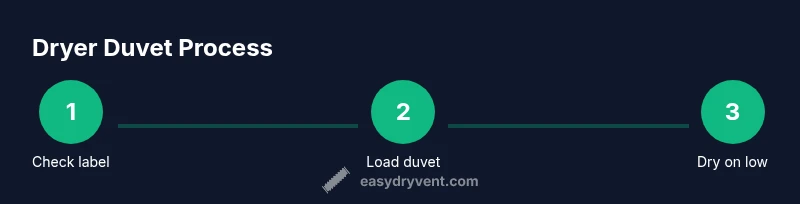
Check the duvet care label
Inspect the label for drying symbols and fill guidance. If the label prohibits tumble drying, follow the suggested alternative. If it allows drying,記 note any special instructions (e.g., “low heat”).
Tip: When in doubt, err on the side of caution and air-dry rather than risk damage. - 2
Load the duvet and add tumbling aids
Spread the duvet evenly in the drum to avoid bunched fabric. Add 3–4 dryer balls or clean tennis balls to help separate the fill and promote loft.
Tip: Avoid overloading the drum; a roomy load dries more evenly. - 3
Set the dryer to low heat and start with short cycles
Choose a delicate or low-heat setting and run an initial 15–20 minute cycle. This minimizes heat exposure on sensitive fills.
Tip: Low heat reduces the risk of scorch marks and feather matting. - 4
Pause and fluff the duvet
Pause the cycle every 15 minutes to remove the drum gently and fluff the fill. This prevents clumps and accelerates even drying.
Tip: Fluffing returns loft and prevents cold spots from forming. - 5
Repeat cycles until dry to the core
Continue cycling and fluffing until the duvet feels dry to the touch in all areas. Check for damp spots, especially around seams and edges.
Tip: If you detect damp areas, run another short low-heat cycle instead of increasing heat. - 6
Finish with air-drying if needed
If the duvet still feels slightly damp after cycles, remove it and finish outdoors or on a drying rack to finish air-drying completely.
Tip: Air-drying reduces the risk of heat damage while preserving loft. - 7
Care after drying
Clean the lint trap, inspect the vent path if you notice excess lint, and store the duvet in a breathable cover to prevent mildew.
Tip: Proper post-drying care maintains dryer efficiency and fabric longevity.
Common Questions
Can I dry a down-filled duvet in the dryer?
Yes, with caution. Use a low heat setting and regularly fluff the fill to prevent clumping. Always follow the care label for specific guidance.
Yes, you can dry a down-filled duvet in the dryer, but use low heat and fluff often, following the care label.
What heat setting should I use for synthetic fillings?
Synthetic fillings usually tolerate low to medium heat, but always follow the label. If in doubt, stick to low heat and shorter cycles.
Synthetic-filled duvets do best on low to medium heat, and you should follow the label for safety.
How can I prevent the duvet from clumping in the dryer?
Use 3–4 dryer balls or clean tennis balls, load evenly, and fluff the duvet between cycles to keep the fill loose.
To prevent clumping, add dryer balls and fluff the duvet during cycles.
How long does it take to dry a duvet in a large-capacity dryer?
Drying time varies by duvet and dryer size, but typically 60–90 minutes with low heat, checking and fluffing as you go.
Expect about an hour to an hour and a half, with checks and fluffing along the way.
What if the duvet is still damp after cycles?
Finish air-drying on a rack or line until completely dry to prevent mildew and odor.
If it’s still damp, finish drying outside the dryer or on a rack until fully dry.
Are there safer alternatives to using a dryer for duvets?
Air-drying on a clothesline or drying rack is safe and energy-efficient, especially for delicate fills or limited dryer space.
If you prefer, air-drying is a safe alternative for most duvets.
Watch Video
Key Points
- Check the care label before drying.
- Use a large-capacity dryer on low heat.
- Add dryer balls to prevent clumping and fluff regularly.
- Finish drying with air-drying if needed.