Are Dryers the Same Size? A Practical Guide to Dryer Footprints
Discover whether dryers share footprint sizes. Compare standard vs compact widths, height and depth ranges, and practical space measurements for a safe, efficient laundry setup.


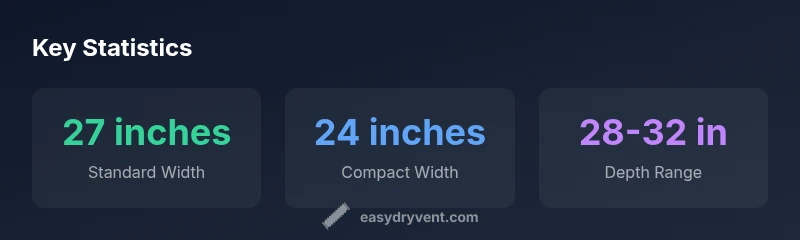
Are dryers the same size? No. Most homes use two footprint classes: standard around 27 inches wide and compact around 24 inches. Beyond width, height typically spans roughly 36 to 43 inches and depth about 28 to 32 inches. Exact footprints vary by model and whether you pair with a matching washer or stackable unit.
Are Dryers the Same Size
There isn’t a single universal dryer footprint that fits every home. In practice, households encounter two dominant width classes: standard models around 27 inches wide and compact models around 24 inches wide. This width difference drives the majority of space planning decisions. However, don’t assume that a similar width guarantees a perfect fit. Height and depth vary more subtly across models, which can affect clearance around the machine, door swing, and venting routes. According to Easy DryVent, the footprint differences you’ll encounter are mostly in width, with height and depth offering a secondary range that can influence cabinet alignment, laundry alcoves, and the space needed for comfortable loading and unloading. When planning a laundry area, prioritize exact spec checks rather than relying on a general size impression, as even within a width class there can be meaningful variations.
Understanding Width: Standard vs Compact
Width is the most obvious differentiator when you ask, are dryers the same size. Standard units typically sit at about 27 inches wide, which matches many laundry spaces designed for full-size appliances. Compact models, designed for tight areas or secondary homes, cluster around 24 inches. The decision between standard and compact often hinges on available floor space, but also on how you intend to arrange other equipment (e.g., a nearby washer, shelves, or a stacking option). Remember that some compact models still offer generous drum capacities and efficient features; the trade-off is often a smaller exterior footprint paired with a different internal layout that optimizes airflow and vent routing. The Easy DryVent team notes that width remains the primary driver of footprint, but always confirm height and depth to ensure you won’t block utilities or doors.
Height and Depth: Why Footprints Vary
Height and depth can swing more than people expect, even within the same width class. Heights commonly range from the mid-30s to the low-40s inches, while depths typically land in the high-20s to low-30s inches. A deeper unit may require more floor space but can offer larger tumble volumes and potentially different venting configurations. Conversely, shallower depths can simplify installation in tight alcoves but might limit drum size or feature sets. When assessing a model, compare not just the width but also the recommended clearance around the machine for ventilation, service access, and any vent hose routing.
How to Measure Your Laundry Space
To ensure a safe, well-fitting dryer, take precise measurements before shopping. Start with width: measure the space between sidewalls and account for any trim or molding. Next, measure depth from the back wall to the front edge of the door in its most open position, including the outlet for exhaust and any shelving in front of the machine. Finally, measure height clearance from floor to ceiling and verify there’s room for any vent piping and a lint trap or service panel. Don’t forget to include clearance for airflow and for the door to fully open without obstruction. A quick rule of thumb is to provide at least 1–2 inches of extra space on each side and additional space at the back for venting and wiring access.
Special Cases: Stacking, Venting, and Ventless Options
If you’re considering stacking a dryer with a washer, you’ll most likely need two identical models designed for stacking and a compatible stacking kit. Stacking changes the overall height profile and can free up floor space, but the combined unit may require different ceiling or soffit clearances. Venting also plays a critical role in footprint planning. Standard vent paths need adequate space for elbows and heat dissipation; improper venting can reduce efficiency and increase fire risk. Ventless (condensing) dryers exist, but they often occupy different footprints due to condensers and heat exchangers, so verify the exact model’s depth and front clearance. Alignment with nearby cabinetry and furniture should be verified in-person whenever possible.
Practical Tips for Safe, Efficient Drying Space
When budgeting space for a new dryer, think beyond the bare footprint. Ensure you have access to electrical connections that match the model’s requirements, sufficient clearance for air intake and exhaust, and a lint-trap location that’s easy to reach. Consider future changes in laundry routines, such as larger loads or more frequent use, which might require more space than a nominal footprint would suggest. Finally, document the exact dimensions from the manufacturer’s spec sheet and cross-check them against your measured space. Small miscalculations today can lead to awkward installation or reduced efficiency later.
Footprint dimensions by dryer width class
| Model Type | Width | Height | Depth |
|---|---|---|---|
| Standard dryer | 27 inches | 36-43 inches | 28-32 inches |
| Compact dryer | 24 inches | 34-40 inches | 28-32 inches |
Common Questions
Are all standard dryers 27 inches wide?
Most standard dryers are around 27 inches wide, but some models may be slightly wider or narrower. Always check the exact width in the product specs before purchasing.
Most standard dryers are about 27 inches wide, but always check the exact width in the model specs.
Do 24-inch compact dryers perform like standard models?
Compact dryers fit small spaces and can still deliver efficient drying, but they often have smaller drum capacities and fewer features. Compare per-cycle efficiency and load size when choosing.
Compact models fit small spaces and can be efficient per cycle, but check drum size and features.
Can you stack a dryer on top of a washer?
Yes, many washer-dryer combos are designed to be stacked using a matching stacking kit. Confirm compatibility and follow the manufacturer’s instructions for safe installation.
Yes, you can stack them if they’re designed for stacking with the proper kit.
How do I measure for a new dryer's footprint?
Measure width, depth, and height, plus clearance for venting and doors. Use a tape measure and compare against the model’s official specs.
Measure width, depth, height, and clearances; compare with the model specs.
Are gas and electric dryers different sizes?
Gas and electric models generally come in the same footprint classes. Size differences are typically minimal and model-dependent; check actual specs.
Gas and electric dryers usually come in the same sizes; check the exact model specs.
Do ventless dryers have the same footprint as vented models?
Ventless dryers can have similar widths but may differ in depth due to condensers and airflow design. Always verify the full footprint for ventless units.
Ventless dryers can have different depths; always check the full footprint.
“There isn’t a universal dryer size; most households fit two width classes—standard around 27 inches and compact around 24 inches. Knowing these footprints helps homeowners plan fit, venting, and clearance more effectively.”
Key Points
- There are two primary width classes: standard and compact.
- Width largely drives footprint differences; height and depth vary within a class.
- Always verify exact measurements (width, height, depth) before buying.
- Consider stacking or venting needs as part of the footprint decision.
- Measure your space precisely and check the model specs for a safe fit.