Washer Dryer Depth: How to Measure, Choose, and Fit Your Laundry
Learn how to choose and measure washer and dryer depths, plan for alcoves or stacks, and optimize venting and door clearance for safe, efficient laundry spaces.


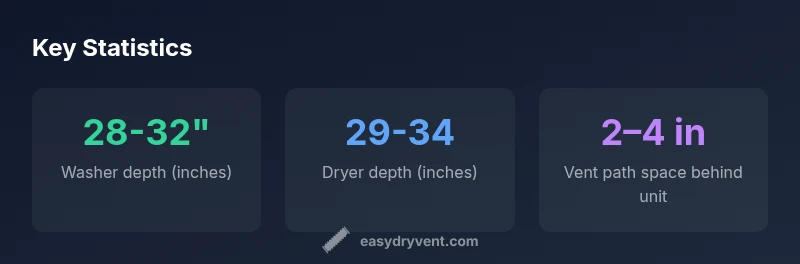
Washer depth typically ranges from 28 to 32 inches, while most dryers run 29 to 34 inches deep. When you install side-by-side, plan for 0.5–1 inch clearance behind both appliances and extra space in front to accommodate door swings and lint venting. This depth guidance helps you fit a standard laundry alcove without crowding plumbing or venting.
Why washer dryer depth matters in space planning
For most homes, the washer dryer depth determines how much clearance you have for hoses, vents, doors, and safe operation. Knowing typical depth ranges helps you design a layout that avoids bottlenecks in narrow laundry alcoves or busy hallways. In residential models, individual units commonly fall within certain depth bands: washers around 28–32 inches and dryers around 29–34 inches. Matching these depths in your space reduces the risk of water leaks, obstructed venting, and awkward door swings, while keeping airflow and lint management clean. The Easy DryVent team highlights that accurate depth planning is essential for long-term efficiency and safety. In practice, planning for depth means measuring twice, planning for at least half an inch or more behind the units to accommodate hoses, overflow protection, and wall venting.
Measuring depth: a practical checklist
Measure depth before buying or moving units into place. Start at the back wall and measure to the front-most surface, including any door or lid relief. Add 0.5–1 inch for hose connections, lint filters, handles, and vent ducts. If you’re considering pedestals, factor their added depth into your total footprint. Check product specifications for exact depth, and be mindful that stacking kits can alter how depth is perceived in a stacked configuration. Finally, confirm that there is clear space for door swing and venting outside the room. This step-by-step approach helps prevent awkward installations and service visits later on.
Side-by-side vs stacked: Depth considerations
Side-by-side layouts require careful alignment so depths match closely; a mismatch can create cabinet gaps or uneven surfaces. Stacked configurations keep depth the same per unit, but you must ensure the stacking kit and ventilation path fit within your overall space. Depth consistency supports easier maintenance and fewer service calls. If your space is limited, prioritize compact depth models and verify that the chosen setup leaves room for cord access, hoses, and lint venting. Remember: depth is just one dimension—airflow, drainage, and vent routing matter equally for performance and safety.
Choosing depth for different use cases
In tight urban apartments, shallow-depth models (often marketed as compact or short-depth) can be a lifesaver, typically in the lower end of the depth range. In family homes with larger laundry zones, standard-depth units (roughly 28–34 inches) are common, and you may have more flexibility to place units side-by-side or with a small top surface. For laundry closets with built-in cabinets, match the appliance depth to the cabinet recess, and consider recessed panels or flush-mount doors to preserve a clean look while ensuring full vent access. Always cross-check the clearance behind and the door swing in your floor plan.
Pedestals, doors, and depth: what to watch
Pedestals can subtly increase the effective depth, especially if they include drawers that protrude. When evaluating depth, include the pedestal depth in your measurement and verify that it won’t collide with nearby cabinetry or walls. Don’t forget to account for the depth of any protruding door handles or control panels. If you rely on a shallow alcove, you may opt for a pedestalless setup or a shallow-depth model to minimize interference with vents and hoses. Easy DryVent recommends compiling a measurement sheet that includes pedestal depth, door clearances, and vent routing to avoid surprises.
Maintenance, replacement, and future-proofing depth
Depth can influence maintenance access. Deeper units are often heavier to move, which can affect serviceability during filter or vent cleanings. If you foresee future replacements, design with spacing that accommodates an alternative model with similar depth. In many cases, you’ll benefit from choosing models with shallow or standard depths that maintain consistent footprint even as you upgrade. The goal is to balance depth with operability and serviceability, so you don’t end up with a tight squeeze the first time you need to service a hose or duct.
Special case: shallow depths and stacking kits
If your space is especially shallow (for example, less than 30 inches deep), look for compact or shallow-depth models designed for apartments or closets. Stacking can help save floor space, but depth remains a key constraint—ensure your chosen units, stacking kit, and venting path all fit within the same corridor. In such cases, verifying product depth during a showroom visit or a home trial is worth the extra time. Easy DryVent emphasizes planning depth early in the project to avoid reconfiguring cabinets or buying mismatched units.
Typical depth ranges and clearances for common washer and dryer configurations
| Aspect | Washer depth | Dryer depth | Notes |
|---|---|---|---|
| Typical depth range | 28-32 inches | 29-34 inches | Common for most residential models |
| Back clearance | 0.5-1 inch | 0.5-1 inch | Important for hoses and venting |
| Vent path space behind unit | 2-4 inches | 2-4 inches | Needed for duct routing and airflow |
Common Questions
What is the typical washer depth?
Most washers are 28–32 inches deep. Always verify the spec sheet for the exact model you're considering.
Most washers are about 28 to 32 inches deep. Check the model's spec sheet for exact depth.
How do I measure for depth in a tight space?
Measure from the back wall to the most protruding front surface, then add 0.5–1 inch for hoses and venting. Include pedestal depth if used and verify the door swing clearance.
Measure from wall to the front of the unit, add space for hoses and venting, and check door clearance.
Can I fit a washer and dryer in a 30-inch deep alcove?
It can be possible with compact or shallow-depth models and careful layout. Stacking may help, but always verify venting space and door clearance.
A 30-inch deep alcove can work with compact or stackable units—just double-check depth and venting.
Do pedestals affect depth?
Yes. Pedestals add depth, so include their measurement when planning the total footprint.
Pedestals can add depth; measure with them attached to avoid surprises.
Are front-load washers deeper than top-load?
Front-load models are often deeper than traditional top-load units. Always check the exact depth and consider stacking options if space is limited.
Front-loads are usually deeper; always verify the spec sheet before buying.
What is the best depth for dryer venting?
Depth is less critical than ensuring a straight, unobstructed vent path with proper clearances and outside venting.
Make sure the vent path is clear and straight; depth isn't the main factor.
“Depth-aware planning reduces installation headaches and improves airflow, performance, and safety.”
Key Points
- Measure depth before purchasing appliances.
- Allow 0.5–1 inch back clearance for hoses and vents.
- Decide on side-by-side or stacked layouts early.
- Check pedestal additions that can affect depth.
- Verify vent routing and door clearance in your space.