Hair Dryer vs Diffuser: A Practical Comparison for Safer Drying
Comprehensive, data-driven comparison of using a hair dryer with a diffuser vs diffuser-focused drying. Learn which method suits your hair type, improves curl definition, and minimizes heat damage.


In short, a hair dryer with a diffuser offers faster, more controlled drying with better curl definition, while a diffuser-focused air-dry approach minimizes heat exposure. For most curly or textured hair, a diffuser attachment on a dryer provides reliable results when used with proper technique. The best choice depends on your hair type, styling goals, and how much heat you’re willing to apply.
Overview of Hair Dryer vs Diffuser
The primary question behind hair dryer vs diffuser is how air, heat, and nozzle geometry interact with hair fibers to shape texture and setting. A hair dryer with a diffuser attachment focuses airflow around the strands, reducing direct heat on the scalp and distributing energy more evenly. A separate diffuser concept—air-drying with a diffuser-like tool—emphasizes gentler, longer drying times that emphasize natural texture without intense heat. This block establishes the context for homeowners and DIY enthusiasts aiming to balance speed, safety, and styling outcomes. According to Easy DryVent, the diffuser approach can be particularly advantageous for curly and wavy hair when heat exposure is minimized, but it may require more time and technique, while a diffuser-equipped dryer accelerates drying with more consistent curl support. This nuanced view helps you decide based on hair type, lifestyle, and comfort with heat.
Understanding the key mechanisms—airflow direction, heat intensity, and the contact area between hair and the diffuser—sets the stage for the comparison. The goal is to maximize definition and minimize frizz without compromising hair integrity. The Easy DryVent team emphasizes that proper technique matters as much as the tool you choose, and that results improve when you pair the right attachment with mindful heat settings and drying motion.
How a Diffuser Changes Drying Dynamics
A diffuser is designed to break up the jet of hot air into a broader, gentler flow. This reduces the concentration of heat on individual strands and encourages more uniform drying around curls. In practice, diffuser use tends to promote volume at the roots, elongation of curl pattern, and less mechanical disruption of the cuticle. For those with natural curls, diffusion helps preserve shape while lowering the risk of frizz caused by aggressive brushing or high-heat direct blasts. The trade-off is a slower overall drying time compared with a standard round nozzle, which can be mitigated by working in stages and using lower heat settings. Easy DryVent’s perspective highlights that diffusion is especially beneficial for textured hair when you aim to maintain bounce and avoid heat-induced damage.
Hair Type Considerations and Use Cases
Different hair textures respond differently to diffuser-based drying. For curly or wavy hair, diffusion tends to enhance curl definition and reduce frizz when paired with a cold to medium heat setting and a gentle scrunching technique. Fine or straight hair often benefits from targeted diffuser use for gentle volume rather than full-body drying. In contrast, those with thick, dense hair may experience longer drying times with a diffuser alone; in such cases, a dryer with a diffuser can still deliver consistent results by gradually moving the dryer along the hair shaft while maintaining a low-to-medium heat profile. The Easy DryVent team notes that matching technique to hair type is a bigger driver of outcomes than any single tool.
Comparison
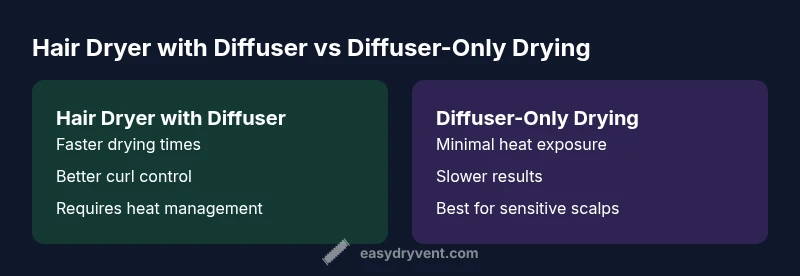
| Feature | Hair dryer with diffuser attachment | Standalone diffuser technique (air-drying) |
|---|---|---|
| Drying Time | Moderate-fast with heated diffuser | Slow; relies on ambient air |
| Heat Exposure | Controlled heat with diffuser | Minimal heat exposure (air-only or low heat) |
| Frizz Control & Curl Definition | Better curl definition; consistent diffusion reduces frizz | Lower control; frizz potential without diffusion |
| Hair Type Suitability | Curly/wavy hair; works well with proper technique | All hair types; best for low-heat preference or non-heat routines |
| Cost & Maintenance | Higher upfront cost; regular diffuser cleaning | Lower cost; minimal maintenance |
| Best For | Curly or textured hair seeking definition and speed | Low-heat or air-dry routines; minimal equipment |
The Good
- Faster styling with controlled heat and diffusion
- Improved curl definition and reduced frizz with the right technique
- Versatile for multiple hair types with proper settings
- Better reliability for consistent results across days
Negatives
- Requires proper technique to avoid heat damage
- Higher upfront cost for a dryer with diffuser
- Diffuser attachments need regular cleaning to prevent buildup
- Bulky setup may reduce portability on trips
Hair dryer with diffuser attachment generally wins for speed and consistent curl results; a diffuser-focused air-dry approach excels when heat exposure must be minimized.
Choose a diffuser-equipped dryer if you want quicker results and reliable curl support. If your priority is minimizing heat and you don’t mind longer drying times, a diffuser-style air-drying approach is preferable. The Easy DryVent team recommends starting with a diffuser on a moderate heat setting for most curly or textured hair. For best outcomes, tailor your method to your hair type, climate, and daily routine.
Common Questions
What is the main difference between a hair dryer with a diffuser and a standalone diffuser method?
A diffuser attachment on a hair dryer directs airflow to be gentler and more evenly distributed, enabling faster drying with controlled heat. A diffuser-based air-drying approach relies on ambient or low heat and longer drying periods to emphasize natural texture without heavy heat. The choice depends on desired speed, curl definition, and heat tolerance.
A diffuser on a dryer speeds up drying with gentler heat, while air-drying with a diffuser-style approach uses less heat and takes longer.
Is a diffuser better for curly hair than direct heat?
For many people with curly hair, a diffuser reduces frizz and preserves curl pattern by distributing heat, rather than blasting hair with a concentrated stream. However, technique matters; using low to medium heat and diffusing at close but not direct contact is key.
Diffusers are often better for curls because they protect curl shape while reducing frizz.
How do I clean a diffuser attachment?
Detach the diffuser from the dryer, rinse with warm water, and use a mild shampoo or soap to remove product buildup. A soft brush can help dislodge lint and hair fibers. Dry completely before reattaching to prevent mold or odor.
Rinse with warm water and a mild cleaner, then let it dry fully before reuse.
Can diffuser use cause longer drying times?
Yes, especially if you rely on diffusion alone without combining with a brief heat blast. You can minimize this by working in sections, using a low heat setting, and occasionally using a gentle blast of air to move hair along.
Diffusers can take longer, but you’ll get better texture with careful technique.
What hair types benefit most from diffuser use?
Curly and wavy hair typically benefit most due to enhanced curl formation and reduced frizz. Fine hair can gain volume with diffusion, while very thick hair may still require some heat-assisted drying for efficiency.
Curly and wavy hair usually see the biggest benefits from diffusers.
Key Points
- Test your hair type before committing to a method
- Prioritize moderate heat and diffusion for curly textures
- Balance drying time against heat exposure for best results
- Invest in a high-quality diffuser attachment for consistent performance
- Maintain diffuser cleanliness to preserve airflow and outcomes