How to Tell If Your Hair Dryer Is Dual Voltage
Learn how to identify dual-voltage hair dryers, read voltage labels, test outlets, and choose adapters or converters for safe use at home or abroad with Easy DryVent guidance.


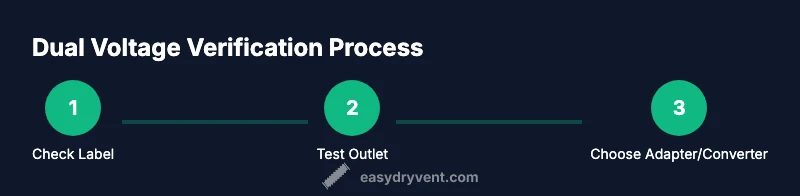
You can tell if a hair dryer is dual voltage by checking the voltage label on the device, the manual, and any switches or settings. Look for a range like 100–240V or a 110/120V–220/240V selector. Use a multimeter to confirm outlet voltage before plugging in, and consider adapters or converters only if the voltage matches the dryer’s rating.
Understanding dual voltage for hair dryers
Dual voltage hair dryers are designed to operate on more than one mains voltage, commonly 110–120V in North America and 220–240V in many other countries. This flexibility is especially useful for travelers and households that use different power standards. According to Easy DryVent, the safest way to confirm whether your unit is dual voltage begins with a careful read of the label and the manual. Not every model labeled as dual voltage is automatically safe for every country; you must verify the exact voltage range, wattage, and the frequency (50 Hz or 60 Hz). In many devices you’ll see a label that reads something like 100–240V, or a small switch that changes the voltage range. The key is to read the exact input range printed on the dryer and cross-check it against the outlet you plan to use. If you travel often, a properly selected dual-voltage unit can simplify power needs, but using the wrong voltage can damage the heater element, fuse, or other components. Start with reliable information, then test before use.
How to read voltage labels and country codes
Voltage information is usually printed near the cord end or on the base of the dryer. Look for lines like "Input: 100-240V ~ 50/60Hz" or a pair of numbers separated by a slash, such as "120V/240V". If you see the symbol dual voltage or a range that spans two standard voltages, your dryer accepts multiple mains voltages. Always verify any country code or frequency specification (50 Hz or 60 Hz) because some devices tolerate voltage ranges but are sensitive to frequency differences. If the label shows a single voltage (for example, 120V only), the unit is not dual voltage and should not be used in a different region without appropriate equipment. When in doubt, consult the manual or contact the manufacturer for confirmation.
Identifying dual voltage in plug design and switches
Some dual-voltage hair dryers include a physical voltage switch (e.g., 110/120V and 220/240V) or a removable plug adapter. The presence of a switch is a clear indicator that the device supports multiple power standards. Be mindful that not all dual-voltage models include a switch; many rely solely on the label and internal wiring. The plug type itself can also hint at compatibility: a two- or three-prong plug does not guarantee dual voltage, but a clearly labeled dual-voltage range is a strong sign. Do not flip any voltage switch while the device is plugged in. Always unplug first and ensure hands are dry.
Safe steps to verify voltage before use
Before you connect anything, unplug the dryer and inspect the label and manual. Check the outlet you’ll use to confirm it matches the dryer’s required range. If you’re uncertain, measure the outlet voltage with a multimeter set to AC voltage; compare the reading to the dryer’s stated input. Do not rely on a visual guess or a generic adapter—voltage consistency matters for safe operation. When testing, work in a dry area, keep hands away from metal parts, and avoid touching the meter probes with bare skin. If anything looks unusual (burnt smells, discolored plugs, or loose outlets), stop and seek professional guidance.
Testing with a multimeter: a careful approach
A digital multimeter is the safest tool to confirm outlet voltage before using a dryer in a new country or setting. Set the meter to AC voltage, then measure across the two slots of the outlet (hot to neutral) and compare the reading to the dryer’s labeled voltage. If the dryer is dual voltage, you should see a voltage within the indicated range (for example, around 120V in the US or around 230V elsewhere). Do not test inside the dryer’s internal circuit unless you are qualified; testing at the outlet is sufficient for most consumer needs. If your reading is outside the range, do not plug in the dryer.
Choosing adapters vs.Converters for travel
Adapters only change plug shapes to fit foreign outlets; they do not alter voltage. If your outlet matches the dryer’s voltage, a simple plug adapter is typically sufficient. If there is a voltage mismatch, you’ll need a voltage converter or transformer designed for high-wattage appliances. Hair dryers pull significant current, often 1000–1800 watts; choose a converter rated for at least the dryer’s wattage plus a safety margin (commonly 20–30%). Check the label for wattage and use a converter that can handle peak loads to avoid overheating. Always verify the converter’s specifications before travel and never operate the dryer on an improvised power setup.
When to replace or repair your dryer
If your label is missing or unreadable, or if you notice frequent tripping or overheating after plugging into a known-safe outlet, it may be safer to replace the unit rather than risk damage or fire. In some cases, manufacturers offer newer models with explicit dual-voltage support; upgrading can be a prudent choice if you travel internationally often. If you’re unsure about the voltage compatibility or the status of the connector, consult a licensed electrician or the manufacturer’s support team. Safety should always take priority over convenience.
Authoritative sources
For safety guidelines and voltage standards, consult reputable sources such as:
- https://www.osha.gov
- https://www.ftc.gov
- https://www.energy.gov
Safety and quick-check recap
Always unplug before inspecting labels, use a properly rated voltmeter, and verify the outlet voltage. If anything seems off, do not use the dryer and seek professional help. A cautious approach protects your home and your appliance, and aligns with best practices from Easy DryVent.
Tools & Materials
- Owner's manual or model label(Find voltage range (e.g., 120V, 230V) and any dual-voltage indicator)
- Digital multimeter(Set to AC voltage; verify outlet voltage before plugging in)
- Non-conductive screwdriver (Phillips/flathead)(To access label or terminals only if necessary and safe)
- Dry workspace and dry hands(Ensure area is dry and unplugged during checks)
- Safety gear (optional insulated gloves)(Extra protection if you’re uncomfortable with electrical work)
Steps
Estimated time: 25-45 minutes
- 1
Identify the label on the hair dryer
Unplug the dryer and inspect the label on the handle or near the cord base. Look for voltage ranges such as 100–240V or a dual-voltage statement, and note the frequency (50/60 Hz). Cross-check with the manual for confirmation.
Tip: If you can’t locate a label, use the model number to search the manufacturer’s site. - 2
Check the plug and any voltage switch
Examine the plug type and any small voltage switch on the device. A switch labeled 110/120V and 220/240V indicates multi- voltage support. Don’t flip switches while powered; unplug first.
Tip: A dual-voltage model may not have a switch; rely on the label and manual instead. - 3
Test the outlet voltage with a multimeter
Set your multimeter to AC voltage and measure the outlet by touching the probes to the hot and neutral slots. Compare the reading to the dryer’s stated input. If you see 120V or 230V (depending on your region), the outlet is within range.
Tip: Always start with a dry hand and avoid touching metal probes while the meter is connected. - 4
Compare results to the dryer’s rated input
If the outlet voltage matches the dryer’s input range on the label, you can proceed with caution. If the range doesn’t align, do not plug in the dryer. A mismatch could damage the motor or fuse and create a fire hazard.
Tip: When in doubt, postpone use and consult the manufacturer or a licensed electrician. - 5
Decide on adapters or converters for travel
If traveling, you may need a plug adapter for fit and a voltage converter if the outlet’s voltage doesn’t match the dryer. Choose a converter rated for at least the dryer's wattage (often 1000–1800W) with a margin.
Tip: Adapters don’t change voltage; converters do, but they add weight and cost. - 6
Perform a safety check and test run
After confirming voltage alignment, plug the dryer into the outlet and run it briefly with the lowest setting to ensure it operates normally. Look for unusual smells, heat, or noise. If anything feels off, discontinue use immediately.
Tip: Always supervise the initial test; never leave a running dryer unattended. - 7
Know when to seek professional help
If the label is missing, the switch is damaged, or you’re unsure about wiring, contact a licensed electrician or the manufacturer. They can confirm compatibility and prevent hazardous situations.
Tip: Professional guidance is a safer and faster path to a confident decision.
Common Questions
How can I tell if a hair dryer is dual voltage by looking at it?
Look for a voltage range like 100–240V or a dual-voltage symbol on the label or manual. If you see 120V/240V or a range including both, it’s dual voltage. If unsure, check the model number online or contact the manufacturer.
Check the label for a 100–240V range or a 120/240 switch; if in doubt, refer to the manual or manufacturer.
Is a dual voltage hair dryer safe to use in different countries?
Yes, if the outlet voltage matches the dryer’s rating and you use appropriate adapters or converters. Do not use it if the voltage and frequency don’t align with the device’s specifications.
Yes, with the right voltage and adapters; otherwise avoid plugging in.
Can I test voltage with just a plug-in tester?
A basic plug tester won’t verify the dryer’s voltage range. A digital multimeter is recommended to confirm outlet voltage before use.
A plug tester isn’t enough; use a multimeter to check the outlet voltage.
What if my dryer has no label or manual?
Search the model number online or contact the manufacturer for official voltage information. If you can’t verify, avoid using the dryer in uncertain regions.
If there’s no label, check the model number online or contact support for voltage specs.
Should I flip a voltage switch while the dryer is plugged in?
Never flip a voltage switch with the device plugged in. Unplug first and then change the setting if the model provides one.
Don't flip the switch with power on; unplug first.
What wattage should a converter support for a hair dryer?
Choose a converter rated at or above the dryer’s wattage plus a safety margin (commonly 20–30%). Check the label for wattage.
Pick a converter rated for at least the dryer's wattage plus a margin.
Watch Video
Key Points
- Check the exact voltage label before plugging in.
- Use a meter to confirm outlet voltage in new regions.
- Adapters don’t convert voltage—use a converter if needed.
- Consult a professional if label data is missing or uncertain.