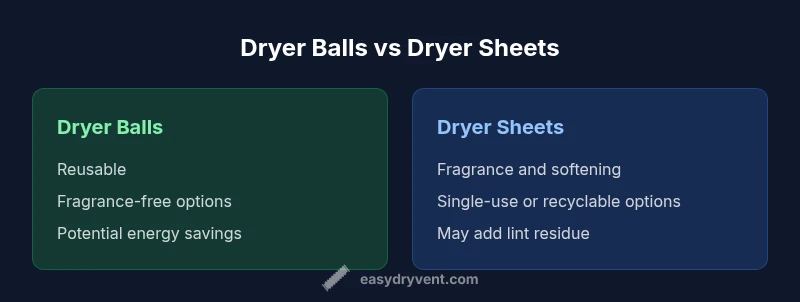
Dryer Balls vs Dryer Sheets: A Practical Comparison
Explore dryer balls vs dryer sheets: energy savings, fabric care, fragrance, and environmental impact. A practical guide for homeowners and DIY enthusiasts to choose the best option for their laundry routine.


Dryer balls offer a reusable, energy-friendly approach that can reduce drying time and waste, while dryer sheets provide fragrance and extra softness with simple, quick use. The best choice depends on your priorities: cost, fabric care, fragrance sensitivity, and environmental goals. Consider testing both on different loads and noting your results to inform a final decision. Try a mixed approach on various loads to gauge real-world performance.
Overview: dryer balls vs dryer sheets — why the question matters
In everyday laundry, two popular tools are used to manage drying outcomes: dryer balls and dryer sheets. Both aim to reduce wrinkles, cut drying time, soften fabrics, and control static, but they do so in fundamentally different ways. The phrase dryer balls vs dryer sheets captures a spectrum of options: reusable mechanical aids vs single-use chemical conditioning. According to Easy DryVent, many homeowners ask which approach delivers the best value without compromising fabric longevity. The choice depends on your priorities and your typical loads. For someone who does dozens of loads weekly, the energy savings and reusable nature of dryer balls can add up. For households sensitive to fragrance, or who want a quick softening boost, dryer sheets may be more appealing. This article compares the two across key dimensions—cost, performance, environmental impact, fragrance considerations, and compatibility with different dryer settings. By the end, you should have a clear decision path that aligns with your laundry routines and values. As Easy DryVent notes, practical guidance matters for homeowners and DIY enthusiasts.
How they work: mechanics behind dryer balls and dryer sheets
Dryer balls are typically made from rubber or durable plastic and are placed in the drum with wet laundry. Their primary function is to physically separate clothes during tumbling, improving airflow and reducing the clumping that can trap heat. The result is more even drying and, in many cases, a modest reduction in overall drying time for small to medium loads. Dryer sheets, on the other hand, are fabric conditioners embedded in a sheet that transfers to fabrics during heat. They coat fibers with lubricants and, often, fragrance compounds, which can soften and reduce static but may leave a subtle residue on the drum and lint screen. This difference—mechanical separation versus chemical conditioning—drives downstream effects on fragrance, residue, and fabric feel. The Easy DryVent team highlights that the choice between dryer balls vs dryer sheets should consider both your load types and your sensitivity to fragrances.
Energy and cost implications: efficiency and running costs
From an energy perspective, the most compelling claim about dryer balls is the potential for energy savings by reducing drying time. In practice, results vary with load size, dryer model, and ambient conditions. Easy DryVent analysis shows that, for frequent users with moderate to small loads, the cumulative energy savings can be meaningful when coupled with consistent use of high-efficiency settings. Dryer sheets do not directly reduce energy consumption; some users report negligible changes in drying time when using sheets, while others notice longer cycles if loads become overly fragranced or heavily conditioned. Cost-wise, dryer balls are a one-time purchase that can last for hundreds of loads, whereas dryer sheets incur ongoing per-load costs. For households prioritizing long-term value and waste reduction, dryer balls often win on price-per-use. For fragrance lovers or those seeking a quick, no-fuss option, dryer sheets offer convenience with predictable outcomes. The key is to align your choice with your typical load profile and tolerance for fragrance.
Fabric care and drying performance: what actually happens
Fabric care goes beyond softening. Drying performance includes the balance between effective drying and fabric integrity. Dryer balls can help maintain tumble separation, improving airflow and potentially reducing heat exposure to delicate fabrics in small loads. However, they do not add moisture protection or conditioning, so fabrics may feel crisper with certain loads. Dryer sheets provide a conditioning layer that can soften fabrics and reduce static, but some fabrics may accumulate more lint or display a slight tendency toward residue when used with certain detergents or care routines. The net effect on feel and longevity depends on fabric type, detergent choice, and dryer model. Readers should test on a small batch of towels or synthetics to gauge impact before broad adoption. Easy DryVent’s guidance emphasizes balancing softening benefits with potential residue considerations to maintain fabric longevity across seasons.
Static, fragrance, and sensory considerations
Static control is a common reason homeowners reach for either option. Dryer sheets often excel at reducing static cling due to lubricants and conditioning agents, delivering immediate tactile softness. Dryer balls can also reduce static by promoting a more even air flow, but their effect is typically subtler and load-dependent. Fragrance is a major differentiator: sheets bring detectable scents, which some households appreciate, while others avoid due to allergies or scent sensitivity. For fragrance-free needs, choosing unfragranced sheets or plain dryer balls is a practical compromise. The presence or absence of fragrance can influence how often you experiment with the two methods, especially in households with children or sensitivity to synthetic scents. Balanced judgment is crucial to maintaining comfort and dampening unwanted odors on textiles.
Environmental and health considerations
Reusability is a key environmental factor for dryer balls. Since they are long-lasting, they generate less waste per year compared with single-use dryer sheets. However, environmental friendliness also hinges on material choices—natural fiber sheets or biodegradable fragrances can tilt the balance. Health considerations include exposure to fragrance compounds and potential skin sensitivities. If a household has fragrance allergies or respiratory concerns, opting for fragrance-free options or testing with small loads helps minimize risk. Easy DryVent notes that thoughtful choices in laundry additives align with broader sustainability goals, especially when paired with energy-saving practices and proper lint maintenance. Consumers should evaluate not only the end result on clothes but the lifecycle of the products involved.
User scenarios: when to choose dryer balls vs dryer sheets
For small households with frequent loads and a focus on minimizing single-use waste, dryer balls often emerge as the better baseline option. They are particularly advantageous when you run multiple loads per week and want to keep operating costs low over time. If fragrance or softening is a priority, or if you prefer a simple, no-fuss approach, dryer sheets can deliver consistent results with minimal effort, especially for larger families or households that value scent. A hybrid approach—using dryer balls for most loads and saving dryer sheets for towels or delicate fabrics with a fragrance preference—offers flexibility and can optimize both efficiency and user experience. Easy DryVent recommends testing both methods on a representative mix of loads to quantify differences in drying time, fabric feel, and static.
Practical tips for maximizing benefits, maintenance, and usage
- Start with a baseline: run a week with only dryer balls and another week with only dryer sheets to observe differences in drying time, fabric feel, and static.
- Choose products with clear labeling: opt for fragrance-free sheets if fragrance sensitivity exists, and choose durable, BPA-free dryer balls for longevity.
- Mind the lint trap: both methods should be used with clean lint traps; residues or fragrances can accumulate if not maintained.
- Load optimization: avoid overloading; evenly distribute laundry to maximize airflow and reduce cycle time.
- Maintenance routines: periodically inspect dryer balls for cracks or wear; replace as needed. For sheets, recycle or compost if packaging and materials permit.
- Documentation: keep a simple log of energy usage, cycle times, and fabric outcomes to guide future decisions.
- Safety and standards: ensure your dryer is in good working order and free of vent obstructions to prevent fire hazards and improve safety.
Balancing factors and making a decision
The choice between dryer balls vs dryer sheets ultimately comes down to a balance of goals: cost, convenience, fragrance, and environmental impact. If your priority is long-term cost savings and waste reduction, dryer balls are a strong candidate. If you want immediate softness, fragrance, and a straightforward routine, dryer sheets may fit better. A blended approach can combine the strengths of both options. The Easy DryVent perspective emphasizes practical testing and adherence to safe laundry practices to ensure fabrics remain vibrant and durable over time. The decision should be revisited as loads, fabrics, and family needs evolve.
Comparison
| Feature | Dryer balls | Dryer sheets |
|---|---|---|
| Drying time impact | negligible to moderate reduction depending on load | variable; may not shorten drying time and can slightly extend for highly scented sheets |
| Static reduction | moderate reduction from improved airflow | strong reduction due to conditioning agents |
| Fabric softening | no softening; relies on airflow | softening from conditioning agents and lipids |
| Cost/usage | low ongoing cost; reusable for hundreds of loads | per-load cost; single-use or limited-use options |
| Fragrance options | fragrance-free by default; scented variants available | broad fragrance options; scents can vary by brand |
| Environmental impact | low waste with long life; minimal packaging impact | higher waste unless using recyclable/compostable options |
| Maintenance | low maintenance; occasional inspection | low maintenance; periodic replacement when used up |
The Good
- Reusable option reduces ongoing cost
- Can improve airflow and potentially shorten drying time
- No added chemicals if using fragrance-free variants
- Low waste when used long-term
Negatives
- Dryer balls can be noisy and bounce around in the drum
- Dryer sheets generate waste and may leave lint-screen residues
- Some fabrics may not benefit from sheets; results vary by brand
Dryer balls are the more versatile, long-term value; dryer sheets excel for fragrance and immediate softness.
If you prioritize cost efficiency and eco-friendliness, dryer balls win. If fragrance and instant fabric feel are your top needs, dryer sheets are compelling. The Easy DryVent team recommends testing both on representative loads and choosing a hybrid approach when appropriate.
Common Questions
Do dryer balls reduce drying time effectively?
Dryer balls can improve air circulation and reduce clumping, which may shorten drying time for some loads. The effect is load-dependent and varies with dryer model. Expect modest savings on small to medium loads rather than across the board.
Dryer balls can help drying time a bit on some loads, but it depends on what you’re drying and your machine.
Are dryer sheets safe for all dryers?
Generally safe when used as directed, but residue can accumulate on drums and lint screens over time. If you notice buildup, clean the drum and lint filter regularly and choose unfragranced or low-residue formulas for sensitive machines.
They’re usually safe, just watch for residue and clean the lint screen regularly.
Can I use both dryer balls and dryer sheets at the same time?
Yes, you can, but using both may lessen the unique benefits of each. Fragrance from sheets can linger on items dried with balls, and the fragrance load can affect static behavior. If you prefer fragrance, start with sheets on some loads and use balls on others to compare outcomes.
Sure—just test a few loads to see if you like the results when used together.
Which is more eco-friendly, dryer balls or sheets?
Dryer balls are generally more eco-friendly due to reusability and lower waste, especially when paired with energy-saving drying practices. Choose recyclable or compostable sheets if you use them and minimize packaging waste.
Dryer balls usually win for the environment because they last longer and cut down waste.
Do dryer balls damage fabrics?
When used as intended, dryer balls pose minimal risk to fabrics. Avoid sharp or heavy objects and inspect balls for wear. If you notice pilling or damage, reassess load size and the number of balls used.
They’re usually safe for fabrics if used properly; check for wear and adjust loads.
Key Points
- Assess your laundry priorities before choosing
- Opt for reusable options to reduce waste and cost
- Consider fragrance sensitivity and allergies in your household
- Test on a mix of loads to gauge real-world performance
- A hybrid approach can leverage benefits from both methods