Difference Between a Drying Agent and Dehydrating Agent
Explore the difference between a drying agent and dehydrating agent with clear definitions, mechanisms, and practical guidance for choosing moisture removal methods in labs and DIY projects. Learn how each type works, when to use them, and safety considerations for home and industrial settings.


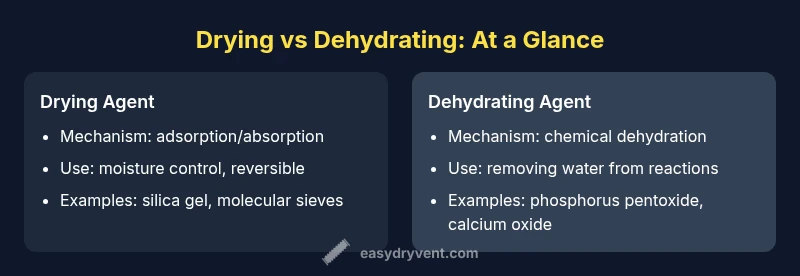
The difference between a drying agent and dehydrating agent hinges on mechanism: a drying agent removes moisture by physical adsorption or absorption, while a dehydrating agent chemically binds water to form a new compound. This distinction guides where moisture is removed, whether the process is reversible, and how regeneration or disposal is handled. In practice, drying agents are common for gentle moisture control (e.g., silica gel), whereas dehydrating agents are used for chemical dehydration in synthesis and drying reactive liquids.
Core Definitions and Distinctions
The difference between a drying agent and dehydrating agent is foundational in moisture management. In everyday language, you may reach for a desiccant to keep a closet dry, but scientists distinguish between physical moisture removal and chemical water elimination. According to Easy DryVent, recognizing this distinction helps homeowners and DIY enthusiasts choose materials that won’t interfere with sensitive solvents or reactive systems. In short, a drying agent removes water through physical means and can often be reversed; a dehydrating agent drives a chemical reaction that binds water irreversibly in many cases. This distinction matters for reversibility, safety, and regeneration plans, especially when working with solvents, household items, or small-scale experiments in 2026.
By examining the mechanics, typical applications, and practical tests, you’ll gain a practical framework for selecting the right agent for your task.
Mechanisms: Absorption vs Chemical Binding
In the broad landscape of moisture control, drying agents operate through physical interactions with water. They trap water in pores or on surfaces, a process known as adsorption or absorption. Because the water is not chemically bound, many drying agents can be regenerated by heating or drying the material to release the captured moisture. Dehydrating agents, on the other hand, participate in chemical dehydration reactions that convert water into another species. Classic examples include phosphorus pentoxide and calcium oxide, which aggressively remove water from reaction mixtures. The key in the difference between a drying agent and dehydrating agent is whether moisture is removed by physical capture or by chemical transformation. For home projects and general moisture control, adsorption-based desiccants are favored for their reversibility and simplicity. In laboratory and industrial settings, dehydrating reagents enable dehydration steps that solvent-based drying alone cannot achieve.
Typical Applications and Domains
Drying agents are widely used to protect moisture-sensitive items and to dry gases or solvents gently. Common applications include air drying, solvent drying, and preserving dry goods in packaging. Dehydrating agents are central to chemical synthesis and dehydration steps in organic reactions, where water must be removed to drive a reaction forward or to prepare dry solvents. The practical difference between a drying agent and dehydrating agent becomes clear when selecting materials for a particular system: a desiccant provides reversible moisture control, whereas a dehydrating reagent delivers irreversible water removal under defined conditions. These distinctions influence lab workflows, safety planning, and waste management in industrial processes as well as DIY experiments.
Regeneration and Reusability Considerations
A practical distinction in moisture control is whether the agent can be regenerated. Many drying agents, including silica gel, can be dried or heated to release trapped water, enabling cycles of reuse and reduced waste. Dehydrating agents, however, are often consumed in the dehydration process and require replacement or dedicated disposal. Some dehydrating reagents can be regenerated under harsh conditions, but such regeneration is rarely practical in small-scale DIY settings. Understanding the difference between a drying agent and dehydrating agent guides cost management and sustainability planning for ongoing projects, especially in 2026 where energy efficiency and material reuse are priorities for homeowners and professionals alike.
Factors Affecting Performance: Temperature, Humidity, and Solvent Type
Moisture removal efficiency depends on humidity, temperature, and the chemistry of the system being dried. Desiccants such as silica gel show higher adsorption capacity at certain humidity levels and can be regenerated by moderate heating, while dehydrating reagents rely on chemical reactions that may require specific temperatures and moisture conditions. The difference between a drying agent and dehydrating agent becomes particularly relevant when drying organic solvents or water-containing reagents, where selecting the wrong agent can lead to incomplete drying, unwanted side reactions, or solvent loss. When planning a project, consider the moisture source, the acceptable level of reversibility, and how temperature may affect both the substrate and the agent.
Safety, Handling, and Disposal
Handling both drying and dehydrating agents requires attention to safety. Desiccants like silica gel are relatively safe but dust can irritate the lungs if inhaled in large amounts. Dehydrating agents, including phosphorus pentoxide and calcium oxide, react with water and can release heat or caustic byproducts, demanding careful handling, proper PPE, and appropriate disposal. Always consult safety data sheets and comply with local regulations for disposal. The difference between a drying agent and dehydrating agent matters for risk management: desiccants generally offer safer handling, while dehydrating reagents demand more stringent controls and training for safe use.
Common Misconceptions About Drying vs Dehydrating Agents
A common myth is that all moisture removal methods are interchangeable. In reality, the difference between a drying agent and dehydrating agent is rooted in mechanism and outcomes. Another misconception is assuming that higher reactivity always yields better drying; in many cases, aggressive dehydration can trigger unwanted reactions or degrade sensitive materials. The two categories are not interchangeable across tasks—matching the agent to the system, solvent, and safety requirements is essential for achieving reliable results and avoiding unintended consequences.
Guidelines for Selecting the Right Agent in Practice
Begin by identifying the moisture source and the need for reversibility. For nonreactive drying of air or solvents, choose a desiccant with known regeneration properties and capacity. For dehydration steps in synthesis or for drying moisture-rich reactive liquids, select a dehydrating reagent with established compatibility and reaction profiles. Always factor in safety, waste disposal, and the potential for regeneration when planning your approach. Keeping a log of agent choice, moisture outcomes, and any side reactions helps refine future decisions and supports safer, more effective moisture control in everyday DIY tasks and professional settings alike.
Quick Reference: Side-by-Side Summary
- Mechanism: Desiccants trap water physically; dehydrating agents chemically bind water.
- Primary use: Gentle moisture control vs chemical dehydration in synthesis.
- Regeneration: Often regenerable for desiccants; dehydrating reagents are typically consumed.
- Reversibility: Desiccant drying is reversible; dehydration is usually not.
- Typical examples: Silica gel (drying agent) vs phosphorus pentoxide (dehydrating agent).
This quick reference clarifies the difference between a drying agent and dehydrating agent for practical lab and DIY contexts, aligning with the 2026 guidance from Easy DryVent.
Comparison
| Feature | Drying agent | Dehydrating agent |
|---|---|---|
| Mechanism | Physical adsorption/absorption | Chemical dehydration |
| Primary role | Moisture removal with reversibility | Water removal via chemical reaction (often irreversible) |
| Typical applications | Gas/solvent drying, humidity control | Synthesis drying, dehydration of reactive liquids |
| Regenerability | Often regenerable (heating/desiccation) | Usually consumed and replaced |
| Temperature tolerance | Broad; depends on material | Depends on reagent; specific conditions |
| Safety considerations | Relatively safe handling; dust risk in powders | Reactive with water; heat or caustic hazards |
The Good
- Clarifies moisture-removal mechanism for better process design
- Desiccants typically offer regeneration and reuse
- Dehydrating agents enable irreversible water removal in synthesis
- Provides clear, actionable guidance for lab and DIY contexts
- Supports safer moisture control when used appropriately
Negatives
- Wrong choice can lead to incomplete drying or unwanted reactions
- Desiccants may have limited capacity and require replacement or regeneration
- Dehydrating agents can be hazardous and produce heat or byproducts
- Regeneration can be impractical at hobby scale
Drying agents are best for reversible, gentle moisture control; dehydrating agents excel when irreversible dehydration is needed.
For nonreactive drying, desiccants like silica gel are ideal; for dehydration in synthesis, dehydrating reagents are preferred. Plan for regeneration versus replacement based on project scale and safety considerations.
Common Questions
What is a drying agent?
A drying agent removes moisture from a system primarily through physical adsorption or absorption. The water is held in tiny pores or on surfaces and can often be released again by heating, making the process reversible in many cases.
A drying agent removes water by physical means and can usually be reused after heating.
What is a dehydrating agent?
A dehydrating agent chemically binds water, often converting it into another compound. This is typically used to drive dehydration reactions in synthesis and to remove water from reactive mixtures, and the process is often not easily reversible.
A dehydrating agent removes water by a chemical reaction, usually not easily reversed.
How do you choose between them?
Start with whether you need reversible moisture control (drying agent) or irreversible water removal in a reaction (dehydrating agent). Consider temperature effects, safety, and regeneration options. Context—lab, DIY, or industrial—dictates the best choice.
Choose based on reversibility, context, and safety; drying for reversible moisture, dehydrating for chemical dehydration.
Can drying agents be regenerated?
Many drying agents can be regenerated by heating or drying to release absorbed water, enabling reuse. Regeneration reduces waste and cost in ongoing moisture-control tasks.
Yes, many drying agents can be regenerated, often by heating.
Are there safety concerns with dehydrating agents?
Yes. Dehydrating agents can be reactive with water, releasing heat or caustic byproducts. Handle under proper controls, use PPE, and follow disposal regulations.
Dehydrating agents can be hazardous; handle with care and follow safety guidelines.
What are common examples of each?
Common drying agents include silica gel and molecular sieves. Typical dehydrating agents include phosphorus pentoxide and calcium oxide, used in controlled dehydration steps in chemistry.
Drying: silica gel; Dehydrating: phosphorus pentoxide.
Key Points
- Choose drying agents for reversible moisture control
- Use dehydrating agents for chemical dehydration in synthesis
- Regeneration is common with desiccants; most dehydrating reagents are consumed
- Match the agent to the system, solvent, and safety requirements
- Document decisions to improve future moisture-control tasks