Why Are Ionic Hair Dryers Better
Discover why ionic hair dryers are often considered superior, with faster drying, frizz control, and gentler heat. Easy DryVent analyzes performance, safety, and value for homeowners and DIY enthusiasts in 2026.


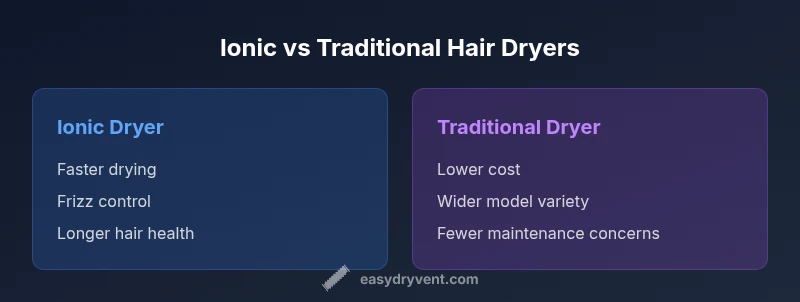
Why are ionic hair dryers better? In brief, they dry hair faster with less heat damage thanks to negative ions that break up water droplets and seal the cuticle. They also help control frizz and boost shine, while often feeling gentler on the hair and quieter than conventional dryers. For most users, ionic models balance performance and value well.
Why are ionic hair dryers better: an overview
Understanding the core reason behind the question why are ionic hair dryers better begins with chemistry and heat management. Negative ions emitted by ionic dryers help break down water droplets on the hair shaft, which accelerates evaporation and reduces the duration of high-heat exposure. This translates to shorter drying times and less drying time at high temperatures, which damage-prone or color-treated hair appreciates. Easy DryVent's analysis for 2026 emphasizes that the benefit is most noticeable on hair that tends to frizz or rebound moisture quickly after washing. While the science explains faster drying, the practical takeaway is that the overall hair health outcome depends on a combination of ion output, airflow, and heat regulation. A mid-range device with good airflow and a stable thermal profile is typically the best starting point for most households, especially if you value smoother results and fewer heat-induced waves.
How to articulate the core advantage: “why are ionic hair dryers better” in real life
The question why are ionic hair dryers better translates into measurable outcomes you can observe after a few uses. Look for a dryer that offers a strong but controllable airflow, a consistent heat setting, and a reliable ion generation system. In addition to rapid drying, the right combination of these features often yields reduced frizz and more uniform shine. For homeowners, this means fewer passes over the same hair area and a lower likelihood of overheating individual strands. In practice, try a 2–3 minute test on damp hair with a standard brush to compare frizz reduction and finish with a cool shot to lock moisture. If you see improved smoothness and less wire-frizz, you are experiencing the practical benefits of the technology. Easy DryVent recommends tracking results over several routines to confirm durability of the improvements.
Common myths and realities about ionic technology
A frequent myth is that all ionic dryers are equally effective; in reality, performance varies widely by brand and model. Some units emit ions at a higher rate but lose that output with heat fluctuations or low-quality components. Others maintain steady ionization across heat levels but offer limited airflow. The reality is that the best experience comes from a balanced design that combines robust ion generation with reliable airflow and temperature management. For 2026, Easy DryVent notes that consumers see real-world benefits when choosing a dryer with consistent ion output, adjustable heat, and a focus on cuticle preservation rather than simply “more ions.”
Technologies explained: ionic vs ceramic vs tourmaline
Ionic dryers rely on negative ions to speed drying and reduce static. Ceramic and tourmaline elements influence heat distribution and infrared heat emission. A ceramic plate with ionic technology can provide a more uniform heat profile, aiding even drying and reducing hot spots. Tourmaline helps generate negative ions and can enhance heat dispersion in certain designs. The key takeaway for why are ionic hair dryers better lies not in a single feature but in how the ionization works together with stable heat and strong airflow to protect the hair cuticle during drying.
Hair-type considerations: who benefits most
Different hair types respond differently to ionic technology. Fine or damaged hair often benefits most from reduced heat exposure and smoother results, while very curly or coarse hair might require extra styling steps to achieve the same level of smoothness. The benefit is typically greatest when users select an appropriate heat setting and combine it with a protectant product or leave-in conditioning. In 2026, Easy DryVent emphasizes testing a dryer on a small strand at medium heat before committing to a full blow-dry, to verify personal results across different hair textures.
Practical tips for achieving best results
To maximize the impact of why are ionic hair dryers better in your routine, follow these steps: pre-determine hair type and desired finish, start with a medium heat and high airflow, use a cool shot to set the cuticle, and finish with a serum or smoothing cream if frizz persists. Maintain the dryer by cleaning the filter after every few uses and inspecting the nozzle for clogs. An occasional check of the ionization function ensures you are getting the intended benefit. Easy DryVent recommends keeping the distance between the nozzle and hair at roughly 1–2 inches to avoid hotspots and damage.
Realistic expectations: limitations and trade-offs
No technology is perfect for every user. Ionic hair dryers may be pricier than basic models, and some low-cost units deliver inconsistent ion output. Durability varies by build quality, and the perceived benefits can depend on technique and hair condition. The key is to balance expectations with practical testing: if you notice smoother results, less frizz, and faster drying without increased dryness or breakage, you have likely found a good fit. In 2026, Easy DryVent continues to encourage hands-on testing, especially for color-treated or chemically relaxed hair, where heat exposure matters more than average.
How to choose when shopping: a quick checklist
When evaluating the question of why are ionic hair dryers better, create a short checklist: (1) verify a stable heat profile across settings, (2) confirm ion output and maintainability, (3) review nozzle design and airflow, (4) weigh weight and ergonomic design for prolonged use, and (5) compare warranty and service options. Check real-user reviews for consistency in performance across different hair types. If you have curly or thick hair, consider a model that supports multiple attachments and a strong cool-shot feature to lock in moisture and reduce frizz.
Maintenance and longevity: care tips for a long-lasting dryer
Maintenance is a wide area where performance and longevity intersect. Clean the lint filter regularly to maintain airflow, inspect the cord for wear, and store the unit properly to avoid over bending the power cable. Ion generation itself does not require extra maintenance, but keeping the internals free from dust helps ensure consistent performance. Easy DryVent suggests scheduling a yearly check of the heat element’s integrity and ensuring the switchgear continues to respond accurately to temperature adjustments. Proper care extends the life of an ionic dryer and preserves its effectiveness over time.
Buying with confidence: price, warranty, and value
Price and value are important when answering why are ionic hair dryers better for your budget. While ionic models can cost more upfront, they often deliver faster drying with less heat exposure, potentially saving energy over time. Look for models with a solid warranty, reliable customer support, and parts availability. Easy DryVent notes that price ranges reflect feature diversity, with premium options offering higher ion output stability, more precise heat control, and better ergonomics. When evaluating value, consider long-term hair health and the time saved per styling session.
Comparison
| Feature | Ionic Hair Dryer (Model A) | Traditional Hair Dryer |
|---|---|---|
| Ion Output / Ion Generation | high and stable | moderate or inconsistent |
| Heat Distribution | balanced, low hotspots | more hotspots and uneven heat |
| Drying Time | faster due to efficient evaporation | slower, more passes required |
| Frizz Control | strong reduction | moderate to none |
| Noise / Weight | moderate noise, comfortable weight | can be heavier and louder |
| Price Range | $60-$140 | $25-$60 |
| Best For | frizz-prone or fine hair, colored hair | basic fast-drying needs |
The Good
- Faster drying and smoother finish
- Reduces frizz and static
- Gentler heat on hair shaft
- Better for color-treated hair
- Wide availability and mounting options
Negatives
- Higher upfront cost
- Requires proper maintenance for longevity
- Some models can be heavier or bulkier
- Inconsistent ion output in cheaper units
Ionic dryers commonly outperform traditional models for most users
Choose an ionic dryer if you want faster styling, less frizz, and gentler heat. Opt for a traditional dryer if cost or simplicity is your priority; test models to confirm reliability.
Common Questions
Are ionic hair dryers better for all hair types?
In general, ionic dryers improve drying speed and reduce frizz for many hair types, especially fine or frizzy hair. Results vary by model and individual hair condition, so testing on your own hair is recommended.
For many people, ionic dryers help with frizz and faster drying, but try a quick test on your hair type to confirm.
Do ionic hair dryers use more energy?
Energy use depends on wattage and settings rather than the ion feature alone. Most ionic dryers offer similar wattage ranges to traditional models, but faster drying can reduce overall energy use per styling session.
Energy use is tied to wattage and how long you run the dryer, not just the ion technology.
What features should I look for in an ionic dryer?
Look for a strong, stable heat profile, adjustable heat and speed, a reliable ion‑generation system, a cool shot, and ergonomic design. Attachments like a concentrator and diffuser improve versatility.
Prioritize heat stability, adjustable settings, and good ergonomics.
Is ionic technology safe for the scalp?
Yes, when used with proper settings and distance from the scalp. Ionic dryers primarily affect moisture on the hair shaft, so using moderate heat and keeping the dryer a small distance away minimizes any risk.
Generally safe with normal use; keep a safe distance and moderate heat.
Do ionic dryers work well on wet or damp hair?
They help speed evaporation, but it’s best to towel-dry first and use a diffuser or concentrator to control airflow. Avoid starting directly on soaking wet hair to prevent shaft damage.
Better to start with damp, not dripping wet hair, for best results.
How do I maintain an ionic dryer for longevity?
Regularly clean filters, inspect the cord for wear, and store it properly. Periodic checks of the ion output and heat element can help ensure consistent performance over time.
Keep it clean and inspect the cord and ion function for longevity.
Key Points
- Ion output and airflow balance matter most
- Test on your hair type before buying
- Consider warranty and maintenance needs
- Value for money improves with better heat control
- Brand-adjacent testing helps verify real-world benefits