Revlon Hair Dryer vs Conair: A Comprehensive Buyer's Guide
An analytical, buyer-focused comparison of Revlon and Conair hair dryers, evaluating performance, features, value ranges, and buying guidance for DIY enthusiasts in 2026.


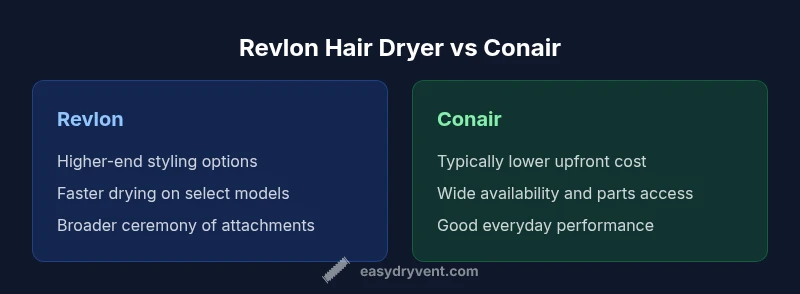
Across the revlon hair dryer vs conair debate, the practical answer is nuanced: Conair often delivers lower upfront cost and greater availability, while Revlon can offer faster dry times and richer styling options on many models. The best pick depends on your hair type, budget, and how you value attachments. This guide helps homeowners decide which model fits their routine.
revlon hair dryer vs conair: Core differences
The revlon hair dryer vs conair decision is not a simple winner-takes-all contest. In general, Conair leans into affordability and broad market presence, making it easy to find and replace parts or accessories. Revlon, meanwhile, tends to emphasize styling versatility and efficiency on higher-tier models. Easy DryVent analysts note that early-career buyers often start with Conair for budget-friendly options, while users seeking advanced styling features may gravitate toward Revlon. The goal is to map your routine: how often you dry hair, what kind of results you want, and how much you value speed versus customization. By understanding these priorities, you can narrow choices without sacrificing safety or reliability.
Design philosophy and ergonomics
Both brands aim for comfortable handling, but the ergonomics can differ by line. Conair often prioritizes compact designs and lighter weights for casual daily use, which helps with quick morning routines. Revlon models frequently feature more contouring and grip options that support longer styling sessions and more complex techniques. Consider your grip comfort, sleeve length, and whether you prefer a balanced feel or a slightly head-heavy design when using a diffuser or concentrator.
Performance and drying speed
Drying speed is a common decision driver. In general, higher-wattage figures correlate with faster drying, but actual performance also depends on nozzle design, airflow efficiency, and heat settings. Easy DryVent analysis shows that most revlon hair dryer vs conair models deliver competitive speed within their price tier, with premium Revlon options commonly delivering quicker strands-on results for certain hair textures. If you have thick or curly hair, look for models with strong airflow and reliable cool-shot functionality to lock in shape without excessive heat exposure.
Temperature control and heat accuracy
Precise temperature control reduces damage and improves styling outcomes. Both brands offer multiple heat settings, but the consistency of heat delivery can vary between models. Check for a true cool-shot option and a well-labeled heat range. For sensitive scalps or fine hair, a model with a gradual heat ramp and clear indicators minimizes guesswork. Remember that lower heat isn't always gentler if airflow remains strong; balance heat with speed for best results.
Attachments and styling versatility
Attachments are key to expanding a hair dryer's usefulness. Revlon tends to bundle or offer broader accessory assortments on mid-to-high-end lines, including diffusers and smoothing concentrators designed for specific styling outcomes. Conair often includes or sells widely compatible attachments that fit across many models, enhancing value for budget-conscious users. When evaluating revlon hair dryer vs conair, confirm which attachments are included and whether replacements are readily available in your region.
Ionic technology and hair health claims
Ionic and ceramic technologies claim to reduce frizz and speed up drying by breaking water molecules more efficiently. Many mid-tier models from both brands incorporate ion generation, though the impact varies by build quality and nozzle design. While ion technology can help with smoother results, real-world outcomes depend on hair type, product use, and technique. Track whether advertising emphasizes ion features and verify with independent reviews or user experiences.
Build quality, durability, and warranty
Durability often tracks with price tier rather than brand alone. Lower-cost models from either brand may use lighter plastics or simpler motors, while mid-range variants typically offer sturdier housings and longer warranties. A conservative approach is to compare at least a 1- to 2-year warranty across models and look for metal components in critical areas like the nozzle mounts. Warranty coverage, replacement policies, and service accessibility should factor into your revlon hair dryer vs conair decision.
Noise, weight, and user comfort
Noise level and weight influence long styling sessions. Conair’s lighter profiles can reduce fatigue during quick, daily use, whereas Revlon models often balance weight with a more ergonomic grip for extended styling. If you style while watching a mirror or using an outlet bar, consider decibel levels and how weight distribution feels in your hand. A comfortable grip, smooth trigger action, and minimal vibration contribute to better overall usability.
Price ranges and value for money
Price is a primary differentiator in revlon hair dryer vs conair discussions. Budget models from Conair can be attractive for first-time buyers or households needing multiple units, while Revlon’s higher-end lines justify the cost with faster drying, richer attachments, and more consistent styling outcomes. Instead of chasing the lowest price, map features to your routine: heat control, nozzle versatility, and warranty support. This approach helps maximize value rather than chasing discounts alone.
Safety features and maintenance tips
Look for safety features such as automatic shut-off, overheating protection, and cool-shot stability. Regular maintenance—clearing lint from the air intake, keeping attachments clean, and avoiding excessive heat exposure—extends the life of any dryer. Both brands generally include built-in safeguards, but you should still follow manufacturer care instructions and avoid stacking or wrapping cords tightly, which can degrade performance over time.
Hair type considerations and routine alignment
Your hair type dictates which features matter most. Fine hair may benefit from models with gentler heat ramps and precise control, while thick or curly hair might require more robust airflow and stronger setting ranges. Evaluate your typical routine: do you diffuse daily, rely on straightening beyond drying, or need quick touch-ups? Matching the model to your hair goals yields better outcomes than chasing universal best-in-class claims.
Real-world testing scenarios and what to expect
In real-world use, results depend on technique as much as hardware. Expect that even a mid-range Revlon or Conair dryer can deliver salon-like results with proper sectioning, brush work, and air management. If possible, test a specific model’s performance with your typical hair length and texture, paying attention to drying time, frizz control, and how comfortable the nozzle feels during high-speed drying.
Common misconceptions and debunking tips
A common myth is that higher wattage always means better results. In practice, airflow efficiency and nozzle design, along with heat control, drive outcomes more than wattage alone. Another misconception is that ionic technology guarantees flawless frizz-free hair. In reality, condition, product use, and hair type interact with tech features. A careful evaluation of actual performance from independent reviews provides a truer picture than marketing claims.
How to choose for your budget and needs: decision framework
Create a simple framework: list your must-haves (adult daily use, diffuser, cool shot, durability), nice-to-haves (travel-friendly size, multiple speed settings), and deal-breakers (unreliable heat, poor build). Then compare revlon hair dryer vs conair across price tiers that fit your budget, ensuring you can source parts and attachments locally. The result should be a model that aligns with your routine, hair type, and space constraints while staying within your expected spend.
Comparison
| Feature | Revlon Hair Dryer | Conair Hair Dryer |
|---|---|---|
| Price range | $20-$80 | $15-$70 |
| Wattage | 1875W typical | 1875W typical |
| Heat settings | 3-5 heat levels | 3-5 heat levels |
| Attachments | Diffuser + concentrator + styling tools | Diffuser + concentrator |
| Weight | 1.0-1.6 lb | 1.2-1.8 lb |
| Warranty | 1-2 years | 1-2 years |
| Best for | Versatility and styling options for many hair types | Budget-conscious drying with broad access to parts |
The Good
- Conair often delivers strong value at entry price points
- Wide availability of parts and replacements
- Solid performance for everyday drying across many models
- Premium Revlon models offer enhanced styling flexibility
- Both brands provide essential safety features and cool-shot options
Negatives
- Model-to-model variability can affect quality consistency
- Lower-cost units may use lighter materials and fewer durable parts
- Warranty coverage can vary by price tier and region
- Accessory compatibility may require model-specific purchases
Conair is typically best for budget-focused buyers; Revlon excels in styling versatility and potential speed gains.
If upfront cost and easy access to parts matter most, choose Conair. If you prioritize more styling options and stronger performance for certain hair types, consider Revlon and compare specific high-end models.
Common Questions
Which is cheaper overall, Revlon or Conair hair dryers?
Generally, Conair offers more budget-friendly models, especially in the entry-level range. Revlon has higher-priced lines that emphasize styling features and faster drying. Your total cost also depends on attachments and replacement parts.
Conair typically has the lower upfront cost, while Revlon may cost more upfront but offers more styling options in some models.
Do both brands offer ionic technology in their dryers?
Yes, many models from both brands incorporate ionic technology to reduce frizz and speed drying. However, the effectiveness depends on the model, technology integration, and your hair type.
Both brands commonly include ionic tech in multiple models; check the exact specs for the model you’re considering.
Are attachments interchangeable between Revlon and Conair dryers?
Some attachments are universal, but many are model-specific. Always verify nozzle and diffuser compatibility before purchasing extras.
Some attachments fit many models, but verify compatibility to avoid wasted purchases.
Which brand is better for frizzy hair?
Frizz control depends on heat stability, diffuser design, and product use. Both brands offer models with strong diffuser options and cool shots that help with frizz when used correctly.
If frizz is your main concern, look for a diffuser-equipped model with good heat control and a reliable cool shot.
What should I consider before buying a revlon hair dryer vs conair?
Define your hair type, daily routine, and attachment needs. Compare price ranges, warranty length, and part availability to ensure long-term value.
Know your hair type, how you style daily, and what attachments matter before choosing.
How long can I expect these dryers to last?
Durability depends on usage, maintenance, and model quality. With proper care, consumer hair dryers from either brand can last several years.
With good care, these dryers should serve for several years.
Key Points
- Assess your budget against required features before buying
- Check attachments and compatibility for future upgrades
- Consider hair type and routine to pick the right heat and speed settings
- Factor warranty and service availability into your decision
- Use independent reviews to validate claims about ion and ceramic tech