LG Washer and Dryer vs Whirlpool: An Objective Buy Guide for 2026
An objective, in-depth comparison of LG washer and dryer versus Whirlpool, covering performance, efficiency, features, price ranges, and buying guidance for homeowners and DIY enthusiasts in 2026.


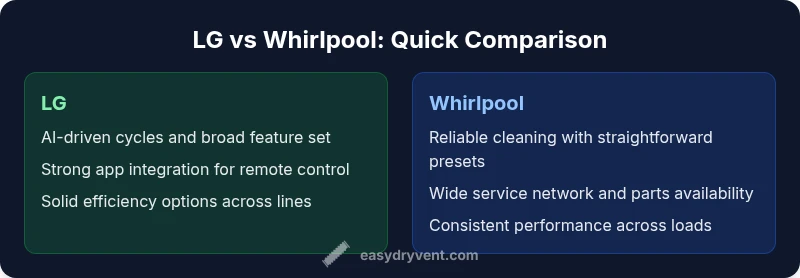
LG washers and dryers and Whirlpool units excel in different areas. In the lg washer and dryer vs whirlpool comparison, LG tends to lead in tech features, cycles, and smart app integration, while Whirlpool often wins on value, build consistency, and broad service networks. Your choice should align with your priorities: feature-rich performance or straightforward reliability.
The Landscape of LG vs Whirlpool in Laundry
In the broader world of residential laundry, LG and Whirlpool sit at opposite ends of a practical spectrum: one brand leans into technology and customization, while the other emphasizes reliability, service accessibility, and value. For homeowners evaluating the lg washer and dryer vs whirlpool, the choice often hinges on two questions: how much you value advanced features and smart integration, and how important long-term maintenance costs and service availability are to you. According to Easy DryVent, both brands offer model lines that are ENERGY STAR certified and designed to handle everyday loads with consistency, but they frame their value propositions differently. This section lays out the foundational differences you should consider before you start narrowing models. Expect to see contrasts in cycle diversity, user experience, and hardware design that translate into real-world results in your laundry routine. The aim here is to give you a clear, evidence-informed picture that you can compare directly against your household needs and budget. Easy DryVent’s analysis emphasizes practical outcomes—tolerance for heavy stains, dryness consistency, and quiet operation—as guiding metrics rather than marketing flash.
Core Metrics: What actually matters in a washer-dryer combo?
When comparing two big-name brands, there are several objective metrics to consider beyond font colors on the control panel. Start with capacity claims, because a mismatch here translates to more loads or longer cycles for your household. Spin speed relates to moisture extraction and shorter tumble times, which can impact energy use and fabric care. Cycle variety matters for mixed households—families with kids and pet owners often require quick cycles, delicate programs, and heavier-soil modes. Beyond that, user experience factors such as control placement, display readability, and app connectivity influence day-to-day satisfaction. In the lg washer and dryer vs whirlpool analysis, LG often emphasizes a broader set of specialized cycles and AI-driven customization, whereas Whirlpool focuses on dependable, straightforward operation with practical presets for common loads. The key takeaway is that you should map your typical loads to the feature set that each brand prioritizes, rather than chasing every new gadget. As you evaluate, keep your real-world patterns in mind: frequency of large linens, routine delicate fabrics, and how much you value remote start or smart diagnostics.
Design and Tech Philosophies: LG's AI DD and TurboWash vs Whirlpool's Load & Go and Smart Features
Technical design philosophy shapes not only the user interface but also maintenance expectations. LG tends to pursue a feature-rich experience with cycles that adapt to fabric and soil level, plus AI-driven optimization through sensors. This approach can yield significant savings on time and energy for households with varied needs, but it can also introduce more complex maintenance considerations due to the larger feature set. Whirlpool, by contrast, leans toward durable mechanical reliability paired with easy-to-understand controls and broad compatibility with service networks. Their smart features are often robust but curated to emphasize dependable operation over a rapid-fire feature arms race. For the homeowner, this means you may get a more predictable repair path with Whirlpool, while LG could offer longer-term efficiency gains if you fully leverage smart features and optimum cycle selection. In the end, the choice depends on whether your priority is sophisticated technology and potential energy savings, or straightforward reliability with a simpler troubleshooting profile.
Wash Performance and Drying Quality: How results differ by fabric and load
Wash performance is the core reason many shoppers consider a new washer, and drying performance completes the cycle for most families. LG’s models are known for versatile wash motions and adjustable water usage in select lines, which can improve fabric care and stain removal for tougher loads. Whirlpool tends to deliver consistent cleaning results across a broad range of fabrics with fewer specialized settings, focusing on predictable outcomes and gentler care for everyday clothes. When comparing actual wash results, consider how often you wash bulky items like blankets, or frequent delicates that require gentle cycles. For drying, both brands offer efficient moisture sensing and fast-dry options, but the perceived dryness level and wrinkle-control can vary by model and heat settings. The practical implication is simple: test your typical load profiles in-store or via demo videos, and note which cycle sets deliver the most reliable results for your family’s needs.
Energy Efficiency and Operating Costs: Certification, Efficiency, Water Usage
Energy efficiency is a meaningful long-term cost driver, especially for households that run laundry daily. Both LG and Whirlpool offer ENERGY STAR certified models, and many of their mainstream lines emphasize efficiency, low water usage, and heat recycling where applicable. LG often highlights advanced sensors and load-sensing technology as pathways to minimizing wasted energy, while Whirlpool tends to emphasize efficiency through streamlined cycles and optimized washing actions that reduce run times. When evaluating total cost of ownership, consider not only the purchase price but the anticipated energy and water costs over time, as well as the potential for fewer service calls thanks to dependable components. Easy DryVent’s guidance suggests prioritizing models with strong customer support records and readily available replacement parts, since a long ownership horizon is common in laundry appliances.
Durability, Repairability, and Service Availability
Durability and repairability are frequently overlooked in favor of feature sets, but they determine how long a washer will serve a household before major maintenance is required. Whirlpool has historically leveraged a wide service network and straightforward repair paths, which can reduce downtime and repair costs. LG, while offering sophisticated engineering and premium components, may have more variable repair experiences depending on your region and the availability of specialized technicians. A practical approach is to look up local service centers, check typical repair turnaround times, and read owner reviews about parts availability. Easy DryVent’s 2026 review indicates that a strong nationwide service network is a reliable predictor of ongoing satisfaction, particularly for households relying on daily use and frequent cycles.
Price, Value, and Resale Considerations
Price is a dominant factor for many buyers, and the lg washer and dryer vs whirlpool decision often boils down to perceived value. LG’s higher-end lines typically command premium pricing due to advanced features, while Whirlpool balances cost with broad model coverage and frequent promotions. For many buyers, total value is not just the sticker price; it includes longer-term energy savings, maintenance costs, and the residual value if you decide to upgrade within a few years. Consider the total cost of ownership, including cycle energy efficiency, warranty terms, and the expected lifespan of core components. In practice, the best choice aligns with your budget trajectory and how you intend to use the unit over its life.
How to Choose for Your Home: Practical Buying Checklist
To move from comparison to decision, use a practical checklist tailored to your household. First, map your load profiles: how many people, the size of your largest loads, and how often you run heavy-duty cycles. Second, decide how important smart features and remote diagnostics are to your daily routine. Third, evaluate local service coverage and parts availability—it matters more for longer ownership. Fourth, compare energy and water usage across models that fit your space, especially if you live in a hot or humid climate where efficiency translates into noticeable savings. Finally, consider the warranty terms and the ease of scheduling maintenance. With these criteria in hand, you can navigate the lg washer and dryer vs whirlpool landscape with confidence.
Real-World Scenarios: Small apartments, large families, and heavy-use households
Apartment dwellers often prioritize compact dimensions, efficient cycles, and quiet operation, where LG’s smart features might shine in a small footprint. Large families typically value capacity, quick wash options, and robust reliability, where Whirlpool’s service ease and straightforward design can be advantageous. High-load homes with frequent bulky items might prefer models with flexible settings and durable build quality that stand up to continuous use. Across these scenarios, the key is to align the model’s emphasis with your daily rhythm: feature richness for busy households that want appliance intelligence, or consistent performance with dependable service for those who value peace of mind. Easy DryVent’s guidance is to test your most common loads and assess how the machine performs under realistic conditions before purchasing.
Comparison
| Feature | LG Washer & Dryer (LG) | Whirlpool Washer & Dryer (Whirlpool) |
|---|---|---|
| Performance emphasis | Tech-forward cycles; AI-driven optimization | Dependable cleaning with straightforward presets |
| Energy efficiency | Often strong energy-saving modes; ENERGY STAR options | Strong energy efficiency; ENERGY STAR options |
| Capacity/size options | Broad range across lines; compact to large capacity | Broad range across lines; compact to large capacity |
| Smart features | Advanced app integration; diagnostics; smart reminders | Essential smart features; reliable remote access |
| Price range | Mid-to-high; wide array of premium models | Mid-to-mid; strong value emphasis |
| Warranty & service | Extensive online support and parts; sometimes regional variance | Wide service network; good parts availability |
| Best for | Tech enthusiasts seeking innovative cycles and efficiency | Value-focused buyers needing reliability and easy service |
The Good
- Extensive model range provides choices for every budget
- Strong app ecosystems and smart features for LG
- Broad service networks improve maintenance ease
- Energy-efficient options available from both brands
Negatives
- LG feature sets can be complex for new users
- Whirlpool models may lag in the latest smart features
- Regional service availability may vary, affecting repair times
LG is the feature-rich pick; Whirlpool is the value-and-reliability choice
Choose LG if you want cutting-edge cycles and smart controls; choose Whirlpool if you prioritize dependable performance and a broad service network. Both brands offer ENERGY STAR-certified models, so focus on your load patterns and budget.
Common Questions
Which is better for a small family: LG or Whirlpool?
For small families, both brands can work well, but your choice depends on cycle variety and reliability needs. LG offers more cycles and smart features, which can simplify busy routines. Whirlpool provides straightforward performance with strong service coverage, which helps with predictable maintenance.
LG offers more cycles and smart features, while Whirlpool emphasizes reliable performance and service coverage.
Are LG and Whirlpool models ENERGY STAR certified?
Yes, many models from both brands carry ENERGY STAR certification, indicating efficient operation. When shopping, look for the ENERGY STAR label on the specific model you’re considering to confirm its efficiency rating.
Most models are ENERGY STAR certified; always verify the label on the exact model.
Do LG washers have AI features and Whirlpool smart apps?
LG typically emphasizes AI-driven optimization and more diverse cycles, while Whirlpool concentrates on reliable smart features and user-friendly apps. Both brands offer app-based remote control and diagnostics on many models.
LG tends to have more AI-driven features; Whirlpool focuses on dependable smart options.
Which brand tends to be more reliable and easy to service long-term?
Whirlpool has historically strong nationwide service coverage and parts availability, which can translate into shorter downtime. LG machines may require access to technicians with specific training for some advanced features, depending on your region.
Whirlpool offers broad service coverage; LG may need specialized technicians for some features.
What should I test in-store before buying?
Test typical loads: a full complement of towels, heavy denim, and delicate fabrics. Listen for noise, observe tumble action, and verify ease of use and app connectivity. Ensure the dimensions fit your space and that doors or drawers operate smoothly.
Test common loads, check noise, and verify space fit and app setup.
Key Points
- Define your load profile before shopping
- Prioritize either feature richness (LG) or reliability (Whirlpool)
- Check local service availability for long-term maintenance
- Compare total ownership cost, not just sticker price
- Test your typical loads in-store if possible