Freeze Dryer vs Dehydrator: Which Is Better for Home Preserving?
An analytical side-by-side guide comparing freeze dryers and dehydrators for home use, weighing upfront costs, performance, energy, and practicality to decide which is better for preserving food.


Is Freeze Dryer or Dehydrator Better? In practical terms, the choice hinges on your preservation goals, budget, and available space. If you want maximum texture, flavor, and long-term storage, a freeze dryer edges ahead for quality and longevity. If upfront cost, footprint, and ease of use matter most, a dehydrator offers strong results with a friendlier price tag. This guide unpacks the key trade-offs to help you choose.
Is freeze dryer or dehydrator better for your goals?
When homeowners ask which appliance delivers the best balance of convenience, cost, and quality, the answer depends on your goals. At Easy DryVent, we emphasize aligning equipment choices with how you plan to use food preservation over time. In practice, a freeze dryer tends to excel when the objective is long-term storage with peak texture and nutrient retention, while a dehydrator shines for budget-conscious, flexible, and space-conscious setups. The decision should reflect your typical projects (fruit leathers, herbs, bulk garden harvests), your tolerance for upfront investment, and how much kitchen space you can dedicate to a dedicated appliance. For many households, a dehydrator is the practical starting point, with a freeze dryer reserved for special batches and ambitious preservation plans. The choice is not a universal winner; it’s a fit based on your process, patience, and pantry goals.
According to Easy DryVent, understanding the trade-offs between freeze drying and dehydration helps homeowners make safer, smarter choices. This guide will connect the dots between how each method works, what outcomes you can expect, and how those results map to real-world home use.
How freeze drying works
Freeze drying is a process that first freezes food, then reduces the surrounding pressure and adds just enough heat to allow frozen water to sublimate directly from ice to vapor. This sublimation removes most of the water while leaving behind cellular structure, vitamins, and flavor compounds. For home users, a freeze dryer typically handles entire fruits, vegetables, cooked meats, and prepared meals with minimal texture collapse and excellent shelf stability. It requires careful pre-treatment (such as slicing uniformity and pre-freezing) and a controlled environment to minimize off-flavors or surface ice. Energy usage tends to be higher per cycle but can yield very long-lasting results, making it a superior option for bulk preservation and long-term storage.
From a durability standpoint, freeze-dried foods rehydrate effectively and retain a near-fresh texture when prepared properly, which many enthusiasts value for reconstituting meals or snacks. The trade-off is cost, size, and cycle duration: freeze dryers are typically larger, heavier, and require longer processing times per batch.
How dehydration works
Dehydration uses low heat and air flow to remove moisture from foods. This slower, gentler process helps concentrate flavors and preserve many nutrients while reducing water activity to a level that resists microbial growth. Home dehydrators are often compact, affordable, and versatile enough for batch-based work such as sliced vegetables, fruit leathers, herbs, and trail snacks. The simplicity of operation means less maintenance and easier repair pathways, which appeals to DIY enthusiasts. However, dehydration can lead to uneven dryness if air flow is inconsistent, and some foods may become brittle or leathery depending on sugar content, fiber, and thickness. In most households, dehydration strikes a balance between cost, space, and reasonable shelf life for everyday use.
Even though the concepts differ, both methods share the goal of reducing moisture to extend shelf life and ease storage. The choice is less about which is universally better and more about which suits your pantry needs, appetite for experimentation, and willingness to manage cycles.
Key differences at a glance
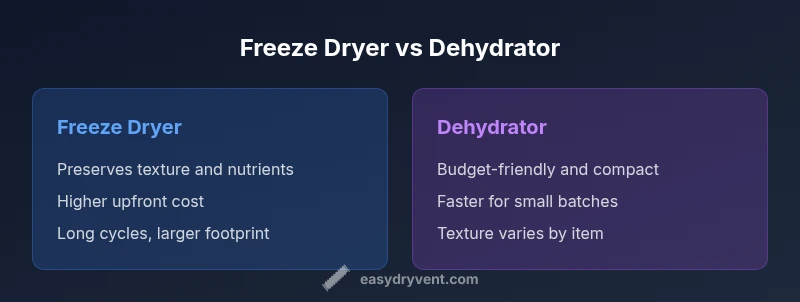
- Upfront cost: Freeze dryers typically require a higher upfront investment, while dehydrators are usually more budget-friendly.
- Processing time: Freeze drying cycles are longer per batch, whereas dehydration can finish faster for small quantities.
- Space and footprint: Freeze dryers tend to be larger and heavier; dehydrators are commonly compact and home-friendly.
- Texture and quality: Freeze-dried foods retain a near-fresh texture and higher nutrient retention; dehydration often yields crisp or leathery textures with slightly different flavor profiles.
- Shelf life: Both methods extend shelf life significantly, but freeze-dried products are generally more shelf-stable at ambient temperatures with less moisture reabsorption risk.
- Maintenance: Freeze dryers require more complex maintenance and periodic service checks; dehydrators usually demand simpler cleaning and routine care.
The practical takeaway: if your priorities include maximum quality and long-term storage, aim for a freeze dryer; if you value cost control and ease, a dehydrator is often the smarter starting point.
Use-case scenarios: pantry, homestead, and hobbyist
Consider these common situations to anchor your decision. A busy family that values quick meals and snack prepping may benefit from a dehydrator due to ease and speed for small batches. A gardener or hunter who stores seasonal harvests for extended periods might prefer a freeze dryer, accepting the higher price for peak texture and extended shelf life. A kitchen with limited space and limited budget may find a compact dehydrator ideal, while a dedicated preservation hobbyist with room for a larger unit might justify the investment in a freeze dryer for occasional but significant preservation projects. Your typical batch size, storage strategy, and willingness to manage longer cycles should drive your choice. At Easy DryVent, we regularly see homeowners balance practical space constraints with long-term storage ambitions to reach the right fit.
Food quality, texture, and nutrition: what to expect
Texture is a major differentiator between these two methods. Freeze drying often yields a light, fluffy texture that rehydrates quickly with minimal structural damage, preserving flavor and most vitamins. Dehydration tends to produce crisp or soft textures depending on the material and thickness. Some nutrients are more heat-sensitive, and dehydration can lead to slight nutrient changes if conditions are suboptimal, but many foods still preserve excellent flavor and aroma. For the home cook, the decision often comes down to the type of meals you want to prepare after storage: rehydrated soups and stews benefit from freeze-dried ingredients, while dried fruit, jerky, and herbs suit dehydration well. Consumers aiming for the highest overall quality and longest shelf life often favor freeze drying, while those prioritizing simplicity and cost lean toward dehydration.
Space, energy, and placement considerations
A freeze dryer typically requires a larger dedicated footprint and a stable electricity supply, plus adequate ventilation and some level of routine maintenance. Dehydrators are more forgiving on space and power, often fitting on a countertop or in a pantry. If your kitchen layout is open and you want a dedicated appliance for preservation, a freeze dryer can be integrated into a storage room or utility space; if you prefer a multipurpose kitchen with limited extra space, a dehydrator is more practical. Energy impact varies by model and cycle length, but the overall pattern is that freeze drying consumes more energy per batch, while dehydration offers a lower energy draw for shorter runs.
Practical buying considerations: how to choose a model
Begin with capacity and batch size: if you routinely process whole baskets or bulk harvests, a larger freeze dryer makes sense; for occasional, small batches, a compact dehydrator is often sufficient. Evaluate control quality: precise temperature and airflow management are crucial for consistent results in both technologies, with freeze drying requiring careful vacuum control. Consider accessory ecosystems: trays, racks, and pre-treatment options influence throughput and ease-of-use. Finally, plan for maintenance and service availability, especially for a freeze dryer, where professional servicing may be needed from time to time. By aligning these factors with your budget and goals, you can select a model that will deliver reliable preservation outcomes over many seasons.
How to maximize outcomes: best practices
To optimize results, adopt consistent prep steps: uniform slice thickness, proper pre-freezing for freeze drying, and thorough cleaning between cycles for all devices. Label and organize dried or freeze-dried batches to prevent confusion and ensure even rehydration. Maintain a clean environment to avoid contamination, and follow manufacturer guidelines for loading, cycling, and rest periods. For best flavor and texture, store preserved foods in appropriate containers with controlled humidity and temperature, and periodically rotate stock to ensure freshness. With method-specific care, both freeze drying and dehydration deliver dependable, delicious results for a wide range of foods and recipes.
Common mistakes to avoid
Avoid overloading trays, which can hinder airflow and lead to uneven drying, and skip proper pre-treatment that can compromise final texture. Do not mix raw and cooked items in the same batch, as moisture content and processing times differ. Underestimating space requirements or cycle durations can lead to rushed decisions or poor results. Finally, neglecting maintenance or ignoring unusual odors or noises can prematurely impair performance and safety. With careful planning, you can maximize the benefits of either method without costly missteps.
Authority sources
- https://extension.illinois.edu/food-preservation
- https://nchfp.oregonstate.edu/food-preservation
- https://www.fda.gov/food
Comparison
| Feature | Freeze Dryer | Dehydrator |
|---|---|---|
| Upfront Cost | higher upfront investment | lower upfront investment |
| Operating Cost / Cycle | typically higher energy use per batch | generally lower energy use for small batches |
| Drying Time per Batch | longer cycles per batch | shorter cycles for small batches |
| Texture Retention | excellent texture retention after rehydration | varies; often crisper or leathier textures |
| Nutrient Retention | high retention when properly processed | good retention but sometimes less than freeze drying |
| Food Types Best For | bulk fruits, vegetables, meats, meals for long-term storage | herbs, fruit leathers, snacks, quick-dry batches |
| Footprint / Space | larger unit, heavier footprint | compact and space-friendly |
| Maintenance | more complex maintenance and possible service needs | simpler cleaning and routine care |
| Best For | maximal shelf life and premium quality | budget-friendly preservation with convenience |
The Good
- Enables long-term preservation with low moisture
- Preserves flavor and aroma for a wide range of foods
- Reduces waste by extending shelf life
- Creates flexible meal options with rehydration
Negatives
- Higher upfront equipment cost for freeze drying
- Longer processing times per batch
- Larger footprint and more complex maintenance
- Requires more planning for batch processing
Dehydrator suits budget-minded, space-conscious homes; freeze dryer is ideal for premium, long-term preservation.
If you prioritize upfront cost and convenience, dehydration wins. If your aim is maximum texture, nutrient retention, and long shelf life, freeze drying wins—choose based on goals, budget, and space.
Common Questions
What is the main difference between a freeze dryer and a dehydrator?
A freeze dryer removes moisture through freezing and vacuum-induced sublimation, preserving texture and nutrients; a dehydrator removes moisture with controlled heat and airflow, producing crisper textures and easier storage. Both slow moisture growth, but the processes and results differ significantly.
The main difference is that freeze drying uses freezing and vacuum to preserve texture and nutrients, while dehydration uses heat and airflow to create dry, shelf-stable foods.
Is a freeze dryer worth it for home use?
For dedicated preservation enthusiasts and those prioritizing maximum quality and shelf life, a freeze dryer can be worth the investment. For casual, budget-conscious use, a dehydrator often provides the best balance of cost and results.
A freeze dryer can be worth it if you want top quality and long shelf life; otherwise, a dehydrator is usually plenty for home use.
Which is faster for everyday food prep?
Dehydration generally offers faster results for small batches and everyday snacks, whereas freeze drying involves longer cycles but yields superior quality for long-term storage.
Dehydrators are usually faster for small batches; freeze dryers take longer but deliver better long-term quality.
What foods are best preserved with each method?
Dehydrators excel with herbs, sliced fruits, and snacks like jerky or fruit leathers. Freeze dryers work best for whole meals, large batches, and items where texture and rehydration quality matter, such as soups, stews, and mixed dishes.
Use dehydration for snacks and herbs; freeze drying for meals and bulk preservation where texture matters.
How much do these appliances typically cost upfront?
Upfront costs vary widely by model and capacity. Dehydrators are generally more affordable, while freeze dryers represent a substantial investment that can be spread over years with heavy use.
Dehydrators usually cost less upfront; freeze dryers are a bigger investment but can be economical over time with frequent use.
What maintenance is required?
Dehydrators require regular cleaning of trays and vents. Freeze dryers need more comprehensive maintenance and possible professional servicing over time, along with careful vacuum and temperature monitoring.
Dehydrators need simple cleaning; freeze dryers need more involved maintenance and occasional service.
Key Points
- Define your preservation goals before buying
- Expect higher upfront costs with freeze drying
- Dehydrators offer strong value with simpler operation
- Consider space, energy, and maintenance needs
- Match the choice to expected shelf life and texture outcomes